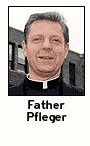
To the Rev. Michael Pfleger, charter schools seem a natural fit.
The Roman Catholic priest serves a predominantly African-American community on Chicago’s South Side. His parish school, St. Sabina, already enrolls more non-Catholics than Catholics among its 550 pre-K-8 students. The school is financially sound, he says, but many families cannot afford the $2,300-a-year tuition.
Hoping to expand the neighborhood’s school options, Father Pfleger has discussed shutting down St. Sabina and, in its place, opening a publicly funded charter school run by a nonprofit board, possibly with links to the parish or the Catholic archdiocese.
It’s an idea that the Chicago public schools’ chief executive officer, Paul G. Vallas, has endorsed, but that the local teachers’ union views with skepticism.
|
The 49-year-old priest and Chicago school officials have stressed that the proposed charter school--which, if approved, would receive roughly $5,000 per student in state funds--would not be a parochial school. District officials, however, have not dismissed Father Pfleger’s plan to offer optional religion classes to students after school.
Father Pfleger is one of a handful of religious leaders who have expressed an interest in recent weeks in launching charter schools in urban districts; New York and Detroit are also among the cities where the idea has been floated. In addition to providing an alternative to the regular public schools, these church officials say they can offer what many charter school organizers lack: buildings to house the schools.
But those trial balloons have set off alarms among some educators and legal experts, who fear that any such charter schools could become, or be viewed as, de facto taxpayer-supported religious schools.
Legal scholars say the details of the religious leaders’ proposals are crucial in figuring out whether they cross the line separating church and state.
And while the proposals floated in Chicago and New York City have made headlines, religious leaders already have been instrumental in launching charter schools--with much less fanfare--in such cities as Grand Rapids, Mich.; Newark, N.J.; and Tallahassee, Fla. Those schools don’t offer before- or after-school religious study, and their administrators say there is a clear separation of governance between the organizers’ churches and the schools.
Involvement Expected
Proponents of charter schools say religious leaders’ involvement in the movement should come as no surprise. Members of the clergy, they note, are often high-profile community leaders, representing the grassroots activism in education that charter schools were intended to inspire.
Charter schools typically receive freedom from certain state rules in exchange for being held accountable for student results. Currently, more than 1,100 such schools enroll about 250,000 students in 27 states and the District of Columbia Parents, teachers, and community groups are among those who have opened the publicly supported independent schools, sometimes teaming with local businesses, museums, or for-profit education management companies that can help find classroom space--a major hurdle for many start-up schools.
Some educators and legal-watchdog groups have attacked the charter concept as a backdoor route to private school choice. But Jeanne Allen, a leading advocate of school choice and the president of the Washington-based Center for Education Reform, says it is important to note that not all religious leaders or institutions are supporters of taxpayer-supported vouchers for private schools.
“So to suggest religious leaders’ involvement in charters is somehow the camel’s nose under the tent is misleading,” Ms. Allen maintained.
But it’s clear that the religious leaders’ interest in charter schools has sparked a debate that some see heading for an eventual legal showdown.
“We have some real fears that this is getting publicly funded religious education through the back door,” said Steven K. Green, the legal director for the Washington-based Americans United for Separation of Church and State.
In New York City, the Rev. Floyd H. Flake, a former Democratic U.S. representative who heads an African Methodist Episcopal church that runs a Christian pre-K-8 school, is among the religious leaders who have proposed launching charter schools and offering religious instruction outside the regular school day.
Mr. Flake and other religious leaders there may face barriers, however, under the state’s recently passed charter school law, which forbids the creation of schools controlled “wholly or in part” by a religious denomination. And, like most states, New York prohibits private schools from converting to charter status.
In Chicago, Father Pfleger’s proposal became public about the time that city’s archdiocese issued a call for its 131,000-student school system to explore significant changes to ensure the future viability of Catholic schools there. (“Chicago Catholics To Reform Their Schools’ Funding,” Jan. 13, 1999.)
Charter schools tend to be defined in state laws as nonsectarian public schools with admission open to all. Most state laws cast a fairly wide net in permitting groups and individuals to apply for charters. But most do not address the issue of a religious leader or group applying, according to Eric Hirsch, a policy specialist at the National Conference of State Legislatures in Denver.
Legal experts and church-state watchdog groups agree that ministers and other religious leaders, as individuals, have a right to be involved in charter schools.
“But they have to be aware that it’s very different than running a church-affiliated private school,” said Elliot M. Mincberg, the legal director for People for the American Way, based in Washington. “And it’s not always clear where the individual ends and the religious institution begins.”
Sponsor Responsibility
To steer clear of violating the U.S. Constitution’s prohibition against government establishment of religion, charter schools, like any other public schools, should not promote “or appear to be promoting” a religious activity or message, Mr. Mincberg said.
But legal scholars say the waters can get muddy in a hurry.
“Inevitably, we’ll have ambiguity here. There’s not a bright line,” said Perry A. Zirkel, a professor of law and education at Lehigh University in Bethlehem, Pa. Ultimately, he said, whether an arrangement passes constitutional muster depends on the specifics of each situation.
Questions Zirkel and others have raised about the proposals being mulled in Chicago and New York include: Who would control the school? Who would organize the before- or after-school religious instruction? Who would teach it? Where and when would it be held?
The debate points up the responsibility held by those who authorize charters--typically local districts, universities, or state bodies--to vet applications and oversee the schools once they are up and running, Mr. Hirsch of the NCSL said.
“We see that as an emerging second-generation issue that a lot of states are starting to deal with now,” he said.
New York state’s new charter law, for example, calls for those authorizers to determine whether an applicant is converting a private school into a charter school, which is forbidden. The law directs the granters to consider factors such as whether the charter would have the same, or “substantially” the same, board of trustees, teachers, students, and property or other assets as the existing private school.
Last month, a group of nonprofit organizations that serve as charter school resource centers in seven states and the District of Columbia launched the National Charter School Accountability Network. The group will help charter schools set measurable goals and work to improve schools’ accountability and oversight by charter authorizers.
Clear Separation
In charter schools launched by African-American ministers in Grand Rapids, Newark, and Tallahassee, officials from the schools and those who granted them their charters say there is a clear separation between the leaders’ churches and the charters. In all three schools, they say, the governing boards are not stacked with church officials or made up only of church congregants.
The William C. Abney Academy in Grand Rapids, which carries the name of the pastor of Bethel Pentecostal Church, is currently housed in portable classrooms behind the church. About a quarter of the 200 students who attend the K-8 school come from families in the Bethel Pentecostal congregation, Mr. Abney said.
In Newark, the Marion P. Thomas Charter School is named for the late wife of the Rev. Charles Thomas, the senior pastor of the New Hope Baptist Church. The charter school, slated to open next fall, was Mr. Thomas’ brainchild, said Karen Thomas, the charter board’s chairwoman, who is not related to the pastor. Organizers expect to draw students from across the city.
As the pastor of Bethel Missionary Baptist Church in Tallahassee, the Rev. R.B. Holmes Jr. said he saw the community’s desire for more school options. In 1996, the local school district granted a charter to the nonprofit Bethel Empowerment Foundation Inc., whose directors include educators and business leaders.
The 48-year-old pastor, who serves as chairman, is the only church leader on the charter board, although about half the board members are Bethel Missionary Baptist congregants, he said.
The Tallahassee school, named the C.K. Steele-Leroy Collins Community Charter Middle School, serves just under 100 students in grades 6-8. Mr. Holmes said only a handful of the students are members of his church, which sits across the street from the school.
Tracey L. Bailey, who oversees charter schools for the Florida education department, said the school is well within the bounds of the state’s charter school law.
“It’s truly a public school,” Mr. Holmes added. “There’s a role for a community of faith in the public education system. You can’t use tax dollars to perpetuate your religious beliefs. But you can use tax dollars to make sure every child gets a good education and parents have some options.”


