
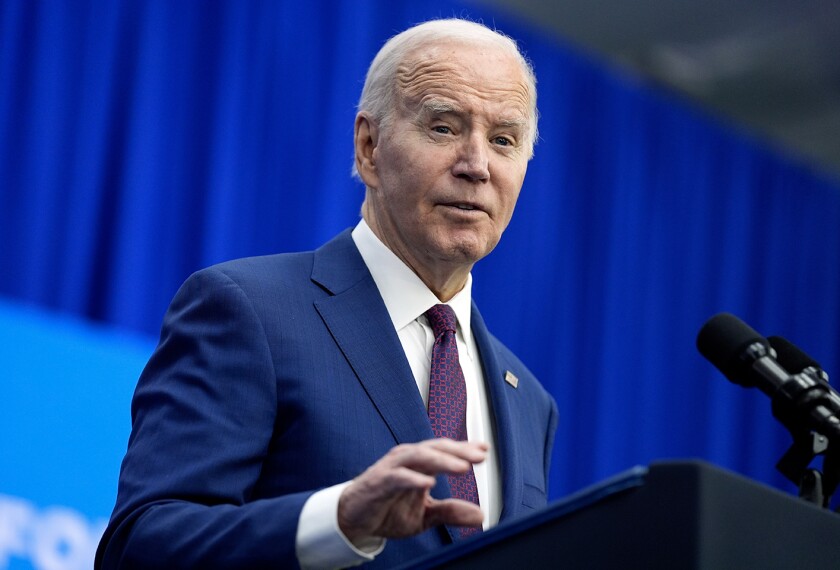
President Joe Biden hopes to secure more money for high-need schools and students with disabilities, and to make free preschool universally available to 4-year-olds in the next fiscal year.
Biden released his proposed 2025 budget on March 11, requesting $82 billion for the U.S. Department of Education.
The budget announcement came days after Biden’s State of the Union address, in which he called for teacher pay raises and expanded access to preschool, tutoring, summer learning, and career and technical education.

The budget document puts many of those priorities on paper. Though there’s virtually no chance it will take effect as proposed, with Republicans controlling one chamber of Congress and proposing domestic spending cuts, Biden’s budget signals his priorities as he seeks reelection in November.
The budget proposes an increase of $3.9 billion over the 2023 budget for the Education Department, and a $2.8 billion bump above projected spending for 2024, for which Congress hasn’t passed a final budget.
In past years, Biden’s budget proposals have included requests for much larger increases in education funding than this year’s request. The 2024 proposal requested a $10.8 billion increase in education funding over 2023 levels, and the 2023 proposal requested a $15.3 billion increase.
The smaller increase proposed this year is the result of the 2023 Fiscal Responsibility Act, a law that allowed Congress to avoid a government shutdown last spring by suspending the debt ceiling through fiscal years 2024 and 2025. The law imposed a cap of nearly $711 billion in nondefense spending for fiscal year 2025, which starts Oct. 1, 2024.
In a news conference with reporters Monday, Education Secretary Miguel Cardona said the proposed budget falls within those caps and emphasized that people should view this year’s proposal in context. Last year, Republicans in the U.S. House of Representatives proposed a budget that would have cut funding for Title I schools by 80 percent, and former President Donald Trump proposed reductions to education spending each year of his term.
“Despite the cap of the Fiscal Responsibility Act this year, this budget still matches the best budget of the Obama years while building on the best budget of this administration, and it blows the Trump budgets out of the water,” Cardona said. “There’s a big difference between raising the bar from the ground and raising the bar from the rooftop.”
A proposed boost for high-need students and schools
The federal government spends far less on public education than state and local governments, but it’s a key funding source particularly for schools in low-income communities and for special education.
As in past years, the budget proposal requests more money for the Title I program, which provides funding for academic programs in schools in low-income communities. The budget proposes $18.6 billion for the program, a $200 million increase over 2023.
If enacted, it would bring the administration’s total increases to Title I funding since 2021 to $2.1 billion. Biden had proposed tripling Title I funding to more than $45 billion while running for president, a proposal he hasn’t come close to achieving.
The administration hopes to further support high-need schools with a proposal for $8 billion in funding to states to provide academic acceleration and achievement grants to schools. Schools would use the grants to support efforts to increase attendance, provide high-quality tutoring and student support, and expand learning time, according to the budget proposal.
In addition, the budget proposes a $12 billion Reducing the Costs of College Fund, the majority of which, $7 billion, would fund grants to state education departments to expand high school students’ access to free dual-enrollment courses that provide both high school and college course credit. The remaining $5 billion would fund grants to colleges and universities to help lower the costs of college and develop evidence-based strategies to improve college graduation rates.
The budget proposal also includes $14.4 billion for the Individuals with Disabilities in Education Act state grants, a $200 million increase over the 2023 enacted level. The proposal includes $125 million in grants to cover the costs of special education and early intervention personnel in schools, which have been among the most difficult roles for districts to fill. The personnel grant proposal represents a $10 million increase over the 2023 budget.
Even with an increase in spending under IDEA, the budget would continue to fall short of meeting Congress’s promise to cover 40 percent of the excess cost of educating children in special education when it passed IDEA in the 1970s. The federal government has never met that promise.
The president also proposed a $50 million increase to the department’s Full-Service Community Schools grant program, bringing the total to $200 million. The program provides funds to support schools that offer wraparound services to students and families, such as medical and dental care, financial literacy classes, housing help, and more.
The budget proposes $5 billion in 2025—and $200 billion over the next decade—to make free preschool universally accessible for 4-year-olds through a state-federal partnership. Parents would be able to choose the setting. Biden’s budget in past years included a similar proposal, which would also give states the option of expanding preschool to 3-year-olds once it’s available to all 4-year-olds.
The budget also includes a $544 million increase in funding for Head Start to pay for teacher pay increases. A new rule proposed by the Biden administration seeks to raise the pay of Head Start teachers in the coming years, bringing it closer to K-12 teacher salaries. The program, which serves low-income children, is experiencing its highest teacher turnover in two decades, limiting how many children it can serve.

Other priorities in the budget proposal include:
- $1.5 billion for the Perkins career and technical education program, a $40 million increase over 2023 spending.
- $216 million for school mental health programs to increase the number of school-based counselors, psychologists, social workers, and other mental health professionals in K-12 schools.
- $215 million for teacher-preparation grants, including $90 million for the Supporting Effective Educator Development grant, a competitive professional-development program; $95 million for the Teacher Quality Partnership program, which supports colleges of education; and $30 million for the Hawkins Centers of Excellence program, which supports teacher education at Historically Black Colleges and Universities and other minority-serving institutions.
- $173 million for the Teacher and School Leader Incentive Fund to support recruitment and retention of educators.
- $940 million to support multilingual learners through the Title III English Language Acquisition program, which is an increase of $50 million from 2023.
- $72 million to help schools hire bilingual teachers and craft professional development on multilingual education.
- $15 billion over 10 years to allow more states and schools to participate in the Community Eligibility Provision, the U.S. Department of Agriculture’s program that allows low-income schools to provide free meals to all students.
Budget receives praise from teachers’ unions, rebuke from congressional Republicans
Predictably, Biden’s budget proposal earned praise from teachers’ union leaders and criticism from Republicans in Congress.
Randi Weingarten, president of the American Federation of Teachers, said in a statement Monday that the president’s budget would give students access to public schools “where they can grow into their full brilliance.”
“President Joe Biden’s budget shows that he values the voice of parents and educators and that his vision for this country is one where all students—Black and white, Native and newcomer, Latino and [Asian American and Pacific Islander]—are always a top priority,” Weingarten said.
Rep. Virginia Foxx, chairwoman of the House’s Education and the Workforce Committee, said in a statement that the president’s budget “will make the nation keel over from shouldering more unsustainable and irresponsible debt.”
Specifically, the North Carolina Republican took issue with Biden’s higher education proposals, including a proposal to create free community college options and increase Pell Grant amounts, and his expansion of the Community Eligibility Provision.


