Blog

Your Education Road Map

Politics K-12

Politics K-12 kept watch on education policy and politics in the nation’s capital and in the states. This blog is no longer being updated, but you can continue to explore these issues on edweek.org by visiting our related topic pages: Federal, States.

Federal

Biden Administration Lays Out Its Top Priorities for Education Grants

By Andrew Ujifusa — December 10, 2021 2 min read
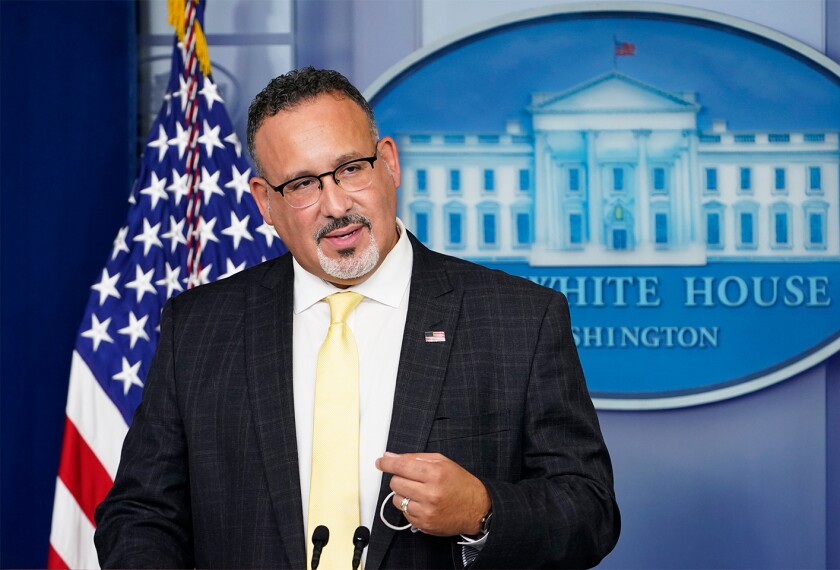
Education Secretary Miguel Cardona speaks during the daily briefing at the White House in Washington on Aug. 5, 2021.
  • Save to favorites
  • Print

The Biden administration’s priorities for education grants will include promoting equity in resources and opportunities, addressing learning loss caused by the pandemic, and advancing “systemic change” in schools.

These priorities, named in a Federal Register notice Dec. 10, involve U.S. Secretary of Education Miguel Cardona’s top issues for grants that Cardona and his department award at their discretion for both K-12 and higher education.

Beyond that, they represent the Biden administration’s overarching philosophy for the most important issues facing schools.

The six priorities don’t apply to federal money that goes out to states and school districts through formulas set by Congress, such as Title I aid for disadvantaged students. And they cover a very small portion of the Education Department’s overall budget. Yet they will serve as a lens through which federal officials will judge hundreds of millions of dollars in grants to schools for a variety of projects.

In a related move, the department simultaneously announced a new grant competition to bolster efforts to help students and schools recover from the pandemic. The grants will be overseen by the Institute for Education Sciences, and will fund “research recovery network” for pre-K, K-12, and community colleges.

In June, the department released a draft version of the discretionary grant priorities for public comment. Those top issues didn’t change in the final version, but the department did tweak some details about them after getting feedback from educators and others.

Some told the department that its use of the term “educator” in its draft lacked clarity about who the term referred to. In response, the department added a definition for the term that includes “early childhood educators, teachers, principals and other school leaders, specialized instructional support personnel (e.g., school psychologists, counselors, school social workers), paraprofessionals, and faculty.”

And for the priority for grants to address COVID-19’s affects, the agency added a focus on “underserved students.”

The priorities detail ways grants can be used to further the Biden administrations’ top issues for schools, and such strategies can vary widely.

For example, the department’s priority dealing with K-12 workforce would apply to projects focused on “increasing the number of diverse educator candidates who have access to an evidence-based comprehensive educator preparation program,” or those that address “implementing or expanding loan forgiveness or service-scholarship programs for educators based on completing service obligation requirements.”

During the Trump administration, former education Secretary Betsy DeVos’ priorities for federal grants included school choice and STEM.

Here are the official discretionary grants priorities released Friday:

  • “Addressing the Impact of COVID–19 on Students, Educators, and Faculty”
  • “Promoting Equity in Student Access to Educational Resources and Opportunities
  • “Supporting a Diverse Educator Workforce and Professional Growth To Strengthen Student Learning”
  • “Meeting Student Social, Emotional, and Academic Needs”
  • “Increasing Postsecondary Education Access, Affordability, Completion, and Post-Enrollment Success”
  • “Strengthening Cross-Agency Coordination and Community Engagement To Advance Systemic Change”

A version of this news article first appeared in the Politics K-12 blog.

Events

This content is provided by our sponsor. It is not written by and does not necessarily reflect the views of Education Week's editorial staff.
Sponsor
College & Workforce Readiness Webinar
Smarter Tools, Stronger Outcomes: Empowering CTE Educators With Future-Ready Solutions
Open doors to meaningful, hands-on careers with research-backed insights, ideas, and examples of successful CTE programs.
Content provided by Pearson
Reading & Literacy Webinar Supporting Older Struggling Readers: Tips From Research and Practice
Reading problems are widespread among adolescent learners. Find out how to help students with gaps in foundational reading skills.
This content is provided by our sponsor. It is not written by and does not necessarily reflect the views of Education Week's editorial staff.
Sponsor
Reading & Literacy Webinar
Improve Reading Comprehension: Three Tools for Working Memory Challenges
Discover three working memory workarounds to help your students improve reading comprehension and empower them on their reading journey.
Content provided by Solution Tree

EdWeek Top School Jobs

Teacher Jobs
Search over ten thousand teaching jobs nationwide — elementary, middle, high school and more.
View Jobs
Principal Jobs
Find hundreds of jobs for principals, assistant principals, and other school leadership roles.
View Jobs
Administrator Jobs
Over a thousand district-level jobs: superintendents, directors, more.
View Jobs
Support Staff Jobs
Search thousands of jobs, from paraprofessionals to counselors and more.
View Jobs

Read Next

Federal Ed. Dept. Layoffs Are Reversed, But Staff Fear Things Won't Return to Normal
The bill ending the shutdown reverses the early October layoffs of thousands of federal workers.
4 min read
Miniature American flags flutter in wind gusts across the National Mall near the Capitol in Washington, Monday, Nov. 10, 2025.
Miniature American flags flutter in wind gusts across the National Mall near the Capitol in Washington on Nov. 10, 2025. President Donald Trump on Wednesday signed a bill reopening the federal government after a 43-day shutdown.
J. Scott Applewhite
Federal Opinion Can School Reform Be Bipartisan Again?
In a world dominated by social media, is there room for a more serious education debate?
8 min read
The United States Capitol building as a bookcase filled with red, white, and blue policy books in a Washington DC landscape.
Luca D'Urbino for Education Week
Federal Judge Tells Ed. Dept. to Remove Language Blaming Democrats From Staff Emails
The agency added language blaming "Democrat Senators" for the federal shutdown to staffers' out-of-office messages
3 min read
Screenshot of a portion of a response email blaming Democrat Senators for the government shutdown.
Vanessa Solis/Education Week + Getty
Federal Trump’s Ed. Dept. Slashed Civil Rights Enforcement. How States Are Responding
Could a shift in civil rights enforcement be the next example of "returning education to the states?"
6 min read
Pennsylvania Sen. Lindsey Williams, D-Allegheny, is pictured during a confirmation hearing for acting
Pennsylvania state Sen. Lindsey Williams, a Democrat, is pictured during an education committee hearing on Aug. 12, 2025. Williams is preparing legislation that would create a state-level office of civil rights to investigate potential civil rights violations in schools. Williams is introducing the measure in response to the U.S. Department of Education's slashing of its own office for civil rights.
Courtesy of Pennsylvania Senate Democratic Caucus