Law & Courts

Appeals Court Rules for Religious Schools in Latest Challenge to Pandemic Restrictions

By Mark Walsh — January 03, 2021 2 min read
Image of a courthouse facade.
  • Save to favorites
  • Print

A federal appeals court has granted an injunction to nine religious schools in Ohio that blocks application to them of a recent county order shutting down public and private schools amid a COVID-19 surge.

A unanimous three-judge panel of the U.S. Court of Appeals for the 6th Circuit, in Cincinnati, held that the fact that both public and private schools were included in the Dec. 4 shutdown order of the Toledo-Lucas County, Ohio, health department was not the proper comparison for a neutral, generally applicable pandemic restriction.

The religious schools’ First Amendment right of free exercise of religion was being infringed because many “comparable” secular businesses were allowed to remain open, the court said.

“In Lucas County, the plaintiffs’ schools are closed, while gyms, tanning salons, office buildings, and the Hollywood Casino remain open,” the 6th Circuit panel said in its Dec. 31 order in Monclova Christian Academy v. Toledo-Lucas County Health Department. “The resolution’s restrictions therefore impose greater burdens on the plaintiffs’ conduct than on secular conduct.”

The court said its decision was supported by the U.S. Supreme Court’s Nov. 25 decision in Roman Catholic Diocese of Brooklyn, N.Y. v. Cuomo, which blocked pandemic-related limits on church attendance in New York state because churches were treated less favorable than “comparable secular facilities.”

The 6th Circuit also relied on a 1993 Supreme Court decision, Church of the Lukumi Babalu Aye v. City of Hialeah, which had invalidated the Florida city’s statutes against animal sacrifice because they targeted practices of the Santeria religion.

The key question in this case, the 6th Circuit said, “is whether we may consider only the secular actors (namely, other schools) regulated by the specific provision here in determining whether the plaintiffs’ schools are treated less favorably than comparable secular actors are.”

“We find no support for that proposition in the relevant Supreme Court case law,” the appellate court said. In Lukumi, the Supreme Court held that “the free exercise clause … ‘protects religious observers against unequal treatment’,” the 6th Circuit noted.

(Legal scholar Josh Blackman has an interesting analysis of the 6th Circuit panel’s discussion of Lukumi in the Ohio schools case in a post at the Volokh Conspiracy website.)

The 6th Circuit panel took note of a Nov. 29 order by another panel of the same court that had refused to exempt a religious school in Kentucky from an order by the governor to shut down in-person learning because of the COVID-19 spike.

Both Kentucky and Ohio are in the 6th Circuit, and the panel in the new ruling involving Ohio said “we have no quarrel” with the earlier panel’s ruling that the Kentucky order did not violate the free-exercise rights of a religious school in that state because both public and private schools were closed. The panel in the Ohio case suggested that the Kentucky case had not squarely presented the issue of whether religious schools were comparable to secular businesses when it came to pandemic restrictions.

(The Supreme Court on Dec. 17 denied emergency relief to the Kentucky religious school, saying that the imminent expiration of the governor’s closure order and the holiday break counseled against granting the school’s request at this time.)

The Toledo-Lucas County school shutdown order was scheduled to expire on Jan. 11. There was no immediate word on whether the county planned to appeal the 6th Circuit order.

Events

This content is provided by our sponsor. It is not written by and does not necessarily reflect the views of Education Week's editorial staff.
Sponsor
Artificial Intelligence Webinar
AI in Schools: What 1,000 Districts Reveal About Readiness and Risk
Move beyond “ban vs. embrace” with real-world AI data and practical guidance for a balanced, responsible district policy.
Content provided by Securly
This content is provided by our sponsor. It is not written by and does not necessarily reflect the views of Education Week's editorial staff.
Sponsor
Recruitment & Retention Webinar
K-12 Lens 2026: What New Staffing Data Reveals About District Operations
Explore national survey findings and hear how districts are navigating staffing changes that affect daily operations, workload, and planning.
Content provided by Frontline Education
Education Funding Webinar Congress Approved Next Year’s Federal School Funding. What’s Next?
Congress passed the budget, but uncertainty remains. Experts explain what districts should expect from federal education policy next.

EdWeek Top School Jobs

Teacher Jobs
Search over ten thousand teaching jobs nationwide — elementary, middle, high school and more.
View Jobs
Principal Jobs
Find hundreds of jobs for principals, assistant principals, and other school leadership roles.
View Jobs
Administrator Jobs
Over a thousand district-level jobs: superintendents, directors, more.
View Jobs
Support Staff Jobs
Search thousands of jobs, from paraprofessionals to counselors and more.
View Jobs

Read Next

Law & Courts Supreme Court’s Gender Identity Ruling Leaves Schools Seeking Clarity
Advocates say they would welcome more from the Supreme Court on gender-notification policies.
7 min read
The Supreme Court is photographed, Friday, Feb. 27, 2026, in Washington.
The Supreme Court is photographed, Friday, Feb. 27, 2026, in Washington. The high court recently ruled that California policies that sometimes limit or discourage schools from disclosing information to parents about children’s gender transitions and expressions at school likely violate parents’ constitutional rights
Rahmat Gul/AP
Law & Courts Supreme Court Backs Parents in School Gender Disclosure Fight
The Supreme Court restored an injunction blocking California policies on student gender transitions
8 min read
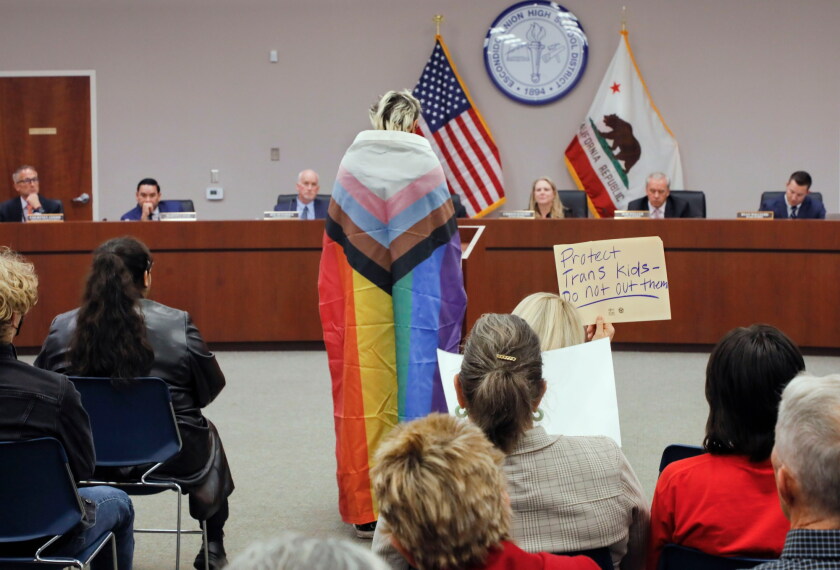
Teacher’s aide Amelia Mester, wrapped in a Pride flag, urges Escondido Union High School District not to have employees notify parents if they believe a student may be transgender in November 2025. A policy on the issue in the city’s elementary school district is the subject of a federal class-action lawsuit in which a judge just sided against the district.
Teacher’s aide Amelia Mester, wrapped in a Pride flag, urges Escondido Union High School District not to have employees notify parents if they believe a student may be transgender at a meeting in November 2025. Two parents and two teachers from the district sued in 2023, challenging California state guidance concerning student gender transitions and parental notification. The U.S. Supreme Court has now reinstated a lower-court decision overturning those state policies.
Charlie Neuman for The San Diego Union-Tribune/TNS
Law & Courts Appeals Court Allows Louisiana Ten Commandments Displays to Proceed
The court said it was premature to rule on the constitutionality of La. Ten Commandments displays.
3 min read
Students work under Ten Commandments and Bill of Rights posters on display in a classroom at Lehman High School in Kyle, Texas, Thursday, Oct. 16, 2025.
Students work under Ten Commandments and Bill of Rights posters on display in a classroom at Lehman High School in Kyle, Texas, Oct. 16, 2025. A federal appeals court has lifted a lower-court injunction blocking a Louisiana law that requires Ten Commandments displays, clearing the way for the law to take effect.
Eric Gay/AP
Law & Courts Social Media Companies Face Legal Reckoning Over Mental Health Harms to Children
Some of the biggest players from Meta to TikTok are getting a chance to make their case in courtrooms around the country.
6 min read
Social Media Kids Trial 26050035983057
Meta CEO Mark Zuckerberg leaves court after testifying in a landmark trial over whether social media platforms deliberately addict and harm children, on Feb. 18, 2026, in Los Angeles.
AP Photo/Damian Dovarganes
