Law & Courts

A District’s Rule Against Misgendering Students Is Likely Constitutional

By Mark Walsh — July 30, 2024 4 min read
Demonstrators advocating for transgender rights and healthcare stand outside of the Ohio Statehouse, Jan. 24, 2024, in Columbus, Ohio. A federal appeals court on Wednesday, July 17, refused to lift a judge's order temporarily blocking the Biden administration’s new Title IX rule meant to expand protections for LGBTQ+ students
  • Save to favorites
  • Print

A divided federal appeals court refused to block an Ohio school district’s rules that bar students from using pronouns that misgender their classmates. The policy, the court said, likely does not violate the First Amendment rights of students with religious beliefs that there is no such thing as a gender transition.

“Transgender students experience the use of non-preferred pronouns as dehumanizing and … as a result, the repeated use of such pronouns can have severely negative effects on children and young adults,” said the majority opinion on July 29 by a 2-1 panel of the U.S. Court of Appeals for the 6th Circuit, in Cincinnati.

The court said the intentional use of preferred or nonpreferred pronouns is speech under the First Amendment, but the policies of the 24,000-student Olentangy school district were likely justified by the need to eliminate disruption and protect transgender students. The court rejected an injunction to block the rules sought by the national group Parents Defending Education on behalf of several district parents who argued that their children should not be required to use pronouns that conflict with their beliefs that there are only two biological-based genders.

“Perhaps the single thing on which the parties agree is that pronouns matter,” said the majority opinion by Judge Jane B. Stranch, an appointee of President Barack Obama. “That is true for transgender students in the district, who experience the use of preferred pronouns as a vital part of affirming their existence and experience the use of non-preferred pronouns as dehumanizing, degrading, and humiliating. It is also true for [the plaintiff] children, whose parents aver that using pronouns inconsistent with a person’s biological sex at birth contradicts their ‘deeply held beliefs’ about the immutability of sex.”

The opinion was joined by Judge Stephanie D. Davis, an appointee of President Joe Biden.

A school district’s rules are interpreted to bar misgendering, but it offers some alternatives

In 2023, the Olentangy district north of Columbus revised several of its policies to add protections against gender-identity discrimination. When a parent asked in an email whether their “devoutly Christian child who believes in two biological genders” would “be forced to use the pronouns that a transgender child identifies with or be subject to reprimand from the district,” a district lawyer responded that a student “purposefully referring to another student by using gendered language they know is contrary to the other student’s identity” would be discrimination under the district’s policies.

Parents Defending Education, which is involved in several similar cases across the country, sued on behalf of several parents in the district, arguing that the policies violated the First Amendment’s free-speech clause by impermissibly compelling speech, regulating speech based on viewpoint and content, and imposing overbroad restrictions on speech.

A federal district court last year denied a preliminary injunction to block the district’s policies. In its July 29 decision in Parents Defending Education v. Olentangy Local School District, the 6th Circuit affirmed the lower court.

“Even this limited preliminary injunction record contains evidence of the substantial disruption that repeated, intentional use of non-preferred pronouns to refer to transgender students can cause,” Stranch wrote for the majority.

The court rejected the compelled-speech argument by the plaintiffs, noting that the school district has said no student would be compelled to use pronouns aligning with a transgender student’s gender identity. Instead, the student could use the classmate’s first name or avoid using pronouns altogether, the district said.

The appeals court rejected the viewpoint-discrimination argument because the district’s policies prohibit harassment, misconduct, and other disruptive speech across a variety of categories and it allows students to express the viewpoint that sex is immutable by several means other than “the use of non-preferred pronouns.” For example, the district said in court proceedings that it would allow a student to wear a T-shirt with the message, “Gender is not fluid,” the court said.

Judge Alice M. Batchelder, an appointee of President George H.W. Bush, dissented, saying “The First Amendment forbids the district from compelling students to use speech that conveys a message with which they disagree, namely that biology does not determine gender.”

The district’s suggestion that objecting students use no pronouns was “awkward” and “requires the speaker to recognize and accept that gender transition is a real thing.”

“Regardless of whether students can also discuss gender ideology in the abstract—which is also protected speech—the students’ protected speech here is their use of biological pronouns to affirm their own belief that people are either male or female and that a child cannot ‘transition’ from one sex to another,” Batchelder said.

Events

This content is provided by our sponsor. It is not written by and does not necessarily reflect the views of Education Week's editorial staff.
Sponsor
Artificial Intelligence Webinar
Managing AI in Schools: Practical Strategies for Districts
How should districts govern AI in schools? Learn practical strategies for policies, safety, transparency, and responsible adoption.
Content provided by Lightspeed Systems
This content is provided by our sponsor. It is not written by and does not necessarily reflect the views of Education Week's editorial staff.
Sponsor
Student Absenteeism Webinar
Removing Transportation and Attendance Barriers for Homeless Youth
Join us to see how districts around the country are supporting vulnerable students, including those covered under the McKinney–Vento Act.
Content provided by HopSkipDrive
This content is provided by our sponsor. It is not written by and does not necessarily reflect the views of Education Week's editorial staff.
Sponsor
Reading & Literacy Webinar
Two Jobs, One Classroom: Strengthening Decoding While Teaching Grade-Level Text
Discover practical, research-informed practices that drive real reading growth without sacrificing grade-level learning.
Content provided by EPS Learning

EdWeek Top School Jobs

Teacher Jobs
Search over ten thousand teaching jobs nationwide — elementary, middle, high school and more.
View Jobs
Principal Jobs
Find hundreds of jobs for principals, assistant principals, and other school leadership roles.
View Jobs
Administrator Jobs
Over a thousand district-level jobs: superintendents, directors, more.
View Jobs
Support Staff Jobs
Search thousands of jobs, from paraprofessionals to counselors and more.
View Jobs

Read Next

Law & Courts Supreme Court’s Gender Identity Ruling Leaves Schools Seeking Clarity
Advocates say they would welcome more from the Supreme Court on gender-notification policies.
7 min read
The Supreme Court is photographed, Friday, Feb. 27, 2026, in Washington.
The Supreme Court is photographed, Friday, Feb. 27, 2026, in Washington. The high court recently ruled that California policies that sometimes limit or discourage schools from disclosing information to parents about children’s gender transitions and expressions at school likely violate parents’ constitutional rights
Rahmat Gul/AP
Law & Courts Supreme Court Backs Parents in School Gender Disclosure Fight
The Supreme Court restored an injunction blocking California policies on student gender transitions
8 min read
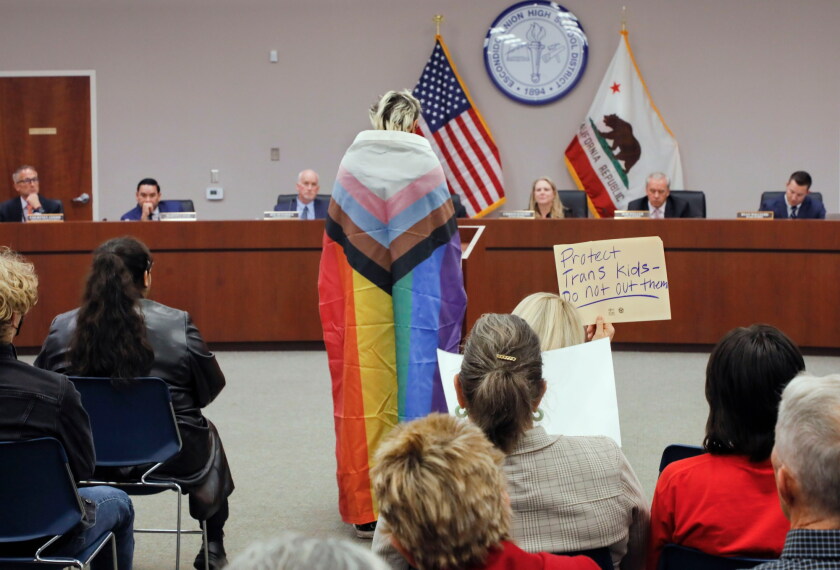
Teacher’s aide Amelia Mester, wrapped in a Pride flag, urges Escondido Union High School District not to have employees notify parents if they believe a student may be transgender in November 2025. A policy on the issue in the city’s elementary school district is the subject of a federal class-action lawsuit in which a judge just sided against the district.
Teacher’s aide Amelia Mester, wrapped in a Pride flag, urges Escondido Union High School District not to have employees notify parents if they believe a student may be transgender at a meeting in November 2025. Two parents and two teachers from the district sued in 2023, challenging California state guidance concerning student gender transitions and parental notification. The U.S. Supreme Court has now reinstated a lower-court decision overturning those state policies.
Charlie Neuman for The San Diego Union-Tribune/TNS
Law & Courts Appeals Court Allows Louisiana Ten Commandments Displays to Proceed
The court said it was premature to rule on the constitutionality of La. Ten Commandments displays.
3 min read
Students work under Ten Commandments and Bill of Rights posters on display in a classroom at Lehman High School in Kyle, Texas, Thursday, Oct. 16, 2025.
Students work under Ten Commandments and Bill of Rights posters on display in a classroom at Lehman High School in Kyle, Texas, Oct. 16, 2025. A federal appeals court has lifted a lower-court injunction blocking a Louisiana law that requires Ten Commandments displays, clearing the way for the law to take effect.
Eric Gay/AP
Law & Courts Social Media Companies Face Legal Reckoning Over Mental Health Harms to Children
Some of the biggest players from Meta to TikTok are getting a chance to make their case in courtrooms around the country.
6 min read
Social Media Kids Trial 26050035983057
Meta CEO Mark Zuckerberg leaves court after testifying in a landmark trial over whether social media platforms deliberately addict and harm children, on Feb. 18, 2026, in Los Angeles.
AP Photo/Damian Dovarganes
