Some Calif. Test Scores Fall Along With Class Size
While class-size reduction has helped achievement in most of California’s large urban school districts, not all of those have enjoyed such results, says a study by the Public Policy Institute of California.
“Class Size Reduction, Teacher Quality, and Academic Achievement in California Public Elementary Schools,” from the Public Policy Institute of California. (Requires Adobe’s Acrobat Reader.)
In fact, some Los Angeles students saw their test scores fall as a result of the 1996 statewide program, which sought to lower class sizes in kindergarten through the 3rd grade. That’s because the most experienced teachers in the lowest-performing schools left for more affluent schools, the report says, and the least qualified teachers were sent to the schools with the most impoverished students.
But overall, the report shows improvement on test scores by students from low-income families who were taught in smaller classes. It documents test-score gains over a three-year period, from the 1997-98 school year to the 1999-2000 one, in the five next-largest districts—Fresno, Long Beach, Oakland, San Diego, and San Francisco—that were included in the study.
Test scores of 3rd graders increased an average of 14 percent in mathematics and 9 percent in reading for the schools with high concentrations of students living in poverty in those districts. The districts’ schools with few needy students saw very slight gains, less than 1 percent, in math scores and a 6 percent increase in reading scores.
But the class-size-reduction program also led to a dramatic increase in the proportion of teachers who lacked certification, had no postgraduate education, and were in their first or second year of teaching.
Further, those less qualified teachers were mainly concentrated in schools with high percentages of poor, minority students.
“This problem appears to have been much more severe in L.A.'s high- poverty schools than in similar schools in other districts,” writes Christopher Jepsen, a research fellow at the institute and one of the report’s authors.
For instance, the Los Angeles schools with the highest percentages of African-American students saw drops of 15 percent in math scores.
Games and Lessons
The teaching of mathematics to young children should combine child’s play and well-planned activities by adults to guide youngsters’ learning of the discipline’s foundations, says a new position statement from groups representing mathematics educators and early-childhood experts.
“Early Childhood Mathematics: Promoting Good Beginnings,” a joint position statement of the National Association for the Education of Young Children and the National Council of Teachers of Mathematics.
Children between the ages of 3 and 6 can start counting by playing board games, learn geometric patterns by building with blocks, and understand basic arithmetic from viewing literature, according to the statement adopted jointly by the National Council of Teachers of Mathematics and the National Association for the Education of Young Children.
For their part, teachers should plan learning opportunities that ensure students have a complete understanding of the mathematical concepts they’ll need to know to succeed in later grades.
“Besides embedding significant mathematics learning in play, classroom routines, and learning experiences across the curriculum,” the statement says, “an effective early- mathematics program also provides carefully planned experiences that focus children’s attention on a particular mathematical idea or a set of related ideas.”
The Reston, Va.-based NCTM includes 100,000 members who are teachers, university professors, and curriculum directors. The Washington-based NAEYC also has 100,000 members, made up of early-childhood teachers and university professors.
Online Teacher Learning
The Jason Project, a popular science program that uses the Internet to link students to hands-on learning, has found success in its first effort at providing online professional development for teachers.
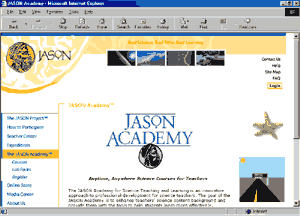
The Jason Academy for Science Teaching and Learning, a project of the Needham Heights, Mass.-based group, recently completed its first year of offering five-week online courses to teachers.
| | 
|
| The Jason Project now offers online professional development for teachers, via the Jason Academy. Most first-year participants said they’d take more training. |
Via the Web, participants expand their scientific knowledge and learn ways to create classroom lessons for students to learn science through activities and experiments.
The courses require six to 10 hours of work a week, and teachers earn five continuing education unit credits. Almost 500 teachers have taken a course from the Jason Academy.
An evaluation of the project found that 87 percent of the nearly 100 participants surveyed said they would take another online course offered by the Jason Academy.
Participants also reported that the most important element of their experience was the ability to e-mail instructors and classmates in chat rooms and discussion boards.
In an online course on ocean science, for example, participants held a live chat while a member of the class witnessed Inuits butchering a whale in Alaska. The experience gave teachers with a variety of expertise and experiences a way to learn together, according to Juliana Texley, an instructor for the academy.
The Jason Project also conducts annual expeditions in which a group of students takes part in a scientific project and documents the experience for others on the Internet.
The evaluation of the professional- development program for teachers was conducted by SRI International, a research company in Menlo Park, Calif.
Testing Guidance
States striving to craft high-quality testing programs at a reasonable cost can turn to two new publications for help.
“State Innovation Priorities for State Testing Programs,” and “Model Contractor Standards and State Responsibilities for State Testing Programs,” are both available from the Education Leaders Council. (Both reports require Adobe’s Acrobat Reader.)
“Model Contractor Standards & State Responsibilities for State Testing Programs,” written by the Washington-based Education Leaders Council and Accountability Works Inc., two nonprofit public-policy groups, provides guidelines for state education agencies and the testing industry on how to clarify their expectations and responsibilities regarding the development, administration, and scoring of state tests.
A second report, “State Innovation Priorities for State Testing Programs,” suggests both an immediate and long-term agenda for improvements in state testing programs, particularly given the testing and accountability requirements in the “No Child Left Behind” Act of 2001. Among other highlights, the report identifies joint initiatives that could be undertaken by groups of states working together with test publishers.
Both publications grew out of an ELC-sponsored testing summit held in February in Austin, Texas, attended by state education and testing- industry leaders. Participants provided input and suggestions regarding the documents.
—David J. Hoff, Lynn Olson, & Joetta L. Sack inclass@epe.org


