
School & District Management

Study Finds U.S. Losing Its Postsecondary Edge

By Sarah D. Sparks — September 20, 2011 2 min read
  • Save to favorites
  • Print

The United States still leads the world in having a college-educated workforce, but it is the only country among the world’s leading economies whose incoming workers are less educated than those retiring, according to a new study by the Organization for Economic Cooperation and Development.

Released last week, the OECD’s “Education at a Glance 2011” report compares education systems in the Group of Twenty, or G-20, economies, which include 19 countries and the European Union.

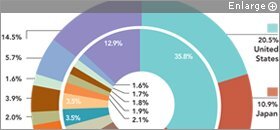
It finds that in 2009, Americans accounted for more than one in every four of the 225 million people with postsecondary degrees in the G-20 countries. But a closer look at the statistics reveals a deep generational divide among degree-holders: Americans make up more than a third of all postsecondary degree holders, ages 55 to 64, but only one-fifth of those ages 25 to 34.

“It’s not that the United States is doing worse; it’s that other countries are starting to do what the United States has been doing for a very long time,” said Andreas Schleicher, who heads the indicators and analysis division at the OECD’s Directorate for Education, in a briefing on the report. “There’s been a quite dramatic expansion of the pool of qualified people.”

A Piece of the Pie

Among the world’s leading economies, the United States accounts for 35.8 percent of all postsecondary degreeholders between the ages of 55 and 64 (inner ring). Among 25-to-34-year-old postsecondary degree-holders, the U.S. share accounts for 20.5% (outer ring).
BRIC ARCHIVE

SOURCE: Organization for Economic Cooperation and Development

China, in particular, has been gaining ground in education. Chinese between 25 and 34 held nearly triple the global share of postsecondary degrees, 18.3 percent, compared to its older workers, who represent only 6.9 percent of postsecondary degrees in their age group.

China on the Rise

Moreover, China’s educational edge is likely to grow. In 2009 China had 36.6 percent of the world’s students entering college, compared with the United States’ 12.9 percent share, and China accounted for 42.6 percent of the world’s students graduating high school, compared with 9.9 percent for American students.

Because of its well-educated older workers, the United States still ranks in the top five most-educated countries among the G-20, but it drops to 15th among those ages 25 to 34—a decline that could deeply affect the nation’s economic well-being, as prior research shows education has a greater effect on a person’s earnings than factors such as race or gender.

Educational attainment can play a role in a country’s politics and social fabric, too. The OECD study also found that 14-year-olds who scored higher on the International Civic and Citizenship Education Study were more likely to vote and to favor gender equality than those with lower civics education.

Mr. Schleicher said higher education in the United States is more expensive than that in other countries, and U.S. students feel a greater sense of risk in taking on student loans.

He added, however: “Tuition that U.S. students pay is still low in comparison to the benefits that you get.” After accounting for gender, age and income, adults with higher education reported they were “more satisfied with life, engaged in society and likely to report that they are in good health.”

Related Tags:

A version of this article appeared in the September 21, 2011 edition of Education Week as U.S. Educational Edge Seen to Be Shrinking

Events

Jobs Regional K-12 Virtual Career Fair: DMV
Find teaching jobs and K-12 education jubs at the EdWeek Top School Jobs virtual career fair.
Teaching Profession Webinar Effective Strategies to Lift and Sustain Teacher Morale: Lessons from Texas
Learn about the state of teacher morale in Texas and strategies that could lift educators' satisfaction there and around the country.
This content is provided by our sponsor. It is not written by and does not necessarily reflect the views of Education Week's editorial staff.
Sponsor
Special Education Webinar
Hidden Costs of Special Ed Vacancies: Solutions for Your District
When provider vacancies hit, students feel it first. Hear what district leaders are doing to keep IEP-related services on track.
Content provided by Huddle Up

EdWeek Top School Jobs

Teacher Jobs
Search over ten thousand teaching jobs nationwide — elementary, middle, high school and more.
View Jobs
Principal Jobs
Find hundreds of jobs for principals, assistant principals, and other school leadership roles.
View Jobs
Administrator Jobs
Over a thousand district-level jobs: superintendents, directors, more.
View Jobs
Support Staff Jobs
Search thousands of jobs, from paraprofessionals to counselors and more.
View Jobs

Read Next

School & District Management Opinion If We Want Teachers to Stay, Principals Must Lead Differently
Here are three ways school leaders can make teaching feel more sustainable.
4 min read
Figures are swept up to a large magnet outside of a school. Teacher retention.
Vanessa Solis/Education Week + Canva
School & District Management How Top Principals Advocate for Their Students and Schools
Principal-advocates coach and encourage others in schools to speak up
5 min read
Rod Sheppard, former principal of Florence Learning Center in Florence, Ala., Angie Charboneau-Folch, principal of the Integrated Arts Academy in Chaska, Minn., and Chase Christensen, the principal of Arvada-Clearmont school in Wyoming, share strategies on how to advocate for public schools at the National Education Leadership Awards gathering in Washington, D.C. on April 17, 2026.
Rod Sheppard, former principal of Florence Learning Center in Florence, Ala., Angie Charboneau-Folch, principal of the Integrated Arts Academy in Chaska, Minn., and Chase Christensen, the principal of Arvada-Clearmont school in Wyoming, were interviewed by Chris Tao, a National Student Council member, on stratgies to advocate for public schools at the National Education Leadership Awards gathering in Washington on April 17, 2026.
Allyssa Hynes/National Association of Secondary School Principals
School & District Management Opinion How Teachers Can Get the Most Out of Their HR Office (Downloadable)
Here’s what your school district’s human resources staff can and can’t do for you.
Anthony Graham
1 min read
A group of people discuss the things human resources can and cannot do.
Vanessa Solis/Education Week + Getty + Canva
School & District Management Can Student Influencers Help This District Rebuild Enrollment?
A district hopes that student influencers can bring a more authentic voice to its marketing push.
5 min read
Images from an influencer's reel.
Images courtesy of thekid.maddie
