FLORIDA
Florida Governor Proposes
Repeal of Class-Size Caps
Gov. Jeb Bush of Florida announced plans last week to seek another public vote on class-size limits in his state—in the hope that the expensive plan would be overturned.

“I believe we must go back to the voters and have them make a decision with all the information in hand, information about the new challenges our state faces, and information about the massive tax increases that will be necessary to pay for them,” the Republican governor said in his State of the State Address on March 4.
But leaders in the House and the Senate, both of which are controlled by Republicans, were reluctant to support Gov. Bush’s call for another vote on the class-size caps. Speaker of the House Johnnie B. Byrd Jr. and Senate President James E. King Jr. both expressed doubts last week about whether the proposed repeal would ever go before voters.
Gov. Bush’s speech came about six weeks after he announced his plans for complying with the class-size limits that voters had approved last fall when they elected him to a second term.
Voters approved the constitutional amendment limiting class sizes in November, even though the governor had campaigned against the ballot measure.
Sorting out what the law means has been challenging for state leaders and school districts alike. The amendment says districts’ average class sizes must be reduced “by two” starting next fall, for example, but views vary on how that mandate should be interpreted.
In January, Gov. Bush unveiled a controversial plan that he said would make the class-size-reduction plan workable. He called for caps on core academic classes only, not including physical education, for instance. He also called for shrinking public school classes by expanding the state’s tuition-voucher programs to allow more students to transfer to private schools. (“Florida Debates How to Shrink Class Sizes,” Feb. 5, 2003.)

|
U.S. Rep. Kendrick Meek, a Florida Democrat who just began his first term in Congress and led the campaign for smaller class sizes as a state senator, blasted Gov. Bush’s call for another public vote on the class-size limits. He said the governor’s move would betray the will of the voters.
Leaders of Florida’s joint affiliate of the National Education Association and the American Federation of Teachers also criticized the proposal.
“We often hear from political leaders about personal responsibility, but political leaders also have a responsibility to the voters,” said Maureen Dinnen, the president of the Florida Education Association. “Now is the time to honor that responsibility.”
—Alan Richard
NORTH CAROLINA
Easley Proposes Increase
In Money for Education
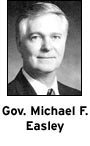
Despite the need to trim North Carolina’s state operating expenses by $800 million in the coming fiscal year, Gov. Michael F. Easley has vowed “no cuts to the classroom—from pre-K through the university.”
In his State of the State Address on March 3, Mr. Easley pushed for expansion of the state’s class-size- reduction initiative, to lower pupil-teacher ratios to 18-to-1 in grades K-3 over the next two years. He also proposed expansion of a public preschool program for disadvantaged 4-year-olds and another round of salary increases and performance bonuses for teachers.
|
The Democratic governor’s $15 billion budget proposal for fiscal 2004, also released last week, includes $6 billion for precollegiate education, a $170 million increase over fiscal 2003.
Other state agencies would bear the brunt of the state’s expected revenue shortfall, with many of them facing cuts of 10 percent. The 2003 budget cut nearly 2,000 jobs from state government, including more than a dozen from the department of public instruction, to address a projected $1 billion budget deficit. Mr. Easley has since balanced the budget by initiating a state hiring freeze and digging into emergency funds.
School districts would lose nearly $60 million in construction money, as well as nearly 1,200 clerical and custodial positions.
In his speech last week, Gov. Easley again called for a state lottery to support education, an issue he has pushed since his 2000 campaign for governor. The lottery, he said, could raise more than $200 million for education programs and school construction.
Several efforts to set up a North Carolina lottery over the past decade have failed to gain sufficient support in the legislature.
— Kathleen Kennedy Manzo
OREGON
Governor Wants School Aid
To Halt’Downward Spiral’
Gov. Theodore R. Kulongoski’s State of the State Address on Feb. 21 was full of hope and aggressive plans to jump-start economic growth in a state suffering its worse recession since World War II.
But his plans to shore up Oregon’s public education system, which took a $1 billion hit in budget cutbacks over the past year, were scant. And while the Democratic first-term governor emphasized his commitment to education, he put the burden of finding a long- term school funding solution squarely on the shoulders of parents, teachers, business leaders, and community groups.
“Through a grassroots movement, the public will decide on its own that our schools need help. This kind of movement has already started, and it’s going to pick up steam,” the governor said. “I want to be part of it. But ultimately, it must be driven by the people.”
The state government had proposed temporary tax proposals over the years in part to help provide funding for schools, but voters rejected all of them, Gov. Kulongoski reminded Oregonians.
“To simply go back to the voters now and ask for more money is a fool’s errand,” he said. “The definition of insanity is doing the same thing over and over and expecting a different result.”
The governor said, however, that his proposed budget for fiscal years 2004 and 2005 “halts the downward spiral of state support for K-12 education.” For instance, his proposed spending for the state department of education stands at almost $6.2 billion, up from $5.8 billion approved for the current biennium in the legislature’s fifth special session last year.
Yet despite the proposed increases in school funding, districts such as Portland, which faces up to a $50 million revenue gap next year, must still deal with especially tight budgets.
—Rhea R. Borja
PENNSYLVANIA
Rendell Eyes Shifting More
Education Costs to State
Pennsylvania Gov. Edward G. Rendell’s first budget address was filled with proposals for painful cutbacks, but he pledged to increase the state’s public school spending and reduce soaring local property taxes.
Speaking to the legislature on March 4, six weeks after taking office, the Democratic governor outlined a $21 billion fiscal 2004 budget that features, among other reductions, a 10 percent, across-the-board cut in state government spending.
The former Philadelphia mayor said he had no choice but to make distasteful decisions in the face of a projected $2.4 billion deficit for 2004.
“I hate this budget,” he said. “I hate it with every fiber of my body.”
Mr. Rendell’s budget plan did not include details of how he would raise state spending on education or lower local property taxes, two ideas that formed cornerstones of his campaign. He pledged to return to the legislature on March 25 with detailed plans in those areas.
The governor said he would make sure the Keystone State’s 501 school districts get the same basic-education subsidy in fiscal 2004 that they received this year.
He proposed that the state’s share of total education costs rise from its current one-third to one-half, the portion it paid in the 1970s. He also called for an average reduction of 30 percent in property taxes this year. Legislators applauded both ideas.
“We have created a system where the quality of your public school education depends too much on where you live,” Gov. Rendell said.
He pledged to find money to pay for preschool programs and full-day kindergarten, reduce class sizes in the early-elementary years, provide high- quality teacher training, and make sure school buildings are clean and safe and children have the books and materials they need.
Some education programs won’t escape the budget knife, Mr. Rendell said, such as performance-incentive grants, which reward schools for improved test scores or attendance. He said that forging a solution to the related problems of high property taxes and inadequate school funding represented a historic opportunity.
“We can do it if we are willing to try,” the governor said, prompting another round of applause.
—Catherine Gewertz



