

After allegations that César Chavez sexually abused girls surfaced in a major investigation this week, dozens of schools named for the farm labor activist faced immediate questions they weren’t prepared to answer.
Would they change their names? And how should they start these conversations with their communities?
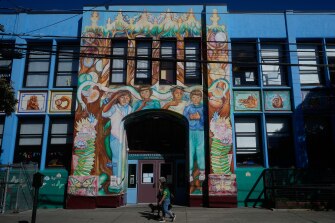
At least 86 public schools in 14 states, Puerto Rico, and the District of Columbia are named for Chavez, according to the most recent federal data, which was collected in the 2024-25 school year and includes charter schools.
To many, the co-founder of the United Farm Workers, who died in 1993, has long stood as a Mexican-American icon, an advocate for the working class, and a champion of non-violent activism. But that legacy was challenged Wednesday, when the New York Times published the results of a five-year investigation of allegations that Chavez sexually assaulted girls and women, including fellow UFW co-founder Dolores Huerta.
The revelations sparked intense emotional reactions and calls to rename streets, buildings, and schools named in his honor.
“A lot of schools are going to have to have some really interesting and really difficult conversations about what it means to publicly commemorate the past,” said Kevin Levin, an author and historian involved in past debates about schools named for Confederate figures.
Districts usually name schools after historical figures to represent a set of values and traits they want to instill in students, he said.
“That individual is a stand-in for what that community believes in, what it aspires to achieve,” Levin said.
Changing those names sparks fraught, emotional conversations about values, alumni connections to their schools, and changing views of history, he said.
Districts with schools named for Chavez are troubled by revelations
Education Week on Wednesday contacted a dozen districts and charter school networks with schools named for Chavez. None had a firm position on renaming, but many acknowledged that conversations were already taking place in their communities.
States including California, Colorado, Minnesota, Texas, Utah, and Washington recognize César Chavez day on the leader’s March 31 birthday. By Thursday, some had already committed to renaming the holiday. Several districts that have the day off said it’s too late to change their calendars. Others that planned commemorations during the school day have canceled their plans.
The San Francisco school district, which has an elementary school named for Chavez, said it “shares in the community’s concerns” regarding the allegations. The San Francisco school board faced pushback when it voted to rename 44 of its 117 schools in 2021 because of concerns their namesakes were tied to racism and oppression. Schools flagged under the plan, which the district later abandoned, included those named for George Washington, Paul Revere, and former U.S. Senator Diane Feinstein.
“As these allegations have only just come to light, the district is closely monitoring the situation,” the district said in a statement hours after the Times published its Chavez investigation on Wednesday.
Some districts said they were bound by policies that only allow school name changes in specific circumstances.

That’s the case for the Ysleta district in El Paso, Texas, which has a school serving grades 6-12 named for Chavez and said in a statement that it is taking the allegations “very seriously.”
The district’s policy only allows for the renaming of an existing facility if its “educational function or support activity is changed and/or redirected,” the statement said, adding that the district “will listen, learn, and act thoughtfully as more information becomes available.”
Districts often seek to prevent naming controversies by avoiding names of living people, assuming the history of those who’ve died is more settled and less likely to spark controversies. But that’s not always the case; there are 26 schools named for former President Barack Obama, federal data show.
And legacies can continue to evolve decades after a person dies, as is the case with Chavez, said Gustavo Balderas, superintendent of the Puget Sound Educational Service District in Washington state.
“My family worked the fields in the Central Valley, so this is a little personal for me,” said Balderas, the past president of the Association of Latino Administrators and Superintendents. “When you have one of your icons accused, it’s heartbreaking.”
When Balderas was an administrator in the Hillsboro, Ore., district, leaders adopted a policy of naming buildings after local landmarks and places, rather than people, to avoid such pitfalls, he said. During a time of population growth, the district opened new schools with names like Free Orchards Elementary and Liberty High School.
Renaming schools can be costly, emotional
Renaming conversations are difficult for school boards because current members often didn’t set policies or name the buildings to begin with, Balderas said.
They can also be costly, requiring new school signs, sports jerseys, and band uniforms, districts learned over the last two decades when they set out to update schools named for Confederate leaders and historical figures who supported segregation. Approximately 340 schools in 21 states are named for Confederate figures, according to an Education Week tracker.

In 2018, Fairfax County, Va., school officials estimated that it would cost about half a million dollars to change the name of J.E.B. Stuart High. Opened in 1959, the school was named in honor of the Confederate general James Ewell Brown Stuart as a symbol of resistance to school integration.
After alumni campaigned to rename the school after figures including U.S. Supreme Court Justice Thurgood Marshall, the district settled on Justice High in honor of a list of significant people in Black history and the civil rights movement.
The districts that have had the best reception to naming conversations did not make decisions unilaterally, Levin said.
Districts considering retitling schools named for Chavez should involve the community members, alumni, and current students in discussions that extend far outside of school board meetings, he said.
For teachers in those schools, the moment may also present a learning opportunity, said Levin, a former school history teacher. Students could discuss the significance of their school’s name, Mexican-American history, and the labor movement, discussing how new revelations change their understanding of history, he said. Teachers might also raise questions about women’s roles and visibility in the labor and civil rights movements, Levin added.
“Put them in a position as much as possible to begin to think carefully about this history and then what, if anything, to do about the school name,” he said.
Districts selecting new names should also remember the significance of naming public spaces for Latino figures, particularly to Latino and Mexican-American students, and potentially explore new names that represent their culture and history in some way, Balderas said.
While Hispanic students make up nearly 30% of public school enrollment, buildings named after white historical figures, like presidents, are far more common.
Naming schools for the labor leader was done “with the best of intent,” Balderas said. “But even with the best of intent, you don’t always know the full legacy of people.”


