

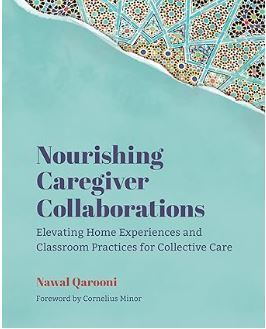
Nawal Qarooni wants educators to be able to communicate better with the people who care for students, the topic she writes about in her new book, Nourishing Caregiver Collaborations: Exalting Home Experiences and Classroom Practices for Collective Care. She is a Jersey City, N.J.-based educator, writer, and adjunct professor.
LF: Why did you feel this book was needed?
Nawal Qarooni:
As a mother of four young children navigating multiple school situations, I’ve seen firsthand the challenges of engaging fully in schools where there might be barriers. I’ve seen my friends unsure of how to navigate school experiences with their kids.
And then as an educator, literacy coach, and researcher in dozens of schools, I’ve seen the flip side. I know how difficult it is to communicate smoothly with caregivers of all kinds. Sometimes, relationships are tentative, or engagement is toxic. Sometimes, it’s fearful. It was during the COVID-19 pandemic though that I made one important revelation: that caregiving and educating children are synonymous. Families and teachers are aiming to achieve the same things. We want to grow our children into healthy, thoughtful, curious, passionate, empathetic, knowledgeable young people who can communicate clearly, find out how to get their questions answered, and innovate.
Nourishing Caregiver Collaborations in an effort to frame how lovingly we can communicate with caregivers about all of the strengths that they’re already bringing to their children’s literacy lives and to share ways we can provide tips for an even more effective engagement—both at home and at schoo—with a simple intentionality. It shows how we might eliminate the inadvertent barriers that our systems or traditions have put up for some families—and instead weaves rich family experiences into our work in the literacy classroom.

LF: I appreciate that your book’s emphasis is on educators looking at students’ families as assets to enhance learning and not as deficits or obligations we might have to “put up with.” What are three actions that might be off teachers’ typical list that we can take to better engage with families?
Qarooni:
I deeply believe that the work of educating children rests on a deep reverence for families. All families have incredible strengths, but sometimes, our own biases around how families should look, sound, and act colors our understanding. Though my book unpacks tons of ideas around deepening family collaborations, here are three of my favorites that folks might try:
- Widen your language stems. Instead of saying “parent-teacher conferences,” you might say “family conferences” or “caregiver conferences.” Instead of saying, “Take this home to your mother and father,” you might refer to the caregivers as “your grownups.” The ways that we label families out loud often inadvertently alienate children whose families inevitably are made differently, and when we assume the heteronormative two-parent household as the way things should be, we can harm relationships. Widening our labels with more inclusive language allows for families to feel more welcomed into school spaces and rituals.
- Diversify traditional assignments to encompass a stance of collective care. Do you have a yearly assignment for family trees that solely include blood relatives? I suggest assigning instead a constellation of care or community map that allows for children to represent the people who love, support, and hold them—whether chosen family, family friends, community members, or otherwise. A more collective framing shares with children an understanding of kinship, which is centered on responsibilities to one another and caring for those around us. In a recent experience with a Jersey City school, one of my students included the local shopkeeper on his community map, because that’s where he goes after school before his family can pick him up. It’s where he debriefs his day. The shopkeeper listens. Diversifying the traditional family tree to include people who support us in a myriad of ways allows for capturing authentic relationships and folds wider family connection into classroom work.
- Invite families into classroom lab sites. Hosting families for short shared literacy experiences with their children is one of the best ways to show families the sort of literacy learning we’re engaging in with their kids. They don’t need to be highly planned or stressfully structured. I run them like a simple fishbowl, with an I-do-we do-you-do approach, where families are partnered with their children and I’m modeling, then conferring and engaging them to co-create something together (like a neighborhood map or an emotions wheel, to springboard writing). I always debrief the lab site and explain to families what we are trying to achieve and why, in addition to leaving them with tips for how to extend the work at home, in the real world.
LF: You talk about the role of oral conversation in developing community and in developing literacy, which is one often overlooked part of discussions in the ongoing “science of reading” discussions. Can you share why you think that is such an important part of literacy?
Qarooni:
Developing oral conversation is critically important for growing highly literate, thoughtful individuals. Oral conversation doesn’t take the place of learning phonics and foundational skills. But we know that oral conversation is part of the way that children develop curious appetites for learning and as an initial step to story-building. We know that some people process information out loud before learning it at all. To ignore the importance of families narrating their worlds, their stories, and their interests is to eliminate an integral part of how children build their repertoires of language.
LF: Supporting student intrinsic motivation (you use the term “self-driven”) for learning is so critical for us to keep in mind. What are some specific steps teachers and caregivers can take to create those conditions for that kind of motivation to thrive?
Qarooni:
When I think about adult learners, I think about how motivation stems solely from their own desire to learn. Likewise for children, their “stickiest” learning occurs when because they want to know something. For example, my son is obsessed right now with Dungeons and Dragons, and as a result, he knows the word “defenestrate.” A lot of adults don’t know the meaning of that word. It’s not on any 5th grade vocabulary lists. But it’s a word he knows because he wants to know it—because it’s important to his social literacy and to his personal passion.
In the context of the classroom, giving students choice often feels messy, or like a loss of control. But the truth is, giving students choice in where they sit, or who they work with, or how they would like to represent their learning, or what topics to write about will always yield intrinsic motivation and stickier learning. Similarly, we can offer tips to families to continue considering choice in their children’s lives. I give each of my four kids a periodic “yes” day, where they get to choose the day’s activities (or order of activities), for example. These might feel small, but they amount to a more child-centered and collective care framing that we can communicate to families, too, for growing young people together.
LF: Thanks, Nawal!
Editor’s Note: Nawal gave permission to reprint this Figure from the book, which highlights the implications of different types of typical teacher/guardian communication:


