
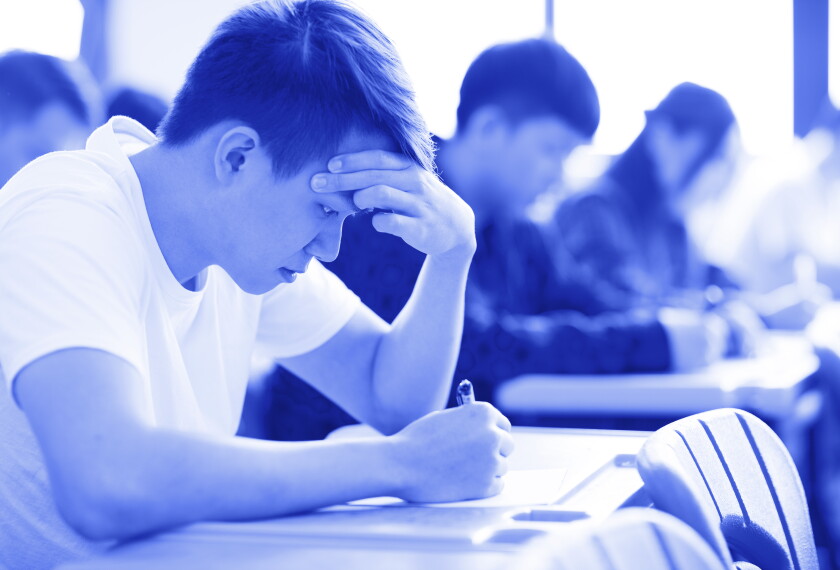
After the pandemic, Keri Rodriguez said she wasn’t too concerned about her son’s academic recovery—until out-of-school testing found he was performing at a 5th grade level in math at the end of 9th grade.
“I was being told from schools or from his report card or from his math teacher, you know, ‘He’s making progress. He’s getting there. Nothing to worry about.’ ” Rodriguez said, “Well, I have a lot to worry about. We’ve had to get to work and engage in a lot of rapid response to make sure that hopefully this year we can get [his academic progress] where it needs to be.”
Like Rodriguez’s son, older students nationwide may, in fact, be running out of time to recover academic progress lost during the pandemic, a new report argues. But financial and educational recovery efforts primarily focus on younger grades, and parents are often out of the loop.
That’s the conclusion of the Center for Reinventing Public Education’s State of the American Student report, released Wednesday morning.
Three and a half years after the start of the pandemic, “we all want things to be back to normal,” said Robin Lake, CRPE’s director. “But it’s clear that the pandemic is continuing to derail learning throughout K-12. … And that derailment is looking more insidious and hidden in some ways, especially for older students.”
“We think many students have already graduated without what they need, and that trend will continue unless we do things differently,” Lake said.
For its annual report, the nonprofit education policy research center at Arizona State University’s teachers college, analyzed data across a wide array of academic, social-emotional, and engagement indicators focusing on secondary students and their postsecondary trajectories. It also interviewed students nearing high school graduation and those in their first year of postsecondary school to get an idea of how the pandemic had affected their paths in education.
Morgan Polikoff, an associate professor of education at the University of Southern California and co-author of the report, noted that pandemic disruptions have hamstrung some 13.5 million high school students across four graduating classes.
Plummeting test scores, rising course failures
In addition to historically low math and reading scores on the National Assessment of Educational Progress, CRPE found spikes in high school course failure rates in districts around the country. In Houston, for example, the share of high school students who failed at least one class rose from 25 percent to 37 percent from 2018-19 to 2020-21, and similar increases in course failure in a separate study of North Carolina.
The rise in course failures has been significantly larger for Black and Hispanic students; the gaps in course failure rates between these students and Asian and white students are 10 percentage points wider than they were in 2019. In South Carolina, for example, white students were 12 percentage points more likely to fail a class by 2021 compared to before the pandemic, but course failure rates rose for Black and Hispanic students by 20 percent and 25 percent respectively. To put that in context, after the pandemic, nearly half of all middle and high school students in North Carolina failed at least one class in 2021.
In addition, average college placement scores for the ACT averaged 19.8 scale points out of 36, the first time average performance has fallen below 20 in more than 30 years.
“There are extremely concerning indicators around declining college readiness, and especially staggering and worsening inequalities,” Polikoff said.
Rodriguez, a co-founder and president of the National Parents Union, said school districts need to be more upfront with parents about their children’s academic status. For example, NWEA data finds the average 8th grader needs more than nine months of additional instruction to catch up to pre-pandemic achievement levels in math, and 7.4 months of instruction to make up for lost learning time in reading. But Rodriguez said 9 out of 10 parents believe their children are on track to graduate.
“Parents across the country are concerned about really getting accurate information so we can be a part of the solution,” she said.
Instead of asking high school seniors who are behind on credits to wait another year to graduate or attend a credit-recovery program—options which have not always proven popular with students and parents—CRPE recommended districts work with higher education to create academic “gap year” programs, which allow students to complete high school credit while also beginning to earn college credits.
“You know, ‘gap years’ are oftentimes known as a time for exploration for more advantaged kids,” Lake said. “Let’s change that, so it’s really a way to get kids back on track. It seems like an opportunity to really focus on career-relevant and college preparation opportunities for kids.”
In about a year, the last round of almost $200 billion in federal pandemic recovery funding will run out, and CRPE found most schools do not have procedures in place to ensure their intervention programs have served the students most in need academically, particularly in the older grades. One in 5 students reported their schools failed to give them mental health supports or individual instruction, according to a separate Gallup survey conducted this spring.
“The wind seems to be going out of academic recovery efforts just at a time when we think things are about to get much harder for schools and for teachers,” Lake said. “I keep thinking of this as a slow-moving train wreck … [with] very specific and real consequences for young people, for our economy, and for society.”


