Student Well-Being & Movement

Mentoring Milestone

November 30, 2004 1 min read
  • Save to favorites
  • Print

The YouthFriends mentoring program has been forging lasting bonds between K-12 students and adults for a decade.

And as it prepares to celebrate its 10-year anniversary on Jan. 18, program officials are looking back on some of those lasting bonds to honor a program that has grown from 613 volunteers in Kansas City, Mo., to 20,000 in Kansas, Michigan, and Missouri.

Nancy Parks, YouthFriends’ vice president of programs and communication, said one current college student—who started working with a YouthFriends mentor 10 years ago when the boy was in 3rdgrade—still meets weekly with his former mentor.

The initiative began in 1995 with a pilot project in six school districts in Kansas City, Mo. Today, Ms. Parks said, the almost 20,000 volunteers mentor about 135,000 students.
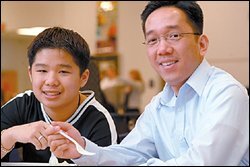
YouthFriends volunteer Minh Le, right, works with a Vietnamese student from Overland Park, Kan.

The one-on-one approach of YouthFriends and the consistency of the weekly meetings in schools can help build self-esteem for some students, she said.

Evaluations show that students with YouthFriends mentors show improvements in academic performance, school attendance, and feelings about school, according to Ms. Parks.

Volunteers meet with students on the school grounds during school hours. Some meet with them during lunch, while others meet during after-school activities.

Several YouthFriends volunteers use e-mentoring, an e-mail communication system in which they stay in touch with students and help them with schoolwork or decisions about future careers.

Sandi Hackman, a YouthFriends employee and volunteer, has been mentoring Claudia, a Mexican-born girl who moved to Missouri five years ago. At the time, Claudia did not speak a word of English. Now, the 4th grade girl is one of the best readers in her class.

Yet Claudia is not the only one who benefits from the weekly meetings.

“YouthFriends gave me a window to learn about a culture I did not know about,” Ms. Hackman said. “And I was happy to transfer my love of reading to someone else.”

Related Tags:

A version of this article appeared in the December 01, 2004 edition of Education Week

Events

This content is provided by our sponsor. It is not written by and does not necessarily reflect the views of Education Week's editorial staff.
Sponsor
Teaching Profession Webinar
Evaluation Beyond the Checkbox: Turning Ratings Into Teacher Growth
Ratings alone don’t help teachers improve. Join us Nov. 10 to hear what happens after the evaluation: feedback, follow-up, and growth.
Content provided by Frontline Education
This content is provided by our sponsor. It is not written by and does not necessarily reflect the views of Education Week's editorial staff.
Sponsor
Assessment Webinar
The Assessment Trust Crisis: How to Measure Learning in the Age of AI
AI is reshaping learning. Is assessment keeping up? Join this webinar to explore how to measure student thinking, not just right answers.
Content provided by Instructure
This content is provided by our sponsor. It is not written by and does not necessarily reflect the views of Education Week's editorial staff.
Sponsor
College & Workforce Readiness Webinar
From Student Trends to Counselor Action: Turning Insight Into Impact
Find out what is changing in how students approach planning for life after graduation and how schools can help.
Content provided by PowerSchool

EdWeek Top School Jobs

Teacher Jobs
Search over ten thousand teaching jobs nationwide — elementary, middle, high school and more.
View Jobs
Principal Jobs
Find hundreds of jobs for principals, assistant principals, and other school leadership roles.
View Jobs
Administrator Jobs
Over a thousand district-level jobs: superintendents, directors, more.
View Jobs
Support Staff Jobs
Search thousands of jobs, from paraprofessionals to counselors and more.
View Jobs

Read Next

Student Well-Being & Movement Opinion We’re Stuck on the Wrong Question About SEL in Early Childhood
A family therapist explores how to help children make sense of their emotions.
Erika Bocknek
•
5 min read
A grid of elementary school children expressing a wide variety of different emotions. SEL. Social Emotional Learning.
Vanessa Solis/Education Week + Getty
Student Well-Being & Movement Why It’s Getting Tougher to Serve School Meals Made From Scratch
Federal reimbursements aren't sufficient to support school meal programs.
3 min read
Collage showing a lunch tray with milk, a sandwich, an apple, and vegetables. The collage includes a green plate, a silver spoon, a triangle shape filled with a hundred dollar bill, and a 4 section pie chart.
Collage by Gina Tomko/Education Week + Canva
Student Well-Being & Movement Preventing Measles Outbreaks in Schools: Key Takeaways
Schools can insulate themselves from health risks through a combination of knowledge and prevention.
1 min read
A flyer is displayed at a Pennsylvania Department of Health measles vaccination clinic located in Lancaster County in Peach Bottom, Pa., Tuesday, Oct. 20, 2026.
Matt Rourke/AP
Student Well-Being & Movement Q&A Teaching Feelings at Age 4 Pays Off at 21, 20-Year Study Shows
Social-emotional learning in preschool is associated with better measures of well-being in young adulthood.
5 min read
Students sit during a TK class at First Street Elementary School in Los Angeles, on Wednesday, April 22, 2026.
Students sit during a transitional kindergarten class at First Street Elementary School in Los Angeles, on April 22, 2026. A new longitudinal study found that social-emotional learning in preschool is associated with better measures of well-being in young adulthood.
Ethan Swope/AP