Student Achievement

Longer COVID-Related School Closures Could Hurt Students’ Future Earnings

By Olivia Rockeman and Nic Querolo, Bloomberg News — October 26, 2021 1 min read
Empty desks in a dark classrooom
  • Save to favorites
  • Print

U.S. students who experienced the longest school closures during the pandemic will face lower future earnings and are less likely to go to college, a new study shows.

Comparing children from the top quartile of income distribution to those from the bottom quartile, welfare losses are about 0.8 percentage point larger for the poorer children, according to a paper circulated Monday by the National Bureau of Economic Research. That calculation doesn’t account for the fact that school closures were longer in richer counties, which would narrow the gap.

Secondary schools were closed for in-person learning for longer periods than elementary schools, meaning that students who started secondary school during the pandemic will endure the largest losses in their earning potential.

See Also

BRIC ARCHIVE
Design: Vanessa Solis/Education Week, Images: iStock

In some cases, students are returning to classrooms this school year for the first time since the beginning of the coronavirus outbreak. The average student may have lost months of instructional time, though the amount varies greatly by age, race and socioeconomic status.

Private-public divide

Private schools experienced shorter closures than public schools, so students at private schools — which typically attract individuals from wealthier backgrounds — are likely to have higher long-term earnings and college attainment.

That said, within public schools, poorer areas — especially in the South but also the Midwest — saw shorter school closures on average than more affluent regions on both coasts.

While children from poorer households are still worse off and might have been affected more severely by the COVID-19 crisis, shorter closures to their schools could mean that “their losses in human capital and lifetime earnings are more benign than those children from richer families,” the paper found.

See Also

8 landing hero
Stephanie Shafer for Education Week
Equity & Diversity Explainer Closing COVID-19 Equity Gaps in Schools
September 16, 2020
4 min read

Many districts are planning to tap federal COVID-19 stimulus funds to pay for support like hiring additional staff, tutoring, new technology, mental-health support or trying to find students who dropped off rosters.

This year, at least 624 districts have been affected by closures in 2,359 schools, though the pace has slowed since late August, according to Burbio, which tracks school closures. The highest share of disruption has been in Kentucky, Tennessee, and Georgia.

Copyright (c) 2021, Bloomberg News. Distributed by Tribune Content Agency.

Events

Jobs Regional K-12 Virtual Career Fair: DMV
Find teaching jobs and K-12 education jubs at the EdWeek Top School Jobs virtual career fair.
This content is provided by our sponsor. It is not written by and does not necessarily reflect the views of Education Week's editorial staff.
Sponsor
Artificial Intelligence Webinar
Making AI Work in Schools: From Experimentation to Purposeful Practice
AI use is expanding in schools. Learn how district leaders can move from experimentation to coordinated, systemwide impact.
Content provided by Frontline Education
This content is provided by our sponsor. It is not written by and does not necessarily reflect the views of Education Week's editorial staff.
Sponsor
Student Well-Being & Movement Webinar
Building Resilient Students: Leadership Beyond the Classroom
How can schools build resilient, confident students? Join education leaders to explore new strategies for leadership and well-being.
Content provided by IMG Academy

EdWeek Top School Jobs

Teacher Jobs
Search over ten thousand teaching jobs nationwide — elementary, middle, high school and more.
View Jobs
Principal Jobs
Find hundreds of jobs for principals, assistant principals, and other school leadership roles.
View Jobs
Administrator Jobs
Over a thousand district-level jobs: superintendents, directors, more.
View Jobs
Support Staff Jobs
Search thousands of jobs, from paraprofessionals to counselors and more.
View Jobs

Read Next

Student Achievement Spotlight Tutoring Works…When It’s Done Right
Well-designed high-dosage tutoring boosts reading, math, and STEM interest, proving that targeted support drives real recovery gains.
Student Achievement The ‘Pandemic Babies’ Are Now in 1st and 2nd Grade. How Are They Doing?
Achievement is still lower for kids who were toddlers during the pandemic—even though they didn't experience school closures.
3 min read
A second grader works on math problems at Place Bridge Academy, May 20, 2025, in Denver.
A second grader works on math problems at a school on May 20, 2025, in Denver. New research shows that children born during the pandemic who are now in 1st and 2nd grades, are showing slightly lower growth than other cohorts.
Rebecca Slezak/AP
Student Achievement These Districts Turned Summer School Into an Inviting Destination for Students
Community partnerships helped with scheduling challenges. Themed programs heightened student interest.
6 min read
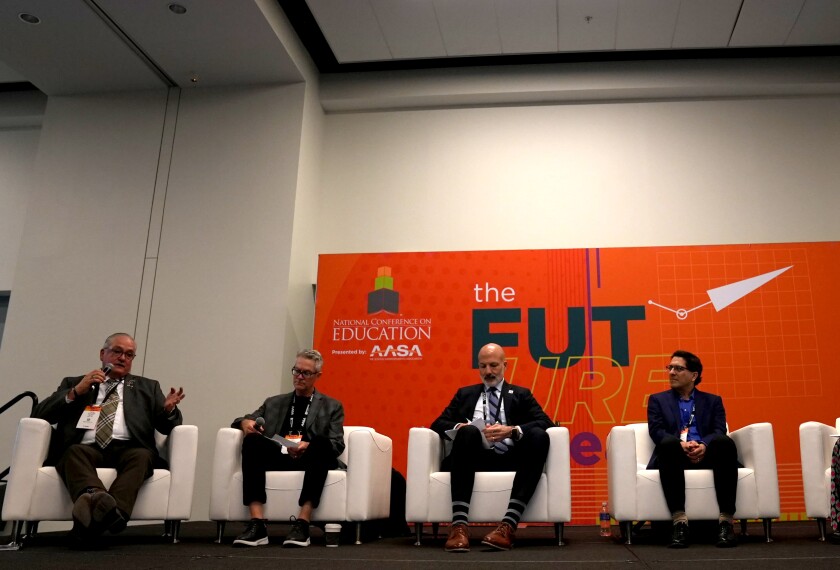
Panelists from left: Carlos Gonzalez, superintendent of the Roma Independent district in Texas; John Skretta, superintendent of Lincoln, Neb., schools; Joe Gothard, superintendent of Madison, Wis., schools; Ben Master, a senior policy researcher at the RAND Corp. speak on summer learning and student success at the National Conference on Education in Nashville, Tenn. on Feb. 13, 2026.
School superintendents, from left, Carlos Gonzalez, of Roma Independent in Texas; John Skretta, of Lincoln, Neb., and Joe Gothard, of Madison, Wis., along with Ben Master, a senior policy researcher at the RAND Corp., discuss summer learning and student success at the National Conference on Education in Nashville, Tenn., on Feb. 13, 2026.
Kaylee Domzalski/Education Week
Student Achievement The Case for Reading Tutoring Before 3rd Grade, Not After
New research suggests virtual tutoring can boost literacy learning before kids begin to struggle.
6 min read
First-graders in Chelsea, Mass. public schools meet with virtual tutors from Ignite Reading in 2025 as part of a study of the program.
First graders in Kelly Elementary School in Chelsea, Mass. meet with virtual tutors from Ignite Reading in 2025 as part of a study of the program. The Chelsea district is now targeting 1st graders for tutoring to make sure all of them meet reading benchmarks by the end of the year.
Courtesy of Chelsea Public Schools
