
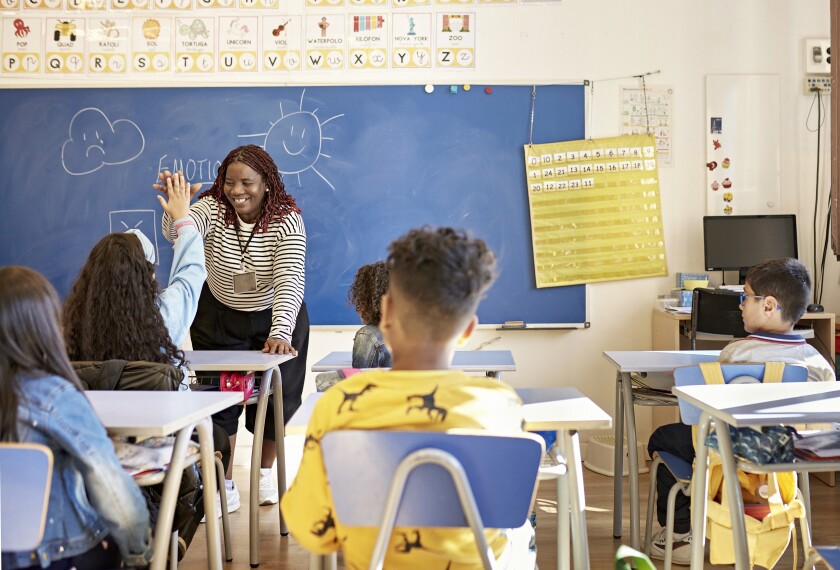
How much time should educators spend during the school day helping students develop healthy social and emotional skills?
It’s an important question as school districts across the country invest more money in social-emotional learning programs and some communities face parent pushback against those efforts. Plus, local and state policies—as well as differing levels of sophistication in how social-emotional learning is integrated at the classroom level into academic subjects—make the question difficult to answer.
“There isn’t a time limit for it,” said Juany Valdespino-Gaytán, executive director of engagement services for the Dallas Independent School District. “When we talk about social-emotional learning in Dallas, we’re not talking about SEL happening at one time of the day. SEL has to be taught and embedded throughout the entire day in order for students to really have the opportunity to develop those skills and apply these skills to everyday life.”
That may be the case in Dallas. But in a national survey of district leaders, principals, and teachers across the country by the EdWeek Research Center last year, about 85 percent said one hour should be the maximum amount of time devoted to social-emotional learning per day.
In interviews with Education Week, social-emotional learning experts said that spending some classroom time explicitly teaching social-emotional skills is important, but what matters even more is effectively integrating the skills—such as time management, collaboration skills, and responsible decisionmaking—into everything that students are learning in school and in after-school programs.
“Social-emotional learning can be applied in a lot of different ways,” said Justina Schlund, senior director of content and field learning for the Collaborative for Academic, Social and Emotional Learning or CASEL. “I often describe this by looking at three things: One, are there some really intentional efforts to build positive relationships among teachers and students? Two, is there some dedicated time to teach social and emotional skills? And three, are there really intentional efforts to integrate social and emotional learning practices throughout academic instruction?”
School district leaders also recognize that social-emotional learning needs to not only be taught explicitly at times but also be embedded throughout the school day. And some even said an hour a day would be excellent.
“Well, if we had an hour a day to explicitly support SEL, that’d be amazing,” said Jill Bryant, assistant director of social-emotional learning for the Portland Public Schools in Oregon. “But then I would just go a step beyond that. It really needs to be woven into the fabric of everything we do all day, even after-school programs as well.”

Valdespino-Gaytán pointed out that educators might be more likely to dismiss SEL or say only an hour or less should be devoted to it if they don’t understand how social-emotional skills can be integrated into the lessons they’re already teaching.
It’s not only during “circle time” in the early elementary grades that students are building their social-emotional skills. Before students take a test, teachers can teach them techniques to calm themselves; before working in teams, students can talk about what makes a good team member; when discussing a story, students can reflect on how they connected to it personally.
There are still some people “who silo SEL in a way that I wouldn’t like to see,” said Lynn Lawrence, SEL and mentoring coordinator for LaGrange School District 102 in Illinois. “They’re going to do that circle, check it off, and then do the rest of the day. Trying to get everybody to see that this is just the way we approach everything, this is our lens through which we view everything, is still something we continue to work on.”
Teachers struggle to find the time to fit anything new into their days
Time might be the biggest challenge for teachers when thinking about how to integrate SEL into their lessons.
Consider, for instance, that the typical teacher works 54 hours a week and just under half that time is spent directly teaching students, according to the 2022 Merrimack College Teacher Survey that was conducted by the EdWeek Research Center.
“Time’s the most finite resource we have, really, even more than money,” said Mary Tavegia, a professional learning lead for the Center for the Collaborative Classroom, which develops literacy and SEL programs. “We can always try to get some grants and get more money, but you can’t get more time. That is something we hear from educators all the time.”
District leaders agreed. Valdespino-Gaytán said a lot of teachers are probably more worried about the core content that students are being tested on and that teachers are being held accountable for than the potential SEL skill development that could be integrated into those lessons.
Bryant said that if districts are emphasizing explicit SEL instruction as opposed to integrating it across the curriculum, then it makes sense when teachers voice concerns about not having enough time.

Reframing the thinking to weave SEL into academic content
If districts “reframe” their thinking and see that SEL is “woven into everything that we do in creating those conditions for students to thrive,” then the priority stops becoming about the number of minutes spent on SEL, Bryant said. Instead it just “becomes how we do things” and then can have “a more sustaining and significant impact for students and staff.”
According to CASEL research, students participating in SEL programs showed improved classroom behavior. District leaders who spoke to Education Week have seen similar effects.
If kids are feeling like they belong, if they’re feeling more cared for, and if they’re feeling more respected, then they are willing to cooperate with their teachers or peers, said Jennifer Heckmann, an instructional coach for the Vinton-Shellsburg Community School District in Iowa.
Before working at the Center for the Collaborative Classroom, Tavegia was a principal at an elementary school in Illinois. She said when the school started implementing an SEL program, many teachers were concerned about not having enough time to get it done. But after a semester, she said teachers found that they had gotten “further and deeper into the curriculum” because students were learning how to better manage themselves.

Data analysis for this article was provided by the EdWeek Research Center. Learn more about the center’s work.


