Student Well-Being & Movement From Our Research Center

How Much High Schoolers Think Their Educators Care About Them

By Arianna Prothero — April 26, 2024 2 min read
Horizontal banner image of group of multiracial teenage high school students standing against blue background wall. Student belonging.
  • Save to favorites
  • Print

Schools are earning mixed reviews from high school students on two key indicators of how well they encourage a sense of belonging.

That’s according to a recent survey by the EdWeek Research Center, which polled a nationally representative sample of 1,056 students in grades 9-12 in February and March.

The survey asked students whether the adults in their school care about their well-being and success and whether students feel like they are accepted and welcomed in their school community.

Although more than half of students answered positively to both questions, there are some concerning trends in the data. A significant proportion of students indicated that they feel disconnected—a troubling sign given the challenges schools are facing with student disengagement and chronic absenteeism.

A majority of students—57 percent—say the adults in their school care about them at least a moderate amount, but 1 in 5 students say the adults care little or not at all about their well-being and success.

Students are much more likely to say they feel accepted and welcomed in their school community overall, with 86 percent agreeing with that statement. That percentage drops slightly for students who are not heterosexual or students who come from low-income families.

Students who feel connected to school are more likely to attend and perform well and less likely to misbehave and feel sad and hopeless. There are even health benefits well into adulthood linked to a strong connection to school as an adolescent.

Schools are using a variety of strategies to bolster a sense of belonging among their students.
See also

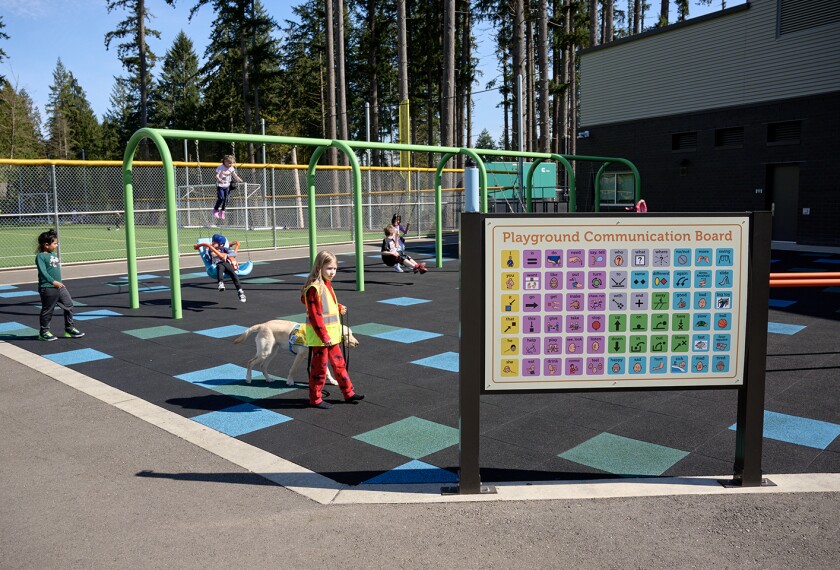
Students at Ruby Bridges Elementary School in Woodinville, Wash., play during recess on April 2, 2024. Students have access to cards with images and words on them so all students, including those who do not speak, can communicate on the playground.
Meron Menghistab for Education Week

Educators at Thomas Kelly College Preparatory have homed in on freshman year as a key time to make sure students have a strong connection to the Chicago high school.

“If you’re a 9th grader, nothing is more important to you than belonging,” Grace Gunderson, a counselor at the 1,700-student school who leads its newly formed freshman success team, said in a recent Education Week special report. “If we can get those kids involved in band, or ‘Hey, I play on the soccer team,’ or ‘Hey, I always eat lunch in Ms. Gunderson’s office,’ now, they have a connection. They have a reason to keep coming to school.”

The 2021 Youth Risk Behavior Survey, which is administered by the U.S. Centers for Disease Control and Prevention, found that students feeling connected to their school was associated with a lower prevalence of several risk factors, such as poor mental health, drug use, and missing school because students felt unsafe. In that survey, 61 percent of high schoolers reported feeling connected to peers and the adults in their schools.

A more recent survey of middle and high school students by YouthTruth, a nonprofit that surveys students and families for school districts, asked specifically about students’ connections to their teachers. The results of that survey aligned closely with the EdWeek Research Center findings.

On both of the survey questions, the EdWeek Research Center’s analysis did not find any statistically significant differences among students by race or gender.

Taken together, the data in the charts below show that while high schools have room for improvement in ensuring that all students feel that they belong and are connected to the adults in their schools, there is a solid foundation to build from.

education week logo subbrand logo RC RGB

Data analysis for this article was provided by the EdWeek Research Center. Learn more about the center’s work.

Events

This content is provided by our sponsor. It is not written by and does not necessarily reflect the views of Education Week's editorial staff.
Sponsor
Artificial Intelligence Webinar
Managing AI in Schools: Practical Strategies for Districts
How should districts govern AI in schools? Learn practical strategies for policies, safety, transparency, and responsible adoption.
Content provided by Lightspeed Systems
This content is provided by our sponsor. It is not written by and does not necessarily reflect the views of Education Week's editorial staff.
Sponsor
Student Absenteeism Webinar
Removing Transportation and Attendance Barriers for Homeless Youth
Join us to see how districts around the country are supporting vulnerable students, including those covered under the McKinney–Vento Act.
Content provided by HopSkipDrive
This content is provided by our sponsor. It is not written by and does not necessarily reflect the views of Education Week's editorial staff.
Sponsor
Reading & Literacy Webinar
Two Jobs, One Classroom: Strengthening Decoding While Teaching Grade-Level Text
Discover practical, research-informed practices that drive real reading growth without sacrificing grade-level learning.
Content provided by EPS Learning

EdWeek Top School Jobs

Teacher Jobs
Search over ten thousand teaching jobs nationwide — elementary, middle, high school and more.
View Jobs
Principal Jobs
Find hundreds of jobs for principals, assistant principals, and other school leadership roles.
View Jobs
Administrator Jobs
Over a thousand district-level jobs: superintendents, directors, more.
View Jobs
Support Staff Jobs
Search thousands of jobs, from paraprofessionals to counselors and more.
View Jobs

Read Next

Student Well-Being & Movement Opinion Is Your School’s SEL Strategy Working? The Questions Every Educator Should Ask
The evidence for social and emotional learning is strong, but the field is messy.
Christina Cipriano
5 min read
Figures tend to a student shaped garden
Mary Hassdyk Vooys for Education Week
Student Well-Being & Movement School Counselors See Rising Trauma Linked to Immigration Enforcement
The school staff whose job it is to support students say they see major signs of emotional distress.
6 min read
Students take a recess break outside of St. Paul district school in St. Paul, MN, February 23, 2026.
Students take recess outside an elementary school in St. Paul, Minn., on Feb. 23, 2026.
Tim Evans for Education Week
Student Well-Being & Movement Looking for SEL's Benefits? Good Implementation Is Key, Experts Say
How well an SEL program is implemented is critical for achieving the outcomes that research promises.
6 min read
Students visit the Alaqua Animal Rescue in Freeport, Fla., for an SEL-based curriculum on Aug. 23, 2025.
Students visit the Alaqua Animal Rescue in Freeport, Fla., for an SEL lesson on Aug. 23, 2025. Social-emotional learning can be a powerful tool for boosting student engagement and improving behavior and academic performance, but experts say it has to be implemented well.
Micah Green for Education Week
Student Well-Being & Movement Millions of Students Attend Schools Near Toxic Sites, a New Study Shows
The study explores schools' proximity to hazardous sites and students' exposure to pollutants.
4 min read
The Fifth Ward Elementary School and residential neighborhoods sit near the Denka Performance Elastomer Plant, back, in Reserve, La., Friday, Sept. 23, 2022. Less than a half mile away from the elementary school, the plant makes synthetic rubber, emitting chloroprene, listed as a carcinogen in California, and a likely one by the Environmental Protection Agency.
The Fifth Ward Elementary School and nearby residential neighborhoods in Reserve, La., pictured here on Sept. 23, 2022, sit near a synthetic rubber plant that has emitted chloroprene, which California lists as a carcinogen. New research finds thousands of schools are located within a quarter mile of such environmental hazard sites.
Gerald Herbert/AP
