Student Well-Being & Movement

Gay Student To Get Nearly $1 Million in Settlement

By Linda Jacobson — November 27, 1996 2 min read
  • Save to favorites
  • Print

In a widely watched civil case that both sides agree has far-reaching implications, a northern Wisconsin school district agreed last week to pay nearly $1 million to a young man who says he was victimized by fellow students because he is gay.

The settlement agreement came after a federal court jury found that administrators in the 2,400-student Ashland district failed to protect Jamie Nabozny from verbal and physical abuse while he was a student there.

Mr. Nabozny will receive $900,000, plus up to $62,000 for potential medical expenses related to injuries he suffered while he was a student.

The Nov. 19 verdict in the U.S. District Court in Eau Claire was the first time a federal jury found school officials responsible for anti-gay harassment committed by students, experts said last week.

Lawyers for Mr. Nabozny and gay-rights advocates hailed the decision as a victory for homosexual students.

“I’m very glad that the truth came out. Now I can go on with my life,” Mr. Nabozny said in a written statement. “I feel like I have justice, and that this means justice for all other kids out there who aren’t sure if they should stay in school or stay alive.”

The jury, however, found no liability on the district’s part, instead faulting the three administrators named in the lawsuit.

District ‘Surprised’

Mr. Nabozny, now 21, alleged that the harassment by fellow students, which he said led him to attempt suicide, began when he was a student at Ashland Middle School in 1988 and continued until he dropped out of Ashland High School in 1993.

In addition to verbally abusing Mr. Nabozny, other students kicked and urinated on him, and in one incident, pretended to rape him in a classroom, his lawsuit said. One attack left him in need of surgery.

Mr. Nabozny’s lawsuit claimed that his middle school principal told him that if he was going to be openly gay, he should expect such treatment.

Represented by the Lambda Legal Defense and Education Fund, a New York City-based gay-rights advocacy organization, Mr. Nabozny filed the suit last year against the school system and the three administrators.

Mr. Nabozny eventually earned a high school equivalency diploma and now lives in Minneapolis. He said in his statement that he hopes “to go to college and have the normal educational experience that I waited a long time for.”

Throughout the case, school officials maintained that they had tried to protect Mr. Nabozny and had allowed him to change his schedule and use a private restroom to avoid the students who were harassing him.

The district also had a policy that protected students, including those who are gay, from discrimination.

‘Surprised and Disappointed’

In an interview last week, Superintendent Steve Kelly said he was pleased that the jury recognized that fact in finding no liability on the district’s part. But, he added, “we are surprised and disappointed that the jury did not come out in support of our administrators.”

Mr. Kelly said the case is precedent-setting for other reasons.

“This has implications for a lot of school districts, if name-calling can become discrimination and can result in a lawsuit,” he said. “This could have happened in any district across the country.”

In October of last year, U.S. District Judge John C. Shabaz said that the school system was not responsible for protecting Mr. Nabozny from “private violence.”

But that ruling was overturned last summer on appeal by the Chicago-based U.S. Court of Appeals for the 7th Circuit and sent back to the district court for trial. (“Gay Student’s Suit Against Wis. District Reinstated,” Sept. 4, 1996.)

A version of this article appeared in the November 27, 1996 edition of Education Week as Gay Student To Get Nearly $1 Million in Settlement

Events

This content is provided by our sponsor. It is not written by and does not necessarily reflect the views of Education Week's editorial staff.
Sponsor
Artificial Intelligence Webinar
Managing AI in Schools: Practical Strategies for Districts
How should districts govern AI in schools? Learn practical strategies for policies, safety, transparency, and responsible adoption.
Content provided by Lightspeed Systems
This content is provided by our sponsor. It is not written by and does not necessarily reflect the views of Education Week's editorial staff.
Sponsor
Reading & Literacy Webinar
Two Jobs, One Classroom: Strengthening Decoding While Teaching Grade-Level Text
Discover practical, research-informed practices that drive real reading growth without sacrificing grade-level learning.
Content provided by EPS Learning
Jobs Virtual Career Fair for Teachers and K-12 Staff
Find teaching jobs and K-12 education jubs at the EdWeek Top School Jobs virtual career fair.

EdWeek Top School Jobs

Teacher Jobs
Search over ten thousand teaching jobs nationwide — elementary, middle, high school and more.
View Jobs
Principal Jobs
Find hundreds of jobs for principals, assistant principals, and other school leadership roles.
View Jobs
Administrator Jobs
Over a thousand district-level jobs: superintendents, directors, more.
View Jobs
Support Staff Jobs
Search thousands of jobs, from paraprofessionals to counselors and more.
View Jobs

Read Next

Student Well-Being & Movement Millions of Students Attend Schools Near Toxic Sites, a New Study Shows
The study explores schools' proximity to hazardous sites and students' exposure to pollutants.
4 min read
The Fifth Ward Elementary School and residential neighborhoods sit near the Denka Performance Elastomer Plant, back, in Reserve, La., Friday, Sept. 23, 2022. Less than a half mile away from the elementary school, the plant makes synthetic rubber, emitting chloroprene, listed as a carcinogen in California, and a likely one by the Environmental Protection Agency.
The Fifth Ward Elementary School and nearby residential neighborhoods in Reserve, La., pictured here on Sept. 23, 2022, sit near a synthetic rubber plant that has emitted chloroprene, which California lists as a carcinogen. New research finds thousands of schools are located within a quarter mile of such environmental hazard sites.
Gerald Herbert/AP
Student Well-Being & Movement 3 Driving Questions to Create a Sense of Belonging in Schools
Students who feel they belong in their school are more likely to show up and learn.
5 min read
MVCS 1981
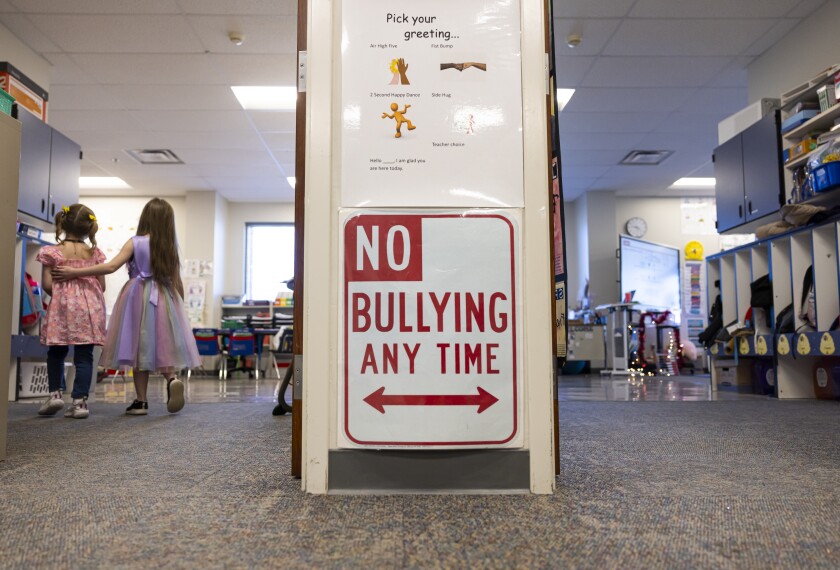
A sign discouraging bullying is seen as two students walk into a classroom at a school in Colorado Springs, Colo., on Feb. 12, 2026. Experts say creating a sense of belonging in school can help curb problems like bullying.
Kevin Mohatt for Education Week
Student Well-Being & Movement Opinion Why a Good School Needs Both Coaches and Referees
If teachers are forced into being referees, they can't fill that role properly or coach well, either.
6 min read
The United States Capitol building as a bookcase filled with red, white, and blue policy books in a Washington DC landscape.
Luca D'Urbino for Education Week
Student Well-Being & Movement Q&A Cellphones: The 'Most Formidable Adversary' Schools Have Ever Faced
The Spokane schools in Washington paired cellphone restrictions with expanded extracurricular activities.
5 min read
Students at Glover Middle School in Spokane, Wash. make bookmarks and snowflakes during Falcon Time on Dec. 3, 2025.
Students at Glover Middle School in Spokane, Wash. make bookmarks and snowflakes during Falcon Time on Dec. 3, 2025. The district has sought to encourage students to spend less time on devices.
Kaylee Domzalski/Education Week
