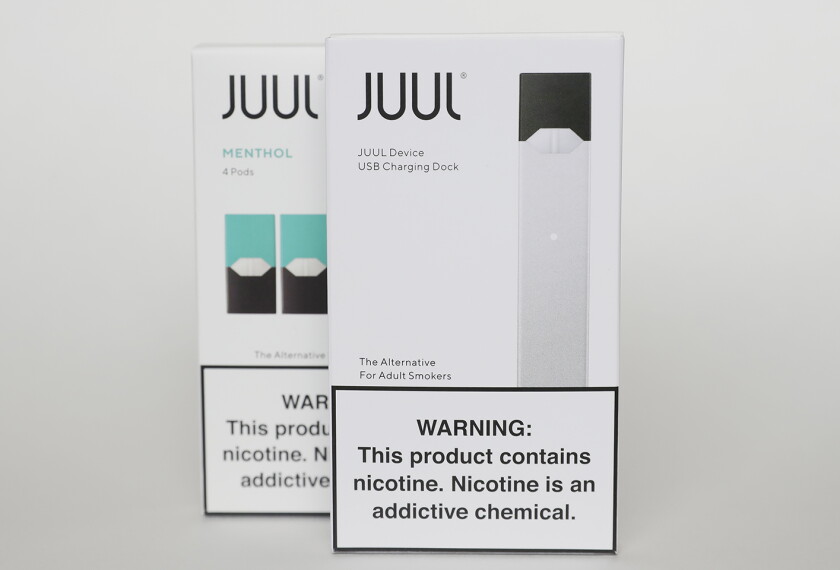
Updated: The FDA’s ban on Juul e-cigarettes is now on hold pending “additional review”. Read more.
The federal Food and Drug Administration’s order that the e-cigarette maker Juul remove its products from the shelves after denying the company’s application to continue selling its products in the country drew applause from school districts and others that have opposed Juul and other e-cigarette companies.
More than 100 districts have accused the companies of targeting youths and saddling school systems with a host of expenses associated with combating rising nicotine use among students.
“Ecstatic” was how Rob Anderson, the superintendent of Boulder Valley School District, in Boulder, Colo., described his response to news of the FDA’s Thursday action. The school system is among those suing Juul.
“We just had significant concerns on the impact of Juuling on the health of our youth and the health of our country,” Anderson said. “So I’m very excited that the FDA came out with their ruling today. I feel like this is a win for families across the country.”
Still, Anderson said, school districts should continue educating students and communities about the impact of nicotine addiction and working in their communities to change local policies.
“We continue to move forward,” Anderson said. “I think that this is evidence that folks are listening. They are listening to educators. They are listening to parents. They are listening to families and students that have been negatively impacted by Juul and Juul-like products. I think we need to continue to press forward to ensure that our kids aren’t exposed to these products.”
Questions about safety
The FDA said the company’s application left lingering questions about the company’s products’ safety.
The agency, said in part, that it “determined that the applications lacked sufficient evidence regarding the toxicological profile of the products to demonstrate that marketing of the products would be appropriate for the protection of the public health.”
As a result of the the FDA’s decision, Juul cannot sell its Juul device along with its tobacco- and menthol-flavored pods.
Juul has indicated that it will appeal the decision. The company’s website said that its products are meant to give adult users an alternative to traditional cigarettes.
Joe Murillo, the company’s chief regulatory officer, said the company disagreed with the FDA, saying that the company provided data to the agency to demonstrate the products met safety standards.
“We intend to seek a stay and are exploring all of our options under the FDA’s regulations and the law, including appealing the decision and engaging with our regulator,” Murillo said in a statement.
Schools struggled to respond to e-cigarette use
E-cigarettes appeared on the market about a decade ago, according to the Associated Press. Their popularity exploded with adults who were trying to quit smoking, but also among young people attracted by flavored nicotine products.
By 2018, after years of successful anti-tobacco campaigns that drove down smoking and nicotine use among teens, school and K-12 health officials soon found themselves in the throes of what the federal government later labeled a youth e-cigarette epidemic.
The small devices were easy to hide, making it hard for teachers to detect them or distinguish them from common USBs.
Districts, such as Boulder Valley, deployed school nurses and teamed up with county health officials on aggressive education campaigns. Other school systems found themselves laying out large sums of money to install vaping detectors in bathrooms and hallways to alert administrators to on-campus vaping and for counselors and nicotine-treatment programs.
Just before the pandemic forced districts into remote schooling, nearly 100 school systems—from Los Angeles, the nation’s second-largest, to La Conner on the Skagit Bay in Washington state—had filed lawsuits in state and federal courts across the country against Juul, PAX Labs, the progenitor of Juul; Altria, a tobacco company that owns a large stake in Juul; and New Jersey-based e-cigarette maker Eonsmoke.
Donna J. Mazyck, the executive director of the National Association of School Nurses, which has developed education and prevention programs and a toolkit for school nurses to help combat nicotine use in their communities, said the FDA’s decision to ban Juul products was good news.
“I think it’s a strong message that the FDA is looking at what doesn’t meet their approval,” Mazyck said. “It’s encouraging in that the FDA is doing the work they need to do to protect the health of the public.”
“It’s a teachable moment,” she continued. “It’s an opportunity for adults who are in the lives of youth to speak to them about why they would be using tobacco products. And if it’s because of stress, depression, and anxiety, to address the root issue. If it’s because it’s a cool thing to do or they are mimicking others who are using tobacco products, to help them really understand what tobacco use does.”
Mazyck said the organization will continue its advocacy to ban flavored e-cigarettes, educate students on marketing tactics, and work to eliminate nicotine use among youngsters.
“There is no moment to stop,” she said.
“We believe that the advocacy goes beyond a company,” she continued. “It’s at the very root of how young people are marketed to become tobacco product users, and that’s what we are against and we’ll continue to advocate against that.”
While Juul continues to be popular, it appears to have lost market share among middle and high schoolers, according to the Associated Press.
The FDA’s action this week followed recent federal scrutiny of the company over whether Juul’s products targeted young people. In 2019, Juul stopped marketing fruity and dessert flavors, which were popular with students, according to the Associated Press. That same year, Congress increased the age to buy tobacco and vaping product to 21.
“I think Juul is probably the most recognized brand, and so I think that matters,” Anderson, the Boulder Valley superintendent, said. “Ultimately, I think that we’ll have to continue to fight, whether it’s Juul or whether another company tries to step into its place. I think that this is a fight that will continue on.
“But I think focusing on Juul which was the name brand [ is important],” he said. “The kids were calling it Juuling; they weren’t even calling it vaping. That’s a huge step in the right direction.”