Separated From Peers And Teachers, Students More Prone to Drop Out
Shuttered schools across the country, amid the coronavirus crisis, have turned to online learning to help students keep up with their coursework. But experts worry that their physical absence will take another toll: dropping out.
Little is known about how previous epidemic-related closures affected students’ long-term school trajectories; most studies have focused on shorter-term effects rather than dropout rates, which may show up months or years later. But significant research finds absenteeism increases the likelihood students will eventually disengage and drop out of school, and schoolwide closures for other reasons—such as natural disasters—have also been found to lower academic progress and graduation rates.
“School has two parts; it has experience and instruction,” said Sandy Addis, associate director of the National Dropout Prevention Center. “Right now, we have a hodgepodge of virtual learning systems in schools, trying to address the instruction side. The experience side of school is almost totally on hold.”
Teachers at Robbinsdale Armstrong High School, outside Minneapolis, have a plan to counter that. Before shutting down March 13 in response to a potential case of COVID-19, they and staff members met one last time in person—keeping six feet apart—to brainstorm ways to keep their students connected.
“The idea is to try to find ways that, once a week at the minimum, you’re doing some sort of face-to-face where the students can hear you talking and they can respond to you in conversation,” said Anne Beaton, an Advanced Placement teacher and coordinator of a program that creates teams of teachers and staff to support students.
Plus, “We’re going to really prompt the students to be reaching out to their classmates, because we also know that there are certain kids who don’t get the same amount of connection when they’re not in the physical space of school.”
Lengthy School Closures a Costly Endeavor
Closing schools can be one of the most effective ways to stop the spread of infectious diseases. But for COVID-19, research suggests school and public-health leaders will have to weigh those potential benefits against the costs of keeping children’s parents home, too.
kids,” said Joshua Epstein, an epidemiology professor at New York University’s school of global public health.
cost the U.S. economy some $50 billion, or nearly a quarter of 1 percent of the gross domestic product, according to a new analysis by Epstein and Ross Hammond, an associate professor of public health and social policy at Washington University in St. Louis and the Brookings Institution.
The economic pain would fall hardest on poor and working=class families, the researchers noted. Not only are they in minimum-wage construction, retail, and other fields unable to telecommute and less likely to have flexible leave policies, but their children are more likely to use school meals, campus wellness centers, and other school-based supports.
“One thing you don’t want to do is have the parents have no paid leave and they have to go to work—and so the kids go home and stay with their grandparents,” Epstein said.
“That’s your most vulnerable group. ... If there’s a way to offer people paid leave or relieve that pressure or find a way to avoid sending the kids home to elderly people, that would be very useful.”
In prior outbreaks of pandemic influenza, children were especially vulnerable to catching and spreading the disease, so closing schools helped slow the contagion and delay its peak, giving medical practitioners time to catch up. But the Centers for Disease Control and Prevention so far has found closing schools for less than four weeks has not been effective at either limiting the spread of the new coronavirus or hospitalizations related to COVID-19. If children do not turn out to be the main vectors for the disease, Epstein said, then closing schools may even hurt the effort to slow outbreaks.
“One of the most affected sectors is health-care workers, because it’s predominantly women, many with school-age kids,” he said. “Many of them are low- and middle-income. ... It’s not the kind of job you can do over the phone. And so those are real losses to the health-care workforce.”
Even Supreme Court Justices Take Back Seat to COVID-19
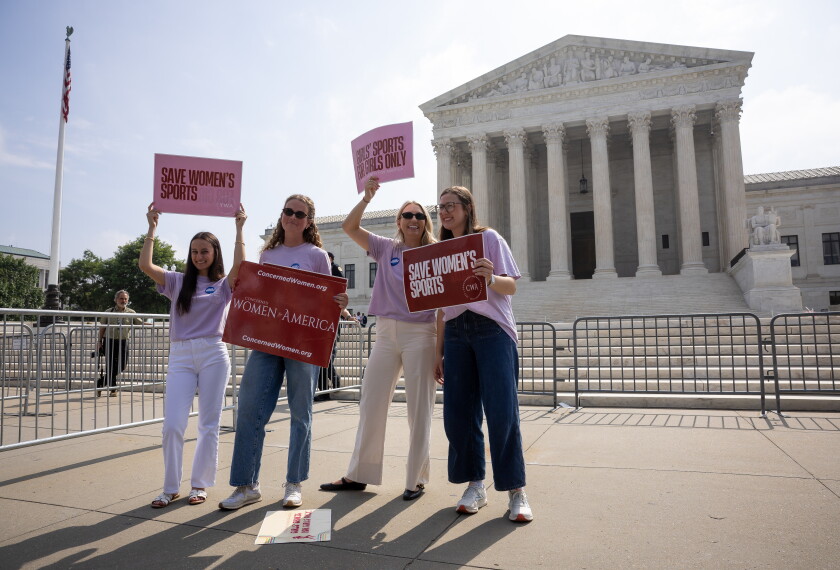
Because of coronavirus concerns, the U.S. Supreme Court has postponed arguments about religious bias in schools that had been scheduled for next week.
The court had planned to hear one hour of argument on April 1 about whether religious schools are exempt from employment-discrimination claims brought by lay teachers. At issue are two consolidated cases from the Roman Catholic Archdiocese of Los Angeles about whether the so-called ministerial exception to employment-discrimination laws for churches and religious schools applies to claims brought by two Catholic school teachers. The teachers involved each taught 5th grade, including daily religious instruction for their students.
The ministerial-exception doctrine says church and religious school employers are exempt from anti-discrimination laws for employees who are deemed to be ministers of the faith.
One teacher alleged that age discrimination motivated her ouster, while the other sued under the Americans with Disabilities Act of 1990, claiming she was fired after informing administrators that she had breast cancer and would have to take time off for surgery and chemotherapy.
Educators have also been awaiting decisions in other cases of interest, including those involving a Montana tax-credit program for donations to private school scholarships; cases about whether federal civil rights laws cover gay and transgender employees; and a case about whether President Donald Trump’s administration properly rescinded the immigration program known as DACA, or Deferred Action for Childhood Arrivals.
Several justices are at an age for which the U.S. Centers for Disease Control and Prevention have recommended precautions to avoid the coronavirus. Justice Ruth Bader Ginsburg just turned 87, and Justice Stephen G. Breyer is 81.
The court’s announcement noted that the postponement of arguments was not unprecedented. In 1918, the court pushed back arguments for a month because of the flu pandemic, and arguments in 1793 and 1798 were postponed because of outbreaks of yellow fever.