

Middle and high schools often favor setting aside a block in students’ schedules for something a little less structured—and a lot less academic—than a traditional class period.
The reoccuring blocks—often called advisories—are adopted as a way to strengthen relationships and help students weather the challenges that may keep them from succeeding academically, including a lack of routines, social isolation, and out-of-school issues that can bleed into the school day.
But problems in the way advisories are designed and carried out can keep them from being a meaningful part of a student’s school experience, educators and researchers say.
If a school wedges an advisory into its master schedule as “just another thing to do” or a panacea for its school climate problems, students aren’t likely to experience the level of vulnerability necessary to have meaningful conversations or shared experiences there, said Rachel Poliner, a Massachusetts consultant who helps schools design advisory programs.
And teachers themselves need direction and training to support their students in those efforts, a task that can also make adults feel vulnerable at times, she said. Otherwise advisories are likely to look like academic class periods without the academics—desks in rows, teachers leading discussions and activities, and students lacking interest.
“As adults we have a lot of routines and rituals in our lives that keep us organized, healthy, connected to family and friends, and eating the right things, and kids don’t have those yet,” Poliner said. “So if advisory could be a place where you actually figure out the routines and rituals that would make their lives better, and involve students in crafting them, and then practice them a lot, wouldn’t that be more authentic?”
Getting It Right
Done well, advisories are designed around the needs of students, giving them the freedom to shape their experiences and the space to express their fears, hopes, and needs, she said, and that kind of model takes planning and resources. To get advisories right, schools need to offer ongoing professional development and support to teachers who may be uncomfortable with the format, and they need to integrate them into larger school strategies, Poliner said. And they need to be thoughtful about what they’re hoping to accomplish by adopting advisories—allowing that purpose to drive decisions about issues like the duration and frequency of advisory periods and how long cohorts of students remain grouped together.
The staff at Wayland Middle School in Wayland, Mass., went through such a planning process in designing its current version of advisories. Administrators lengthened the scheduled time from 25 to 40 minutes, put two adults in every classroom, and integrated advisory groups into academic and social-emotional learning themes that drive projects and activities. The groups emphasize BERT, which stands for Belonging, Empathy, Respect, and Trust.
The center of the strategy, called TAG groups, lets students drive decisions—from how to handle difficult discussions about current events to what kind of rituals they create together to build shared experiences that can form the foundations of friendships.
“Our aim is always to let kids take the lead,” said Principal Betsy Gavron, who co-leads a TAG group of 6th-grade students. Administrators and other staff members help lead TAG groups with classroom teachers, sharing responsibility for the program.
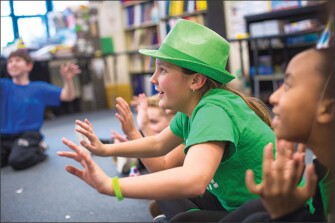
Those little rituals—like playing a certain song on a classmate’s birthday—help students feel more comfortable when more serious issues come into play, Gavron said. TAG groups have discussed broad social issues like justice, and they’ve dropped everything to give students a chance to process their emotions the day after a mass school shooting made headlines.
Each grade level at Wayland has a “house mentor,” which is a historic figure to center their studies, and students also go on a related field trip with their TAG groups. For example, 6th graders study Henry David Thoreau and take a 10-mile bike ride to nearby Walden Pond, 7th graders study conservationist Rachel Carson and do field experiments together at Cape Cod, and 8th-grade groups take a trip to Washington, D.C., as part of their studies of Martin Luther King, Jr. and justice issues.
Sixth grader Lila Berg said her group’s bike trip helped ease her feelings about her transition to middle school. “You know someone really well because they are in your TAG group,” she said.
Wayland has about 640 students, which can be intimidating for young students. “We think about it as another way to make a large school feel smaller,” Gavron said.
Addressing Multiple Concerns
Advisories are not uncommon and they aren’t new. Private prep schools have used them for decades to provide intensive support and academic guidance to their students. And nonacademic student meetings were popular with the growth of the middle school model. But some of the purposes of the student meetings have changed over time.
Advocates for “whole-child education” pitch advisories as solutions to a range of school concerns—from safety and suicide prevention to bullying and academic support.
And more districts have adopted comprehensive social-emotional learning plans, designed to boost student skills in areas like solving problems and building relationships. While those strategies are often more intuitively integrated into elementary school classes, secondary schools often add advisories as a way to “do SEL.”
Curriculum companies have taken notice of the trend, offering packaged advisory programs that include discussion prompts and workbooks. But Poliner says schools shouldn’t lean too heavily on off-the-shelf solutions without giving teachers flexibility to customize their own approaches and students the freedom to take ownership of their experiences.
That’s because the less-structured class periods are often set up as a systemic solution to the individual, sensitive experiences adolescents face, and those students can seem almost allergic to approaches that seem impersonal.
Researchers say students’ learning can be stifled if they feel like they don’t belong at school or if environments don’t seem designed for them. And data support the idea that many students feel isolated or disengaged at school.

A 2017 Gallup Education poll on education described 24 percent of respondents as “actively disengaged in school.” Twenty-nine percent of the national pool of 733,471 students in grades 5 to 12 were described as “not engaged,” while the remaining 47 percent were considered engaged.
The poll derived its engagement scores by combining student responses to a range of questions about the importance of their schoolwork, whether they feel safe at school, if they “have a best friend at school,” and whether they believe “the adults at my school care about me.”
But teachers can feel daunted, or even cynical, about schools’ efforts to address those issues, and that’s especially true if they have fatigue from years of programs that are quickly adopted and discarded before they have a chance to prove their value.
And some teachers feel ill-equipped to talk to students about their emotions or how to build personal skills like self control and setting goals. That’s especially true of some secondary teachers, who may have been drawn to the field because of an interest in a given academic subject, like math, principals say.
In some districts, there has been pushback from parents who would prefer lessons on issues like respect and tolerance take place at home. And some have said schools should focus more energy on academic issues instead.
Poliner said schools need to make the case for advisories and other social-emotional learning programs with teachers and invite them into designing how they work. And they need to make it clear that the teacher’s role is to facilitate conversations, not to take the place of school counselors, psychologists, and social workers.
Audra Connolly, a 6th grade teacher in Nampa, Idaho, said leading her students in open discussions comes more naturally for her because she recently worked in an elementary school, where “circle time” and daily questions were the norm. She still uses those questions to help start conversations with her advisory students in middle school. And sometimes the conversations turn to harder topics, too. After a gunman attacked a Pittsburgh synagogue in October, she gave students time and freedom to grapple with their understanding of the incident.
“Every kid needs adults and people to build relationships with them,” she said. “I’m not just a math teacher. I’m here to help these kids be successful.”
In Wayland, having two adults in each advisory allows one to take the lead when the other feels less comfortable handling a conversation or leading an activity, Gavron said. The majority-white district is part of a voluntary school desegregation program that brings in black students from neighboring areas. Before advisory leaders led conversations about issues like bias, they spent a year and a half preparing through professional development, reading, and staff conversations.
But the advisories at Wayland aren’t just intense conversations. Sometimes the groups award stickers to peers who showed character strengths and play wacky games that seem perfectly in place in a middle school.
Teachers have a variety of online resources, including a menu of tested group activities they can choose from and space to discuss what’s working, and what’s not, with their peers who also lead advisories.
“We take care of one another,” Gavron said. “The adults can only be good for the kids if the adults are in good shape.”


