

The Democratic gains in this week’s New Jersey, Virginia, and Washington elections will have repercussions in all three states in their long-simmering debates over the expansion of charter schools, school funding, testing, and other K-12 issues.
And the political maneuvers used by education policy advocates to animate moderate voters over those issues could provide a script for other states next year when 38 governorships and four-fifths of state legislative seats are up for election.
Currently, more than 25 state capitals are completely controlled by Republicans, while Democrats hold both the governorships and legislatures in just seven states.
That control will have big implications for K-12 in coming years, with governors and state lawmakers taking on added power to shape their states’ education agendas in the era of the Every Student Succeeds Act.
“We’re really feeling good about our momentum as we head into a suite of equally critical races in 2018,” said Carrie Pugh, politics director for the National Education Association, which represents three million teachers nationwide. “We are in a build-back moment [for Democrats]. We have a lot of ground to make up for going into 2018.”
State-Level Battles
In the New Jersey governor’s race, Democrat Phil Murphy, a financier and diplomat who has promised to pull the state out of the PARCC testing consortium, beat the GOP nominee, Lt. Gov. Kim Guadagno. Democrats also took full control of the state’s legislature.
And in Washington state, Democrats took control of that state Senate, which has for years been a singular force opposed to raising taxes in order to comply with a 2012 state supreme court order to increase the state’s minimum teacher salaries. Democrats hold control of the House and the governorship now. The state also has been in a protracted legal battle over the expansion of charter schools.
In Virginia, Lt. Gov. Ralph Northam, a fierce charter school opponent, beat former Republican party Chairman Ed Gillespie, while Democrats gained 14 seats to put them just a few seats shy of controlling the House of Delegates. Recounts are expected.
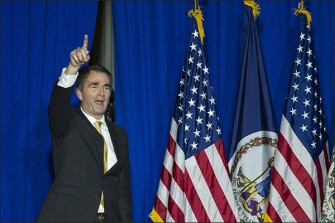
The Virginia race, in particular, drew national attention as a proxy referendum on President Donald Trump. Closer to home, school choice and the state’s accountability system both found their way into that state’s gubernatorial debates. Northam said he wanted to roll back the state’s role in improving schools and Gillespie said he wanted to crack down on underperforming schools and expand enrollment options for students at those schools.
As governor, Northam will appoint both an education secretary, who serves in an advisory capacity, and a state superintendent. But Republican control of Virginia’s House of Delegates has stalled Democrats’ efforts to permanently increase school funding in recent years, said Jim Livingston, the president of the Virginia Education Association.
When Gillespie received a $100,000 donation from Dick DeVos, U.S. Secretary of Education Betsy DeVos’ husband, it provided an opportunity for the teachers’ union to link Gillespie’s priorities to the “DeVos agenda"—a point the union emphasized over and over on flyers and in TV ads.
“That will make the conversation a little more difficult, but overall it’s not a huge change,” said Caleb Taylor, the director of policy for the Virginia Institute for Public Policy which supports tax-credit scholarships and education savings accounts.
Northam also could make changes to the state’s ESSA plan which awaits federal approval. He said on the campaign trail that he thought the state was too reliant on test scores to rate its schools and put too heavy a hand on local school districts.
In New Jersey, Gov.-elect Murphy will be tasked with repairing a fraught relationship between the New Jersey Education Association, the state’s historically powerful teachers’ union, and the state’s education department. In recent years, the state’s appointed commissioners of education implemented several of outgoing Republican Gov. Chris Christie’s controversial teacher quality measures. Christie appointed five commissioners in seven years. Kimberley Harrington, the current commissioner who designed the state’s federally-approved ESSA plan is appointed and will likely be replaced.
The state also has been under pressure to upend its decades-old school funding formula, which has led to increased property taxes. Murphy said he will seek to keep intact the funding formula in the coming years. And Murphy also promised to pull the state out of the PARCC testing consortium and hand back control to several of the state’s urban districts.
Down-Ballot Drama
Among the down-ballot races in New Jersey, State Senate President Steve Sweeney, a Democrat, beat back opposition from the teachers’ union. The union, which typically backs Democrats, spent at least $5 million on a campaign to defeat Sweeney, who has fallen out with the union over, among other things, how the state should pay down pension funds. The union instead supported Republican Fran Grenier, a Gloucester County commissioner who backed Trump in the presidential race.
The union’s opposition to Sweeney will have repercussions down the line, said Janellen Duffy, the executive director of New Jersey’s JerseyCan, a 50Can affiliate that advocates for school choice and more school funding.
“It was an intense feud,” said Duffy. “I think there’s going to be a new dynamic in Trenton. The union has been extremely powerful and because of the strong position that they took and the extensive amount of money they put into the race, their aura of invincibility is going to be changed.”


