SimCityEDU: Pollution Challenge, an educational version of the popular city-building video game, is a known quantity in a fresh wave of serious learning games that bridge the gap between instruction and assessment.
Released last November, the game—in which students acting as mayors must balance the growth of their cities with environmental impacts—tracks, analyzes, and feeds back to teachers through dashboards more than 3,000 different data points showing how well each student understands systems thinking.
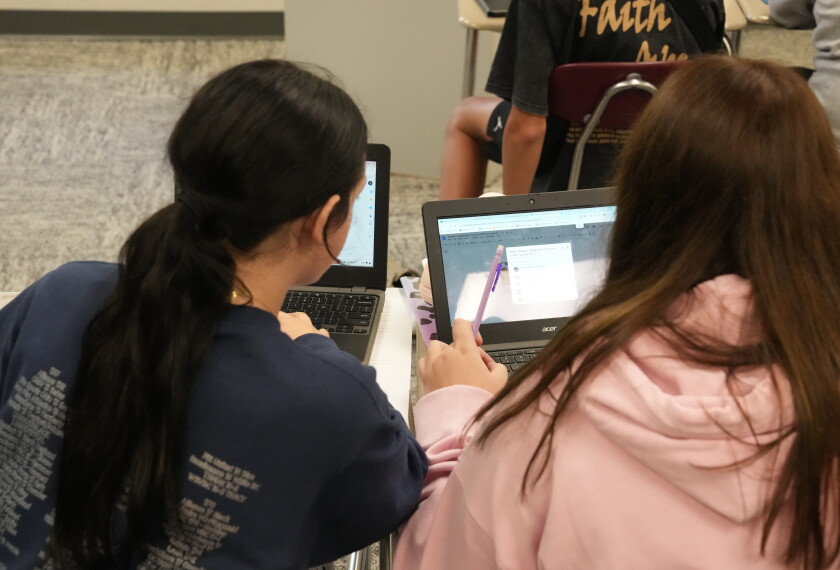
“If a student builds one bus stop, then waits before strategically building other bus stops, he has an eye for problem-solving that I would not have gotten with a multiple-choice or written test,” said Matt Farber, a social studies teacher who beta-tested SimCityEDU with 6th graders at the 650-student Valleyview Middle School in Denville, N.J. “We used to try formal assessments every day, and then do a summative assessment at the end of a unit every two weeks and pretty much move on, but you don’t get a lot of reflection with that. Now, there’s iteration, which I hadn’t planned on. Students get competitive for their personal best.”
That is the double benefit of games with embedded assessments, say those who develop and use them. They not only provide a deeper insight into understanding, allowing educators to more quickly identify students’ strengths and weaknesses, but they also thwart a growing disengagement from traditional forms of evaluation. Teachers commonly report that games with embedded assessments encourage students to look at failure as opportunity—a way of thinking that will serve them well as they grow up.
Expect to see more assessment-embedded video games in classrooms soon, experts predict.
GlassLab, a digital learning game-development studio based in Redwood City, Calif., and the creator of SimCityEDU, plans to develop five more serious learning games with embedded assessments over the next three years with grant money from the Bill & Melinda Gates and John D. and Catherine T. MacArthur foundations. “We’re on track, but frankly, we don’t think that’s enough,” said Jessica Lindl, the general manager of GlassLab, a project of the New York City-based nonprofit Institute of Play. “We want to empower and accelerate the entire market. At the end of our grant, we don’t want just six games. We want thousands of other games to be created.”
Addressing Teacher Needs
GameDesk, meanwhile, is hoping to give teachers the capability to monitor learning outcomes on mobile devices sometime within the next three years, according to Joe Wise, the associate director for new school models and curriculum at the nonprofit education organization based in Los Angeles. Continual feedback that allows teachers to individualize instruction and intervene on a real-time basis is “kind of the holy grail” of embedded assessments, he said.

A new study known as A-GAMES—for Analyzing Games for Assessment in Math, ELA/Social Studies, and Science—is analyzing how teachers use video games for formative assessments, so future designs of such features can better match teacher needs and lead to better outcomes for students. The project is a collaboration between the University of Michigan and New York University, and underwritten by the Gates Foundation. Findings from case studies are expected to be released next fall.
“Actions speak louder than words,” said Valerie J. Shute, a professor in the educational psychology and learning-systems department at Florida State University, in Tallahassee, referring to the great divide between traditional assessments that focus on superficial, declarative knowledge and what she calls “stealth assessments” intended to measure levels of creativity, persistence, and conceptual understanding during game play.
She co-developed a new computer-based game with embedded assessments called Newton’s Playground, which uses 2D simulations to teach about gravity, mass, and other physics concepts. The game measures actual effort rather than a student’s self-reported answer about that effort.
Factoring In PD

Still, experts warn that while digital learning games may be able to provide an authentic context for assessment, their large-scale impact is limited without a significant level of professional development.
“The projection is that over time, they’ll be more commonplace, but until teachers are using them more consistently as a way of life in the classroom, this technology isn’t going to be very effective,” said Arthur C. Graesser, a professor of experimental and cognitive psychology at the University of Memphis, in Tennessee.
Third grade teacher Joli Barker, who has been recognized internationally for the ways she incorporates digital gaming into lessons, wants to see more assessments overall mirror the kind of student information she regularly gleans from her class at the 660-student Earl H. Slaughter Elementary School in McKinney, Texas. Ms. Barker uses MinecraftEDU to assess geometric concepts, and with BrainPop’s “Guts and Bolts,” she has students “screencast” sessions—digital recordings of computer screen outputs—with the volume off and microphones on so they can explain their choices as they make them.
“I know whether they have the skills and how they’re applying them,” said Ms. Barker. “I feel that if I’m asking them to use their imaginations and creativity during class assignments, then assessing them in a similar way is important. We have to consider that the way our educational system approaches testing isn’t necessarily reflective of what students are learning.”
Added Mr. Farber, the New Jersey teacher: “And the kids don’t even care they’re being assessed. That’s a bonus, right?”