Because schools of education, with a few exceptions, have been slow to offer programs to develop virtual instructors, many of the nation’s leading online schools have, for more than a decade, crafted homegrown online and blended professional development.
And with the flexibility offered by the online classroom, instructors who also have face-to-face experience sometimes say the continuous, embedded professional development now in vogue is easier to achieve—be it in collaboration with colleagues, correspondence with advisers, or participation in supplemental education—in an online setting.
So it’s perhaps not surprising that, as more instructors from brick-and-mortar schools are seeking professional development online, virtual schools are exploring how to become providers to teachers as well as students.
“I think, really, we’re going to see us reaching out into more markets,” said Mary Mitchell, the director of professional learning at the 123,000-student Florida Virtual School, or FLVS, which is based in Orlando. “It doesn’t just have to be for virtual teachers, but it’s virtual, and it’s cost-effective. It can be entire districts, entire states.”
So far, the bulk of the Florida Virtual School’s experience offering professional development to instructors who also teach face to face has come through the school’s franchise program. That arrangement allows districts to pay $50 per enrolled student for FLVS content, which is then delivered by district-employed instructors. Teachers at a new franchise undergo professional development similar to what FLVS full-time instructors receive, including three days of face-to-face instruction covering the basics of virtual teaching, as well as an online program orienting them to course content.
The Maynard, Mass.-based Virtual High School Global Consortium, or VHS, a nonprofit organization that provides virtual courses to 15,000 high schoolers worldwide, has gone further during the last half-decade; it offers a five-course series for both online and face-to-face teachers on elements of virtual or blended instruction. The courses can be taken as a series or à la carte, and can also count for three graduate-level credits each through participating universities.
But while VHS has as thorough an online professional-development offering as any virtual school’s, its leaders say their next focus is creating more-targeted offerings that focus on very specific sets of skills.
That’s to take nothing away from the quality of the five courses, they say, which each run for six weeks, require eight to 10 hours of weekly “in class” work, and are approved by the National Education Association Academy, the online-professional-development arm of the nation’s largest teachers’ union.
Virtual Schools Get Inventive With Professional Development
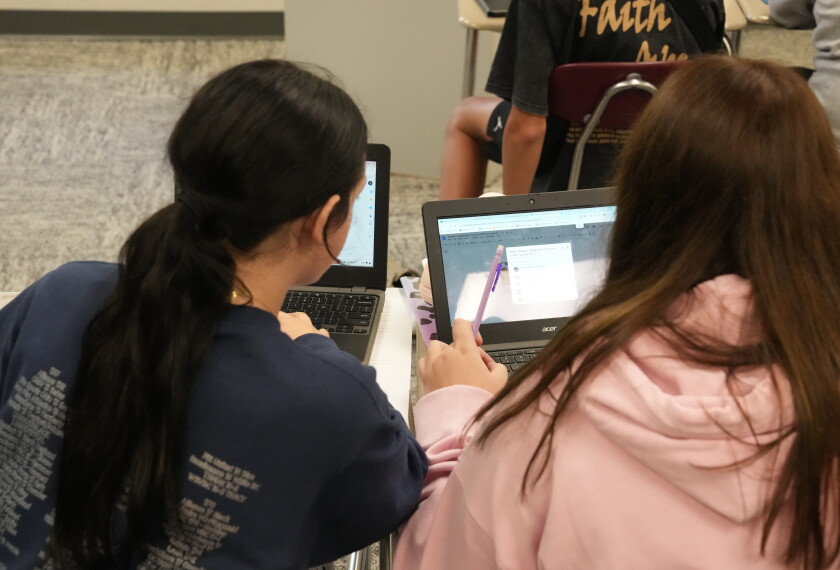
The Florida Virtual School is starting to take a more digital and freewheeling approach to educator training.
“While some teachers really want that and need that, some teachers who are veteran teachers want smaller, more marginalized, targeted PD offerings,” said Colleen Worrell, the manager of professional development for VHS. Through government and private grant funding, the school is exploring ways to meet that demand, Ms. Worrell said, though it is not yet offering any such service publicly.
Meanwhile, although the North Carolina Virtual Public School has yet to offer professional development to teachers who teach only in brick-and-mortar schools, it appears to be mastering the balance between “comprehensive” and “targeted” professional development that VHS is only experimenting with.
With most of its rolling teaching force of 600 to 700 also working full time in face-to-face classrooms, NCVPS blends what it calls its “PD-10” courses—approximately 10-hour self-paced, instructorless online courses that can count as 10 of the 150 hours of professional development the state requires of its teachers—with shorter, more acutely focused “just in time” courses.
For example, copyright and fair use, common-standards compliance, and teaching students with individualized education programs would be PD-10 courses; use of a new geometry math tool or language arts application would fall into the just-in-time category. And because trends and tools can go from cutting-edge to commonplace, the format lends itself to progress, said Karen Creech, the director of curriculum and instruction for the North Carolina school.
“If I can hook a teacher on a resource and get them interested, then I’m going to have a better chance of implementing it in their course,” Ms. Creech said. “We kind of hook them with the just-in-time, and then create a [PD-10] module that goes into detail.”

The hope is that NCVPS can offer its PD-10 courses outside its own school, through the state’s e-Learning for Educators, the online initiative of the Learn N.C. program at the education school at the University of North Carolina at Chapel Hill, which offers K-12 lesson plans, assessments, Web links, and professional development. Such an expansion would require the addition of a facilitator or instructor to any PD-10 course offered through the program, Ms. Creech said, and would also require enough demand in a state where each of the 115 school districts is allowed to offer its own professional development.
Since most NCVPS instructors also teach in brick-and-mortar schools, the vast majority of its PD offerings are optional, which makes correspondence with colleagues across the same subject crucial.
“We think it’s really important, even though it’s considered self-paced, that there is a community of learners that are able to reflect together, ask questions together, implement whatever it is asking them to implement based on the topic,” Ms. Creech said.
Even virtual schools with far fewer resources than the Florida and North Carolina schools have been able to enter the field of professional development for nonvirtual instructors.
For example, Richmond-based Virtual Virginia, which employs just over two dozen full-time instructors as a school that provides supplemental courses to students, is offering an economics and personal-finance course aimed at instructors in regular schools to help the state’s districts meet requirements for graduate study.
All the while, its novice instructors have to go beyond Virtual Virginia for their orientation and complete the EdTech Leaders Online course offered by the Education Development Center, based in Newton, Mass. The school also holds annual face-to-face meetings in Richmond for its instructors at the beginning of the school year, pairs up its novices with mentors, and drives its teachers to collaborate online with other teachers of the same subjects.
“We don’t try to be all things to all people,” said Tammy McGraw, the Virginia education department’s director of education technology. “We’re very focused on being responsive to the things school divisions need.”
Perhaps no other virtual school has the resources or existing content to reach the same number of educators as the Florida Virtual School. The school has created on-demand professional-development modules across all K-12 grades and subjects. It has experience organizing virtual job-shadowing for new teachers, who listen to more experienced teachers’ phone calls with students and watch them interact through instant messaging, chat rooms, and discussion boards.
And FLVS has already moved beyond its own teaching force with a series of professional webinars for other virtual school leaders.
“Districts are really looking for PD where they don’t send teachers away,” said Ms. Mitchell. “Here it can be much more of a natural flow of that kind of conversation because you can set the schedule and have the virtual access toward each other.”