Most students have far to go before they master the skills and knowledge outlined in the new common standards that have been adopted by all but seven states, a new report concludes.
The study, released last month, is the first to try to identify the ground that must be covered as states and school districts hold their students to the new standards. It found that only one-third to one-half of the nation’s 11th graders are proficient in the content and skills that the common-core standards specify as necessary in mathematics and English/language arts for access to good jobs or success in entry-level, credit-bearing college courses.
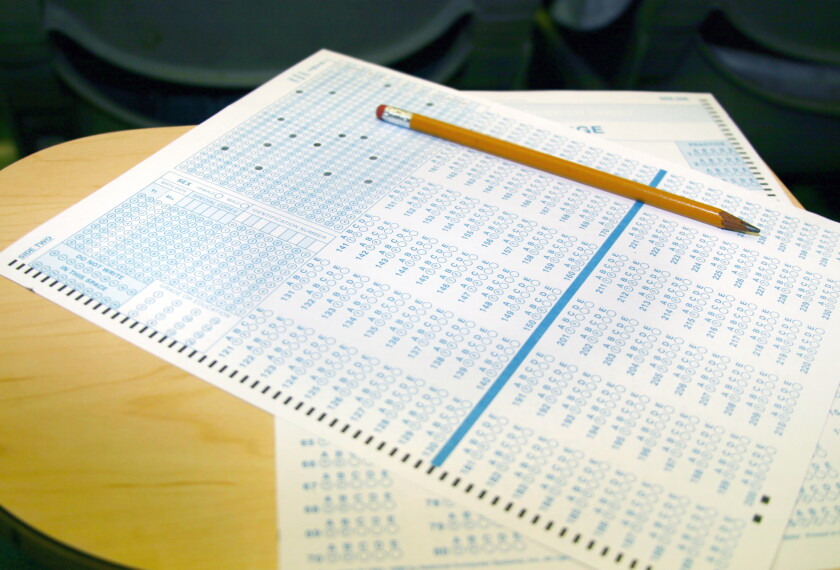
ACT Inc., the Iowa City, Iowa-based nonprofit that produces one of the country’s two dominant college-entrance exams, performed the analysis by identifying items in the ACT exam that reflect specific skills or content in the new standards. As its sample, the ACT used 257,000 high school juniors who took the exam as part of a statewide administration, to avoid skewing the sample with college-aspiring students.
The organization determined how students who score in the ACT’s “college ready” range performed on the items deemed reflective of common-core content. That created a proxy, or estimate, of the cutoff score all students must reach to be considered well prepared in those areas, said Scott Montgomery, an ACT assistant vice president who worked on the report.
The resulting profile is one of a student body largely unprepared for the common standards. The problem was worse in mathematics than in English/language arts, and worse for racial and ethnic minority students than for their white peers.
In English/language arts, only 38 percent of 11th graders hit the “proficient” range in reading, and barely more than half reached it in writing and in language. Subsets of skills stood out as weaknesses: Only three in 10 proved themselves well-versed enough in conquering progressively more complex texts, and only a shade more demonstrated enough strength in their knowledge of language and vocabulary.
Science Literacy Weak
Of particular concern to ACT researchers was students’ weak performance in science literacy. Not even one-quarter of the students showed college-ready levels of skill in understanding scientific reading material. They showed more strength in reading literature, and in grappling with informational texts and social studies material, though proficiency levels in those areas still ranged only between 37 percent and 41 percent.
In math, only 37 percent of students showed proficiency in statistics and probability, and only four in 10 did so in functions. The weakest math area was number and quantity, where only 34 percent showed proficiency in skills considered foundational to later math study. Students also showed weakness on items that reflect their prowess in “mathematical practices,” such as reasoning abstractly and modeling with math. Only one-third of students showed proficiency in those skills.
Minority students showed struggles with mastery in both math and literacy. Only one in 10 African-American students, for instance, reached college-ready levels in reading and in the number and quantity area of math. Hispanic students consistently outperformed black students, but significantly trailed their non-Hispanic white peers. Results for Asian students were not broken out because there were too few in the sample, ACT officials said.
Cynthia B. Schmeiser, the president of ACT’s education division, said that the study defines “clear areas of instructional deficiency” that states and districts can address as they reshape teaching and learning in response to the common standards.
“States need to know what their students’ achievement looks like relative to the common core,” she said. “What are their strengths? What are their weaknesses? What can they focus on now and get a leg up to move forward with implementation?”
The report is a “baseline study” that “raises some real important issues for policymakers at the state level” as they gear up to implement the new standards, said Gene Wilhoit, the executive director of the Council of Chief links.
State School Officers, which co-led the initiative to have state and private-sector experts collaborate to design the standards.
Accordingly, the study’s authors offered instructional recommendations to address the weaknesses pinpointed in the report. They suggested, for instance, that states work harder to ensure that students read progressively more complex texts as they go through school and that they build stronger cross-disciplinary literacy skills. In math, schools should pay greater attention to building a strong foundation in early-grades number-and-quantity skills and beefing up students’ understanding of mathematical processes and practices, the report urges.
The authors advised states, as well, to ensure that teachers have sound professional development so they are prepared for the new standards and that they are provided with model lessons, good formative assessment strategies, and other tools for guiding instruction.
ACT officials, as well as outside experts, cautioned that while the study’s findings offer an instructive early portrait of students’ readiness for the standards, they must also be interpreted with caution because the analysis was done before any serious, widespread effort to teach to the new standards.