Far greater shares of students are proficient on state reading and mathematics tests than on the National Assessment of Educational Progress, and those gaps have grown to unprecedented levels since the federal No Child Left Behind Act became law in 2002, a study released last week concludes.
The study by Policy Analysis for California Education, a nonprofit research group based at the University of California, Berkeley, was released here April 10 during the annual meeting of the American Educational Research Association.
The researchers compiled state and federal testing results for the period 1992 to 2006 from 12 states: Arkansas, California, Illinois, Iowa, Kentucky, Massachusetts, Nebraska, New Jersey, North Carolina, Oklahoma, Texas, and Washington.
In all but two states—Arkansas and Massachusetts—the disparity between the share of students proficient on state reading tests and on NAEP, a congressionally mandated program that tests a representative sample of students in every state, grew or remained the same from 2002 to 2006. A similar widening occurred between state and federal gauges of math performance in eight of 12 states.
Those findings call into question whether the state-reported gains are real or illusory, according to the researchers.
“State leaders are under enormous pressure to show that students are making progress,” said Bruce Fuller, a professor of education and public policy at Berkeley who led the study. “So, they are finding inventive ways of showing higher test scores.”
Under the federal law, states must give reading and math tests annually in grades 3-8 and at least once in high school. Schools and districts that do not meet annual targets for the percentage of students who score proficient on those exams face an escalating series of federal sanctions, with the target rising to 100 percent proficiency in 2013-14.
Critics have suggested that, rather than raising academic standards, the law is encouraging states to lower the bar for passing state tests or otherwise adjust their definition of “proficiency” downward in order to avoid identifying too many schools as missing their targets.
Transparency Urged
In California, for example, in 2002 there was a gap of 15 percentage points between the proportion of 4th graders deemed proficient readers on the state test and the percentage of those who scored at the proficient level on NAEP.
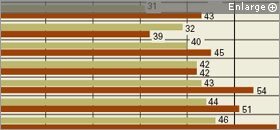
The gap between the proportions of 4th grade readers found “proficient” on state tests and on the National Assessment of Educational Progress grew in most of the states studied by researchers at the University of California, Berkeley.
SOURCE: University of California, Berkeley
By 2006, that disparity had grown to 27 percentage points, the study found. According to the researchers, that equates to 129,000 4th graders who are deemed “proficient” in reading under California’s standards but fail to clear the more demanding federal bar.
In Texas, in 2002, a gap of 48 percentage points existed between the proportions of 4th graders who scored at the proficient level in reading on state tests versus on NAEP. That gap widened to 54 percentage points by 2006.
“Taxpayers now spend billions of dollars each year on standardized tests,” Mr. Fuller said. “But now we have two diverging gauges of how well students are doing. It’s confusing for parents and employers. It makes for mischief out in the states.”
While proposals to address the issue by introducing national standards and tests remain controversial, Mr. Fuller noted in his presentation, the large and growing gap between state and federal testing results “invites stronger centralized control.”
He suggested that a bill introduced by U.S. Sen. Edward M. Kennedy, D-Mass., the chairman of the Senate Health, Education, Labor, and Pensions Committee, offers a middle ground. The legislation would require states to report NAEP results alongside state results and encourage them to benchmark their standards against national and international ones.
Federal officials should consider backing away from micromanaging growth targets, the Berkeley professor suggested, while doing more to enforce transparency in reporting achievement trends.


