When Yosuf Mir and Nazira Karimi attended the schools of their native Afghanistan, they learned to speak English and French. They studied history and economics.
Those state-run schools are closed today, the immigrants to the United States say, and have been replaced by schools with a new agenda—one that teaches a small number of students a fundamentalist version of Islam.
“The Taliban have a very low level of schooling for, I’d say, 1 percent of the population,” said Mr. Mir, referring to the insurgent faction that rules most of the country. “It’s all about how to learn how to become a fundamentalist Muslim.” Mr. Mir came to the United States 25 years ago, but still has family living in his native country.
Those schools and others throughout the region are under an international microscope as the United States and allied countries prepare to wage war against those who sponsored or aided the Sept. 11 terrorist attacks that felled the towers of the World Trade Center, damaged the Pentagon, and left a death toll estimated at more than 5,000.
With the political and military upheaval in Afghanistan and martial law in Pakistan, state-run schools are barely functioning, leaving religious schools to fill in the gap, according to people who know the region.
Those schools, in many ways, are training the young men who could become a new generation of warriors against the United States. Students in the schools, which educate only boys, in keeping with fundamentalist Muslim practices, learn very little about the United States, Mr. Mir and others say.
They memorize the Koran, learn basic academic skills, and practice self-defense. About all the boys learn of the United States is that it is an enemy of their religion, experts say.
“Most of them learn to read and write, read the Koran, and how to do math,” said Nilgun G. Ogun, the program-operations director for Asia for Save the Children, a Westport, Conn.-based group.
Save the Children and other international relief agencies are supporting efforts to provide the basics of an education to the refugees that have fled the Taliban regime.
Within Afghanistan, resistance efforts have been mounted to ensure education for girls and boys. Underground schools use armed guards and regularly shift locations to avoid detection. (“School Doors Shuttered for Afghan Girls,” June 6, 2001.)
Culture and Diversity
In neighboring countries, views of the United States are quite different, according to teachers working there.
Students in Uzbekistan, Kyrgyzstan, and other former republics of the Soviet Union where Muslims predominate learn English and study American democratic principles.
“Our students are very interested in the culture and diversity of the United States,” said Guljan Mamytova, a principal and teacher in Kyrgyzstan, who is visiting U.S. schools this month as part of an exchange program sponsored by the State Department.
“Our schoolchildren are eager to know more about America,” said Ravza Zinurova, a principal in Uzbekistan. The students hold a mock presidential election and congressional proceedings as part of their learning about the U.S. government, added Ms. Zinurova, also a participant in the State Department exchange.
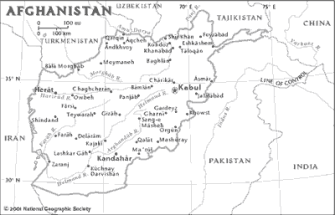
Throughout Pakistan and Afghanistan, however, religious schools focus mostly on instruction in Islam. A network of religious schools in Pakistan, called madrasahs, offers free or subsidized instruction in the Koran, according to reporters who have visited the sites.
|
| SOURCE: National Geographic Expeditions |
On a recent day in one school, according to an Associated Press dispatch, children started their day with prayers, including a plea for Allah to “defeat the enemies of Muslims and make Islam and the Taliban victorious over the Americans.”
Because those schools concentrate on religious teachings, the United States, its history, and its culture are virtually ignored. Thus, most of what the children know about Americans comes from the mass media.
Since the Taliban claimed control of Afghanistan in 1996, some citizens have turned to transmissions from the U.S. government-financed Voice of America and Britain’s BBC radio for an outside view of world events. But in many parts of the country, only Taliban-controlled media are available.
The Way It Was
Before Taliban rule, Afghan citizens placed great value on education, according to Thomas E. Gouttierre, the director of the Center for Afghanistan Studies at the University of Nebraska at Omaha. The government began an extensive school construction program in 1959, when the country still had a monarchy, and within a few years, had extended modern education to its rural populations.
In the 1980s and 1990s, Mr. Gouttierre helped craft elementary and secondary education programs there under grants from the U.S. Agency for International Development.
Even at the height of Afghanistan’s school system, formal lessons on the history or culture of the United States were limited, according to Mr. Gouttierre, who first worked in the country as a Peace Corps volunteer in the 1960s.
“There weren’t great treatises on the advantages of democratic government. That would have been politically incorrect in a country where there was a monarch,” he said. “Generally speaking, people throughout Afghanistan had a very positive image of the United States, but a lot of that was based on false information from movies and magazines.”
Those are the lessons Mr. Mir and Ms. Karimi remember.
Mr. Mir, who is an interpreter for the U.S. District Court in Alexandria, Va., left Afghanistan in the 1970s to study at the University of Iowa. Ms. Karimi graduated from Afghan schools and went on to become a journalist in her own country and in Pakistan. She immigrated to the United States in 1997 and works for a radio program that broadcasts news from Afghanistan and for a cable television talk show on issues facing her country.
“When I was a little child and I was going to school, it was safe and comfortable,” said Ms. Karimi, who lives in a suburb of Washington. “I got a good education with good teachers.”
All of that ended, Ms. Karimi and Mr. Mir said, when the Taliban seized control. “Since the fundamentalist people and the Taliban came to Afghanistan,” she said, “we left because there were no schools, no safety, and no freedom.”


