Standards & Accountability

States’ Grades Inch Upward On Content Standards

By David J. Hoff — January 12, 2000 2 min read
  • Save to favorites
  • Print

The quality of states’ academic-content standards is improving, but still isn’t good enough, according to a group that regularly grades what states say students should know in core subjects.

“The results ... indicate modest progress in the quality of state standards,” Chester E. Finn Jr., the president of the Thomas B. Fordham Foundation, said at a press conference held here last week to release the new grades. “We’ve got a heck of a lot of work to do before the country has standards worth attaining.”

For More Information

“The State of State Standards” is free by calling (888) TBF-7474. It is also online at http://www.edexcellence.net/library/
soss2000/standards2000.html</ a>.

Fordham gave the states a C-minus average after its experts reviewed the materials provided by state officials. That’s up from a D-plus the Washington-based research organization conferred on the states in 1998. Iowa, which does not have state standards, did not receive a grade.

Only eight states and the District of Columbia scored a B-minus or higher, according to “The State of State Standards.” Twenty-three states received a D-plus or lower, according to the foundation, which advocates standards-based policies and market-based reforms. Mr. Finn was the assistant U.S. secretary of education for research during the Reagan administration.

In Fordham’s 1998 report, three states received B’s, and 30 were given D’s or failing marks. (“Many States’ Standards Add Up to ‘D’ in Review,” July 8, 1998.)

While Fordham’s grades are lower than those given by other groups that regularly rate standards, its overall message reflects a consensus that the quality of standards is improving, but not fast enough.

“I agree with the fundamental conclusion: We are not living in the age of standards-based reform—at least not yet,” said Mark D. Musick, the president of the Southern Regional Education Board, whom Mr. Finn invited to comment on the report.
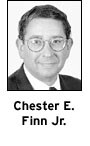
Chester E. Finn Jr.

But many educators quibble with the criteria Fordham chooses to base its grades on.

English standards, for example, are marked down if they don’t require phonics-based instruction in the early grades, and mathematics standards lose points if they suggest that young children could use calculators in classroom exercises.

Both beliefs are subject to rancorous debate among educators who believe that early reading instruction should be based on a combination of literature and phonics, or sounding out, and that elementary school pupils should have access to calculators in some situations.

Kansas Fails Science

While improvement was the norm, Kansas saw its science grade drop. The state board of education’s standards that omit evolution includes “nonsense of a pseudoscientific bent,” the Fordham report says.

The draft rejected by the Kansas board last summer “would have attained one of the highest ratings among the state standards reviewed here,” the report adds. Instead, Kansas’ science grade fell from a C to an F.
Related Tags:

A version of this article appeared in the January 12, 2000 edition of Education Week as States’ Grades Inch Upward On Content Standards

Events

This content is provided by our sponsor. It is not written by and does not necessarily reflect the views of Education Week's editorial staff.
Sponsor
Artificial Intelligence Webinar
Managing AI in Schools: Practical Strategies for Districts
How should districts govern AI in schools? Learn practical strategies for policies, safety, transparency, as well as responsible adoption.
Content provided by Lightspeed Systems
This content is provided by our sponsor. It is not written by and does not necessarily reflect the views of Education Week's editorial staff.
Sponsor
Reading & Literacy Webinar
Unlocking Success for Struggling Adolescent Readers
The Science of Reading transformed K-3 literacy. Now it's time to extend that focus to students in grades 6 through 12.
Content provided by STARI
Jobs Virtual Career Fair for Teachers and K-12 Staff
Find teaching jobs and K-12 education jubs at the EdWeek Top School Jobs virtual career fair.

EdWeek Top School Jobs

Teacher Jobs
Search over ten thousand teaching jobs nationwide — elementary, middle, high school and more.
View Jobs
Principal Jobs
Find hundreds of jobs for principals, assistant principals, and other school leadership roles.
View Jobs
Administrator Jobs
Over a thousand district-level jobs: superintendents, directors, more.
View Jobs
Support Staff Jobs
Search thousands of jobs, from paraprofessionals to counselors and more.
View Jobs

Read Next

Standards & Accountability How Teachers in This District Pushed to Have Students Spend Less Time Testing
An agreement a teachers' union reached with the district reduces locally required testing while keeping in place state-required exams.
6 min read
Standardized test answer sheet on school desk.
E+
Standards & Accountability Opinion Do We Know How to Measure School Quality?
Current rating systems could be vastly improved by adding dimensions beyond test scores.
Van Schoales
6 min read
Benchmark performance, key performance indicator measurement, KPI analysis. Tiny people measure length of market chart bars with big ruler to check profit progress cartoon vector illustration
iStock/Getty Images
Standards & Accountability States Are Testing How Much Leeway They Can Get From Trump's Ed. Dept.
A provision in the Every Student Succeeds Act allows the secretary of education to waive certain state requirements.
7 min read
President Donald Trump holds up a signed executive order alongside Secretary of Education Linda McMahon in the East Room of the White House in Washington, Thursday, March 20, 2025.
Ben Curtis/AP
Standards & Accountability State Accountability Systems Aren't Actually Helping Schools Improve
The systems under federal education law should do more to shine a light on racial disparities in students' performance, a new report says.
6 min read
Image of a classroom under a magnifying glass.
Tarras79 and iStock/Getty
