When most people think about the No Child Left Behind Act, they think of two things: former President George W. Bush, and standardized testing. But the politics, policy, and history of the law are far more complicated than that.
UPDATE: NCLB has been replaced. For information about the latest education law, read our explainer on ESSA, the Every Student Succeeds Act.
The No Child Left Behind law—the 2002 update of the Elementary and Secondary Education Act—effectively scaled up the federal role in holding schools accountable for student outcomes.
In December 2015, Congress passed the Every Student Succeeds Act to replace NCLB. ESSA moved in the opposite direction—it seeks to pare back the federal role in K-12 education. For more information on ESSA, read this explainer. See also our full coverage of ESSA and what it means for states and school districts.

NCLB was the product of a collaboration between civil rights and business groups, as well as both Democrats and Republicans on Capitol Hill and the Bush administration, which sought to advance American competitiveness and close the achievement gap between poor and minority students and their more advantaged peers. Since 2002, it’s had an outsized impact on teaching, learning, and school improvement—and become increasingly controversial with educators and the general public.
Here are a few frequently asked questions about the law, its history, and its policy implications.
What is ESEA?
The Elementary and Secondary Education Act (ESEA) was part of President Lyndon B. Johnson’s Great Society program. Passed in 1965, it created a clear role for the federal government in K-12 policy, offering more than $1 billion a year in aid under its first statutory section, known as Title I, to districts to help cover the cost of educating disadvantaged students. The law has been reauthorized and changed more than half a dozen times since that initial legislation. And, for the most part, each new iteration has sought to expand the federal role in education.
What is NCLB?
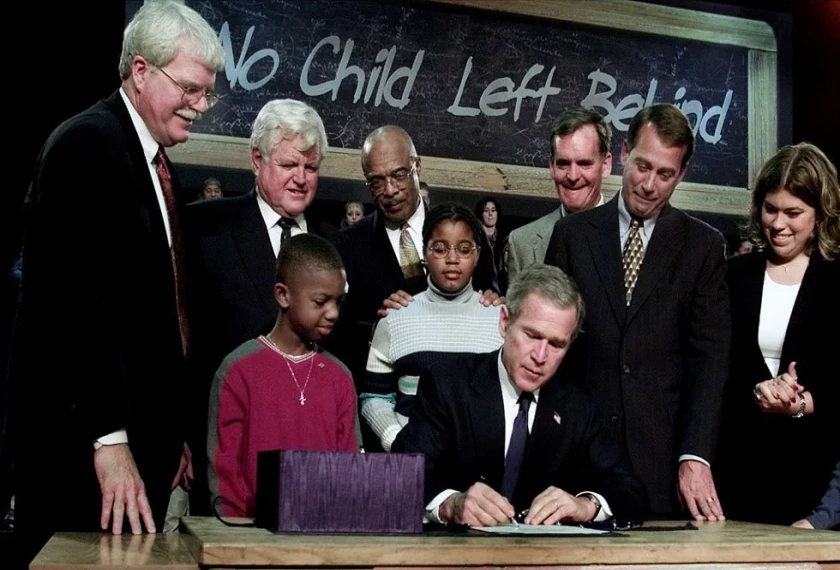
The No Child Left Behind Act (NCLB), which passed Congress with overwhelming bipartisan support in 2001 and was signed into law by President George W. Bush on Jan. 8, 2002, is the name for the most recent update to the Elementary and Secondary Education Act of 1965. The NCLB law—which grew out of concern that the American education system was no longer internationally competitive—significantly increased the federal role in holding schools responsible for the academic progress of all students. And it put a special focus on ensuring that states and schools boost the performance of certain groups of students, such as English-language learners, students in special education, and poor and minority children, whose achievement, on average, trails their peers. States did not have to comply with the new requirements, but if they didn’t, they risked losing federal Title I money.
What do states and schools actually have to do under the law?
Under the NCLB law, states must test students in reading and math in grades 3 through 8 and once in high school. And they must report the results, for both the student population as a whole and for particular “subgroups” of students, including English-learners and students in special education, racial minorities, and children from low-income families.
States were required to bring all students to the “proficient level” on state tests by the 2013-14 school year, although each state got to decide, individually, just what “proficiency” should look like, and which tests to use. (In early 2015, the deadline had passed, but no states had gotten all 100 percent of its students over the proficiency bar.)
Under the law, schools are kept on track toward their goals through a mechanism known as “adequate yearly progress” or AYP. If a school misses its state’s annual achievement targets for two years or more, either for all students or for a particular subgroup, it is identified as not “making AYP” and is subject to a cascade of increasingly serious sanctions:
- A school that misses AYP two years in a row has to allow students to transfer to a better-performing public school in the same district.
- If a school misses AYP for three years in a row, it must offer free tutoring.
- Schools that continue to miss achievement targets could face state intervention. States can choose to shut these schools down, turn them into charter schools, take them over, or use another, significant turnaround strategy.
The law also requires states to ensure their teachers are “highly qualified,” which generally means that they have a bachelor’s degree in the subject they are teaching and state certification. Beginning with the 2002-03 school year, all new teachers hired with federal Title I money had to be highly qualified. By the end of the 2005-06 school year, all school paraprofessionals hired with Title I money must have completed at least two years of college, obtained an associate’s degree or higher, or passed an evaluation to demonstrate knowledge and teaching ability. States are also supposed to ensure that “highly qualified” teachers are evenly distributed among schools with high concentrations of poverty and wealthier schools.
Jan. 8, 2002 – President George W. Bush signs the No Child Left Behind Act
April 2005 – U.S. Secretary of Education Margaret Spellings, who had helped shepherd the NCLB law through Congress as a top domestic policy advisor in the White House, announces plans to offer states limited flexibility from parts of the law if they could prove they were moving the needle on student achievement.
Sept. 2007 – U.S. Rep. George Miller, D-Calif., one of the original architects of the NCLB law and the chairman of the House education committee, unveils the first major, comprehensive NCLB reauthorization draft bill. It ultimately fails to gain traction, thanks in part to opposition from teachers’ unions.
March 2010 – The Obama administration releases its own blueprint for revising the law, which would give states much more control over how to intervene in most schools, in exchange for setting high standards and putting in place teacher evaluations based in part on student outcomes. The blueprint fails to catch fire on Capitol Hill.
Fall 2011 – President Barack Obama offers states flexibility from key mandates of the NCLB law, in exchange for embracing his education redesign priorities. Meanwhile, the Senate and House education committees get moving on reauthorization measures, but neither bill ultimately makes it over the legislative finish line.
June 2012 – More than half of states have been granted waivers, so the majority of the country is no longer operating under the NCLB law as written.
July 2013 – The U.S. House of Representatives passes a bill to renew the NCLB law, with only Republican support. The legislation, which is never taken up by the Senate, would significantly water down the federal role in K-12 accountability.
March 2015 – Most states begin applying to renew their NCLB waivers, even as Congress wrestles with a reauthorization of the law.
What are some of the main criticisms of the law?
Major portions of the NCLB law have proven problematic, particularly as the law has matured without any congressional update or reauthorization. For instance, it’s unclear that the two main remedies for low-performing schools did much to improve student achievement. In many cases, students did not take advantage of the opportunity to transfer to another school, or get free tutoring. States and districts also had difficulty screening tutors for quality. Some districts, including Chicago, successfully petitioned to offer their own tutoring services. States also generally shied away from employing dramatic school turnaround strategies for perennially failing schools.
The NCLB law has also been criticized for growing the federal footprint in K-12 education, and for relying too heavily on standardized tests. And others say its emphasis on math and reading tests has narrowed the curriculum, forcing schools to spend less time on subjects that aren’t explicitly tested, like social studies, foreign language, and the arts.
Education advocates also claim the law has been underfunded. The original legislation called for major increases in education spending to offset the cost of reaching NCLB’s ambitious goals for student achievement, but federal spending never reached the lofty levels outlined in the law. By fiscal year 2007, for example, annual funding for the main NCLB program, Title I, was supposed to rise to $25 billion. It never got there. In fiscal year 2015, for example, Title I receives about $14.5 billion.
What’s more, many states and districts have ignored parts of the law, including the requirement to ensure that highly qualified teachers are evenly distributed between poor and wealthier schools.
In order to improve implementation of the NCLB law, President George W. Bush’s second secretary of education, Margaret Spellings, allowed states to apply to participate in pilot projects to try out changes to the law, including a growth-model pilot that let states consider student progress in rating schools instead of comparing different cohorts of students to one another.
What happened to the 2013-14 school-year deadline for all students to be “proficient”?
By 2010, it was clear that many schools were not going to meet NCLB’s achievement targets. As of that year, 38 percent of schools were failing to make adequate yearly progress, up from 29 percent in 2006. In 2011, U.S. Secretary of Education Arne Duncan, as part of his campaign to get Congress to rewrite the law, issued dire warnings that 82 percent of schools would be labeled “failing” that year. The numbers didn’t turn out to be quite that high, but several states did see failure rates of more than 50 percent. In Congress, meanwhile, lawmakers saw the need for a rewrite, but were unable to bring a bill across the finish line. So that year, the Obama administration offered states a reprieve from many of the law’s mandates through a series of waivers.
What do the Obama administration’s NCLB waivers do?
What’s more, schools that don’t make AYP have to set aside a portion of their federal Title I dollars for tutoring and school choice. Schools at the point of having to offer school choice must hold back 10 percent of their Title I money.
The waivers, which are now in place in 42 states, Puerto Rico, and the District of Columbia, allow states to get out from under many of the mandates of the NCLB law in exchange for embracing certain education redesign priorities. For instance, waiver states no longer have to aim toward the (now past) 2013-14 deadline for getting all students to proficiency, or offer public school choice or tutoring for schools that miss achievement targets.
In exchange, states had to agree to set standards aimed at preparing students for higher education and the workforce. Waiver states could either choose the Common Core State Standards, or get their higher education institutions to certify that their standards are rigorous enough. They also must put in place assessments aligned to those standards. And they have to institute teacher-evaluation systems that take into account student progress on state standardized tests, as well as single out 15 percent of schools for turnaround efforts or more targeted interventions.
The Obama administration has made a number of adjustments to its initial waiver requirements, especially in the area of teacher evaluation, which has been the biggest struggle for states. If the NCLB law has not been reauthorized by the time President Barack Obama leaves office, it’s not clear if a new administration will continue with the waivers or put its own accountability plan in place.
NCLB Terms to Know
Adequate Yearly Progress (AYP): The yardstick at the heart of the No Child Left Behind Act. Under the NCLB law, states must test students in math and reading in grades 3-8 and at least once in high school. Schools must report on the performance of different groups of students, such as racial minorities, as well as the student population as a whole. Students are expected to reach annual achievement targets, known as adequate yearly progress, or AYP.
Title I: The section of the law providing federal funding to school districts to educate disadvantaged children. The Title I program was initially created under the Elementary and Secondary Education Act of 1965 and is now part of the No Child Left Behind Act, the most recent reauthorization of that law.
Highly Qualified Teacher: Under the NCLB law, every teacher in a core content area working in a public school had to be “highly qualified” in each subject taught, by the 2005-06 school year. Under the law, highly qualified generally means that a teacher is certified and demonstrated proficiency in his or her subject matter.
Choice: Under the No Child Left Behind Act, schools that fail to make adequate yearly progress (meet achievement targets) for two years in a row must allow their students to transfer to a better-performing school in the district.
Waiver: Comprehensive flexibility that the U.S. Department of Education has granted to more than 40 states and the District of Columbia from key requirements of the No Child Left Behind Act (the current version of the Elementary and Secondary Education Act) in exchange for embracing certain Obama administration education-redesign priorities on teachers, testing, standards, and school turnarounds.
Supplemental Education Services (SES): This is the No Child Left Behind Act’s legal term for “free tutoring.” Schools that fail to make adequate yearly progress (meet achievement targets) for three consecutive years, even if it’s just for a particular subgroup of students, must offer free tutoring to all students. And schools must set aside 10 percent of their Title I funding to pay for the tutoring services. States with waivers don’t have to abide by this requirement.
Subgroups: Different groups of traditionally overlooked students, including racial minorities, students in special education, English-language learners, and low-income children. Under the NCLB law, schools must break out results on annual tests by both the student population as a whole, and these “subgroup” students. Schools that don’t meet achievement targets for subgroup students are subject to increasingly serious sanctions.
Supersubgroups: Under the Obama administration’s NCLB waivers, some states choose to combine several “subgroups” for accountability purposes, resulting in what’s known as “supersubgroups.” Some civil rights organizations say lumping together different types of students, such as English-language learners and students in special education, makes it much tougher to see how individual groups are progressing relative to other groups of students and the student population as a whole.
Focus School: A term that came about as part of the Obama administration’s No Child Left Behind Act waivers, not the original 2002 law. It refers to schools with stubborn achievement gaps or weak performance among “subgroup” students, such as English-language learners or students in special education. States must identify 10 percent of their schools as “focus” schools.
Priority School: A term that came about as part of the Obama administration’s No Child Left Behind Act waivers, not the original 2002 law. It refers to schools identified as one of the lowest performers in the state and subject to dramatic interventions, including potential leadership changes. States must identify at least 5 percent of their schools as “priority schools.”
NCLB Research and Resources
- The text of the No Child Left Behind Act of 2002.
- All of the information from the U.S. Department of Education about waivers from the No Child Left Behind Act, including which states have them, and what their waiver plans look like.
- “It’s All Relative: How NCLB Waivers Did, and Not Transform School Accountability,” by Anne Hyslop, who at the time was a policy analyst at the New America Foundation, but has since gone to work for the Education Department. An examination of which schools have been identified as underperforming through the Obama administration’s NCLB waivers and how accountability looks different than it did under the original NCLB law. (View an Education Week summary.)
- “The Impact of No Child Left Behind’s Accountability Sanctions on School Performance: Regression Discontinuity Evidence from North Carolina,” by researchers Thomas Ahn and Jacob Vigdor. A look at how schools fared under NCLB’s original interventions, including public school choice and free tutoring. (View an Education Week summary.)
- “States’ Perspectives on Waivers: Relief from NCLB, Concern about Long-term Solutions,” by Jennifer McMurrer and Nanami Yoshioka for the Center on Education Policy. An examination of state attitudes toward waivers. Highlights state’s concerns about how the waivers might effect a potential reauthorization. (View an Education Week summary.)
- “Mapping State Proficiency Standards Onto the NAEP Scales: Variation and Change in State Standards for Reading and Mathematics, 2005-2009.” A look at how the standards and expectations set under the No Child Left Behind Act compare to those of the nation’s report card, the National Assessment for Educational Progress. (View an Education Week summary.)