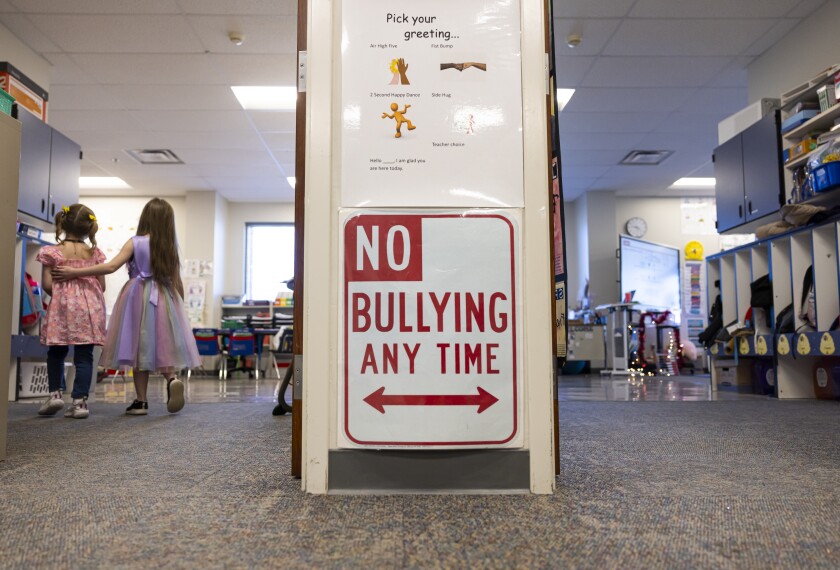
What do children do in school when they are treated like objects to be shaped, controlled, and rewarded—or punished—for what they said or did, learned, or failed to learn?
How can these children grow, be human, be happy, and become good adults? And how can teachers thrive and survive if they, too, are not treated with dignity, and humanity, by their students, colleagues, and administrators?
How can students engage in the learning process if they feel isolated, a condition that affects many students and teachers alike? For teachers are often working in isolation. And students, when they stare at computers all day, are hardly interacting with teachers or peers.
A homeless student, Marlene, a junior in a large urban public high school, told one of us (Kathleen) her feelings about online learning in her school: “I didn’t like it. All the kids weren’t really doing anything. It was all ‘read a passage and answer the questions.’ It was very boring, and I was very upset.” Marlene had been shifted to a classroom where instruction was computer-based because her regular classroom teacher felt Marlene was too disruptive in the traditional class. But Marlene found the experience isolating, “like being in a shelter. I missed interaction with my teachers.”
Schools have lost much of their full, rich, active curriculum in their rush to teach basic English and math."
Tragically, many schools are becoming test-preparation factories where the human, interpersonal side of learning gets lost in the urgent routine of identifying test needs, problems, and distractions from achievement, for the sole purpose of improving “test results.” Often, this tendency comes in tandem with computer-based learning rather than the more personal pupil-teacher relationship.
The joy, love, caring, and fun of being a child in a classroom have been diminished by the need to raise test scores, at all costs.
We argue for the reinstatement of the socioemotional dimensions of education—what was once called, in the educational psychologist Benjamin Bloom’s words, “the affective domain,” where teachers built into a lesson and the curriculum the human feelings, needs, and aspirations of their students, along with the cognitive demands of the learning experience.
Children should be asked what their point of view is and what it could be—how they would feel if, for example, they adopted the perspective of a struggling heroine in a story. Kids must also be encouraged to connect with one another—and the text—to start determining what’s true and real. This process of identifying and understanding is sometimes called critical thinking.
Thus, cognitive learning must be coupled with human, social, and emotional experiences, as they all go together. And schools must link the socioemotional with the cognitive by making these two changes:
1. Reinstate teaching and learning as the primary activity in schools. Children in such an environment would be encouraged to communicate, take challenges, and even learn to take risks without fear of failure and humiliation. In Ellen Galinsky’s 2010 book Mind in the Making, she writes that “Sad + Mad = You Can’t Add” is just another way of saying that children’s emotional status greatly affects their ability to learn.
Unfortunately, learning has often been converted from an interesting, complex, engaging process to a too easily quantifiable, isolated, and boring process: e.g., a yes-no, right-wrong, win-lose experience, devoid of human emotions and meaning.
Somehow, schools have lost much of their full, rich, active curriculum in their rush to teach basic English and math (the subjects that are most likely to be tested and for which teachers will be held accountable).
Dropped or diminished in these program are classes in the arts, physical education, vocational-technical education, and some hands-on sciences and social studies. These courses are disappearing because they are not included in testing and, consequently, have become less valued.
2. Ensure that online learning does not supplant teacher and student interactions in the classroom. Online learning is here to stay, as it allows students to move at their own pace and drill down in areas of interest.
Online learning is everywhere and can reach even those students who cannot or will not come to school. However, it has several potential disadvantages, including: removing or minimizing the human interactions that are important to real learning; taking the joy and camaraderie out of education; isolating and limiting students’ voices and involvement; and making education lifeless and dull.
We believe that cutting costs, constricting classroom life to memorization and test preparation, and replacing human contact with online interaction hurt the growth and learning of the whole child, turning education into a “bucket to be filled” and not “a fire to be kindled,” to paraphrase a famous saying.
We must take the steps above to stop the decline of real education and to build the ability of schools to meet the socioemotional needs of our children and their teachers once again. And when cost-cutting policies are being implemented, programs for the neediest children cannot be first on the chopping block.
The key is to bring school leaders and the staff together, in an exciting, focused way.
As Michael Fullan wrote in a 2011 paper: “After minimal needs are met, what turns most people on is something that is personally meaningful, and which makes a contribution to others as well as society as a whole.” Certainly, this applies to educators. Even more importantly, it applies to our children as well.