Opinion
School & District Management Opinion

An Apology to Secretary Duncan

By Jennifer L. Jennings — May 06, 2013 1 min read
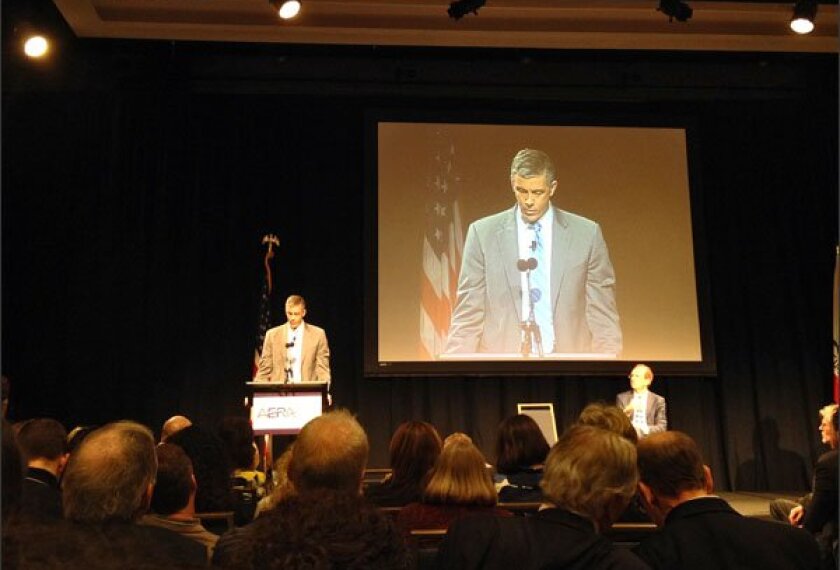
U.S. Secretary of Education Arne Duncan addresses the AERA's annual meeting on April 30.
  • Save to favorites
  • Print

Includes updates and/or revisions.

I agree with U.S. Secretary of Education Arne Duncan on just about nothing. I think Race to the Top is an evidence-free mess. I think the idea of a test worth teaching to is a willful misunderstanding of the science of testing. And I can’t agree with Duncan’s insistence that the cheating scandals that have garnered widespread attention in recent months are a parable about “rotten” school cultures and not a reflection on the incentives that we’ve forced upon teachers.

But as I sat on the floor of a packed ballroom in San Francisco at the annual meeting of the American Educational Research Association last month, I was embarrassed—no, humiliated—when some of my colleagues booed the secretary of education as he approached the microphone for his keynote speech. It is one thing to disagree with some of the Obama administration’s policies, to bring countervailing data to the table, and to engage in reasoned—and, one would hope, enlightened—conversation. It is another thing entirely to abdicate our most sacred responsibility as researchers—a commitment to ideas, to data, to truth, to real debate—at the altar of one-upmanship.

I was embarrassed—no, humiliated—when some of my colleagues booed the secretary of education when he approached the microphone for his keynote speech.”

What saddens me is that the educational policy debate has become an overwhelming chorus of boos, of shout-downs, and of bitter personal insults, rather than a real debate about ideas and data and first principles. Unfortunately, this mirrors the direction that most American political debates have leaned in recent years. It is toxic. It is unnecessary. And it is not befitting of a community of researchers who stand in front of students on most days of the week and call ourselves educators.

I have no senior standing, official office, or public mandate with which to offer this apology, but nonetheless: I’m sorry. I’m sorry that a faceless minority of the educational research community lacked the courage to meet you with ideas rather than with the heckling that is so easy to deploy when you are sitting among hundreds of others, none of whom will ever be called personally to account for their actions.

You had the grace, the guts, and the patience not to reciprocate.

If there is one lesson from this conference, Secretary Duncan, you showed America’s educational researchers that we can have a different debate—one in which we rely on ideas and open disagreement and reason, and not on schoolyard bravado.


A version of this article appeared in the May 15, 2013 edition of Education Week as An Apology to Secretary Duncan

Events

This content is provided by our sponsor. It is not written by and does not necessarily reflect the views of Education Week's editorial staff.
Sponsor
Reading & Literacy Webinar
Unlocking Success for Struggling Adolescent Readers
The Science of Reading transformed K-3 literacy. Now it's time to extend that focus to students in grades 6 through 12.
Content provided by STARI
Jobs Virtual Career Fair for Teachers and K-12 Staff
Find teaching jobs and K-12 education jubs at the EdWeek Top School Jobs virtual career fair.
This content is provided by our sponsor. It is not written by and does not necessarily reflect the views of Education Week's editorial staff.
Sponsor
College & Workforce Readiness Webinar
Climb: A New Framework for Career Readiness in the Age of AI
Discover practical strategies to redefine career readiness in K–12 and move beyond credentials to develop true capability and character.
Content provided by Pearson

EdWeek Top School Jobs

Teacher Jobs
Search over ten thousand teaching jobs nationwide — elementary, middle, high school and more.
View Jobs
Principal Jobs
Find hundreds of jobs for principals, assistant principals, and other school leadership roles.
View Jobs
Administrator Jobs
Over a thousand district-level jobs: superintendents, directors, more.
View Jobs
Support Staff Jobs
Search thousands of jobs, from paraprofessionals to counselors and more.
View Jobs

Read Next

School & District Management The 4-Day School Week: What Research Shows About the Alternative Schedule
More schools have shifted to the four-day week. How common is it? Does it save money and attract teachers?
7 min read
Fifth-grader Willow Miller raises the U.S. and Nevada flags in a daily flag-raising ceremony to start the school day in Good Springs, Nev., on March 30, 2022. Teacher Abbey Crouse assists at right. The school, along with an elementary, middle and high school in neighboring Sandy Valley, are the only schools in the mostly urban Clark County School District to meet just four days a week.
A student raises the U.S. and Nevada flags to start the school day on March 30, 2022, in Goodsprings, Nev., where the elementary school meets four days week. A growing number of schools have turned to four-day weeks over the past two decades, sometimes for budget reasons, other times for teacher recruitment and retention. But the payoff isn't always clear-cut.
Steve Marcus/Las Vegas Sun via AP
School & District Management What's Your Educator Wellness Score? Here's How to Find Out
We curated a fun way for you to take care of yourself as you worry about students, colleagues, and your school.
1 min read
Image of a zen garden and with a rock balancing sculpture.
Canva
School & District Management Not Every Assistant Principal Wants the Top Job: 5 Views From the Field
Promotions are welcome. But assistant principals don’t plan their lives around it.
2 min read
School & District Management Superintendents Increasingly Report Economic Pressures on Their Districts
Nevertheless, most superintendents hope to remain in their current roles next year, a new survey finds.
3 min read
AASA National Conference on Education attendees and exhibitors arrive for registration before the start of the conference at the Music City Center in Nashville, Tenn. on Feb. 11, 2026.
Attendees arrive before the start of the AASA National Conference, which hosted scores of superintendents and district leaders, in Nashville, Tenn., on Feb. 11, 2026. The organization's new survey indicates that most superintendents want to stay put for now.
Kaylee Domzalski/Education Week
