Reading & Literacy

Children Still Prefer Print Books to E-Books

By Catherine Gewertz — January 22, 2013 1 min read
  • Save to favorites
  • Print

Children are embracing e-books by the millions, but most say they still would choose the printed version, according to a survey released last week.

Scholastic’s biennial survey of 6- to 17-year-olds found e-books soaring in popularity: Forty-six percent of the 1,074 children said they had read an e-book, compared with 25 percent who said they had in 2010.

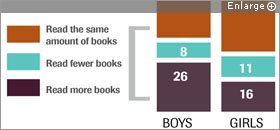
The e-book-reading numbers vary by only a few percentage points by gender or age group. But boys were slightly more likely to say that since they started reading e-books, they’re reading more books overall.

Half the young people said they’d read more books for fun if they had better access to e-books. And it’s clear that those surveyed are doing the lion’s share of e-book reading at home, rather than in school: Three-quarters of the respondents who have read an e-book have done so at home; only one-quarter said they had read an e-book in school.

Impact of E-Reading

Among children who have read an e-book, one in five says he or she is reading more books for fun, especially boys.
BRIC ARCHIVE

Note: Figures may not add up to 100 percent because of rounding.

SOURCE: Scholastic

E-books are particularly good when students are traveling or on the go, they told researchers, or when they don’t want their friends to know what they’re reading.

The survey for the New York City-based educational publisher was conducted online last fall. Questions were put to a nationally representative sample of 2,048 people, including children ages 6 to 17 and their parents.

No Batteries Required

But print books clearly still have a big place in children’s lives. Their responses showed that 80 percent of the books they read for fun are in print. They also prefer the printed form over the e-book for reading at bedtime or sharing with friends, the study found.

Fifty-eight percent said they will always want to read books printed on paper even if e-books are available. Two-thirds of the young people surveyed by Scholastic in 2010 gave the same response.

Asked about the benefits of e-books, children and parents most frequently cited the convenience of carrying all their books around in one place and obtaining books wherever they are. Among the e-book attributes they like the most are dictionaries, built-in note-taking and highlighting features, and skill-building activities.

Print books, on the other hand, got high marks from children and parents for not needing batteries and for the ease of seeing how much of a book has been read. Children, in particular, cited liking to hold a print book more than an electronic device. Parents cited liking to “get away from technology.”

Related Tags:

A version of this article appeared in the January 23, 2013 edition of Education Week as Children Still Prefer Print Books to E-Books

Events

This content is provided by our sponsor. It is not written by and does not necessarily reflect the views of Education Week's editorial staff.
Sponsor
Special Education Webinar
Bridging the Math Gap: What’s New in Dyscalculia Identification, Instruction & State Action
Discover the latest dyscalculia research insights, state-level policy trends, and classroom strategies to make math more accessible for all.
Content provided by TouchMath
This content is provided by our sponsor. It is not written by and does not necessarily reflect the views of Education Week's editorial staff.
Sponsor
School Climate & Safety Webinar
Belonging as a Leadership Strategy for Today’s Schools
Belonging isn’t a slogan—it’s a leadership strategy. Learn what research shows actually works to improve attendance, culture, and learning.
Content provided by Harmony Academy
This content is provided by our sponsor. It is not written by and does not necessarily reflect the views of Education Week's editorial staff.
Sponsor
School & District Management Webinar
Too Many Initiatives, Not Enough Alignment: A Change Management Playbook for Leaders
Learn how leadership teams can increase alignment and evaluate every program, practice, and purchase against a clear strategic plan.
Content provided by Otus

EdWeek Top School Jobs

Teacher Jobs
Search over ten thousand teaching jobs nationwide — elementary, middle, high school and more.
View Jobs
Principal Jobs
Find hundreds of jobs for principals, assistant principals, and other school leadership roles.
View Jobs
Administrator Jobs
Over a thousand district-level jobs: superintendents, directors, more.
View Jobs
Support Staff Jobs
Search thousands of jobs, from paraprofessionals to counselors and more.
View Jobs

Read Next

This content is provided by our sponsor. It is not written by and does not necessarily reflect the views of Education Week's editorial staff.
Sponsor
Reading & Literacy Whitepaper
Widening the Lens on Literacy
Science of Reading 3.0 is here! With contributions from 18+ top experts, we are widening the lens on literacy to advance the science of r...
Content provided by 95 Percent Group
Reading & Literacy Congress Wants to Know What Makes the 'Science of Reading' Work
Experts noted states' careful implementation—and the key role of federal investment in reading research.
6 min read
Students look at books during a book fair at Schaumburg Elementary, part of the ReNEW charter network, in New Orleans, Wednesday, April 19, 2023. Mississippi, Alabama and Louisiana have seen a promising turnaround in their student reading scores after passing a series of similar literacy reforms.
Gerald Herbert/AP
This content is provided by our sponsor. It is not written by and does not necessarily reflect the views of Education Week's editorial staff.
Sponsor
Reading & Literacy Whitepaper
Supporting Adolescent Readers with Word Recognition & Leadership
Designed for secondary educators and leaders, this white paper provides practical examples of explicit literacy instruction that strength...
Content provided by AIM Institute
Reading & Literacy Is the Bible Part of the U.S. Literary Canon? Texas Reading List Sparks Debate
Texas may soon be the first state in the country to mandate that every student read the same texts.
6 min read
Books line shelves in a high school library Monday, October 1, 2018, in Brownsville, Texas. The Brownsville Independent School District announced having been awarded a multi-million-dollar grant to revitalize libraries to encourage reading by school-aged children to improve literacy skills. It was stated in the meeting that money could also be used to replace aging furniture in some of the district's libraries.
Texas is poised to be the first state to require that every student read the same texts—including, controversially, selections from the Bible and several Christian parables. Books line shelves in a high school library on Oct. 1, 2018, in Brownsville, Texas.
Jason Hoekema/The Brownsville Herald via AP
