
High school students work harder and are more focused on school than they were a generation ago, according to a special analysis in “The Condition of Education 2012,” and the economic downturn may highlight an opportunity to put more of them on the path to college.
The National Center for Education Statistics, part of the U.S. Department of Education, released its vast annual statistical snapshot May 24 with a special focus on high schools.
In 2010, the most recent year for which data are available, the NCES reported 14.9 million students were enrolled in grades 9-12, a slight decrease from 2008 but still part of a slow rise since 1990; the NCES expects high school enrollment to recover and increase 4 percent in the next decade.
“The population’s different; it’s poorer and more diverse,” said Mel Riddile, the associate director for high school services at the National Association of Secondary School Principals in Reston, Va., but he noted, “I’ve been in education four decades, and I’ve found the students getting better and better every decade.”
NCES statistics do seem to show a generation more committed to academics.
The latest of the U.S. Department of Education’s annual Condition of Education reports finds declining percentages of high school students, ages 16 and older, are working outside of school.
Additionally, students whose parents have attained higher levels of education are more likely than those with less educated parents to have plans to earn a four-year college degree. But federal statistics show that the percentages of students aspiring to that level of educational attainment has risen in recent decades, regardless of parents’ education background.
SOURCE: National Center for Education Statistics
Fewer high school seniors in 2009 than in 1992 reported missing three or more days of school in the past month, and the percentage of 12th graders reporting perfect attendance in the month previous to the survey rose from 35 percent in 1992 to 38 percent in 2009.
Little to no change occurred from 1990 to 2010 in the percentage of students participating in extracurricular activities such as student government, clubs and drama, though there was an increase in sports participation, from 36 percent to 40 percent.
Lower Employment
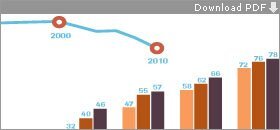
During the same time period, however, high school students have become half as likely to work while in school. From 1990 to 2010, the percentage of students age 16 and older who were employed while in school dropped from 32 percent to 16 percent. While the economic downturn has certainly contributed to that decline, the report shows student employment has been dropping steadily for the past decade.
“It used to be, you’d go to high school at 11 or noon, and there was this mass exodus of students, seniors with a half day,” Mr. Riddile said. “The culture in the schools today is much more oriented toward academics and success after high school than they ever were before. Students are required to take full courseloads and rigorous classes,” due in part to higher graduation criteria in 22 states.
That push for more rigorous coursework, coupled with an increasingly inhospitable employment environment for teenagers, could create some leverage for educators to put more students on track for higher academic achievement.
“Being in high school is a lot better than hanging out somewhere trying to get a job when you are competing against adults with families,” noted Jeffrey E. Mirel, a professor of education and history at the University of Michigan in Ann Arbor.
That may be helping to keep students in school. The NCES found that from 1990 to 2010, the percentage of students considered dropouts declined from 12 percent to 7 percent, and the percentage of freshmen who graduated in four years with a regular high school diploma increased slightly, from 73.7 percent in the class of 1991 to 75.5 percent in the class of 2009.
Moreover, seniors may be graduating better prepared than they were a generation ago.
More high school graduates in 2009 had completed rigorous high school classes than had done so two decades before. Of a slew of mathematics and science courses considered important for college readiness—including algebra, geometry, trigonometry, statistics, analysis/precalculus, calculus, biology, chemistry, and physics—only Algebra 1 saw a decrease in the percentage of students completing the course between 1990 and 2009. The NCES noted that the decrease in Algebra 1 was more likely due to more students taking algebra in earlier grades than to fewer taking the course at all. And all the other subjects—science, technology, engineering, and math—listed saw a significant increase in students from 1990 to 2009, including 24 percent more students completing geometry and at least 20 percent more completing Algebra 2, precalculus, biology, and chemistry.
“If they are taking courses with genuine academic rigor, that is something to be very pleased about,” Mr. Mirel said. It suggests “we are responding to the Great Recession in a better way than educators responded to the Great Depression.”
In the years of the Great Depression, schools likewise saw a sudden increase in the number of students, including the poor and immigrants, remaining in high school, according to Mr. Mirel, a co-author with David Angus of the 1999 book The Failed Promise of the American High School, 1890-1995. The rate of students staying in high school rose from around 50 percent to 74 percent before and after 1940, but in response, states reduced the rigor of the curricula, he found, replacing college-preparatory courses like calculus with “general math.”
This time around, tighter state graduation requirements have coincided with greater access to online courses, particularly in rural districts.
“Certainly, we do see districts and states use distance education to bring in advanced courses that they wouldn’t have been able to afford otherwise,” said NCES Commissioner Sean P. “Jack” Buckley.
Distance-learning enrollment, including online classes, has skyrocketed, from 222,000 students in 2002-03 to more than 1.3 million in 2009-10.

Although students might face a more challenging academic landscape in school, the NCES found it is also a less stressful one from a safety standpoint. From 1992 to 2010, the rates of all school-based crimes dropped dramatically. In 2010, 32 nonfatal violent crimes took place on campus, including sexual assault and robbery, for every 1,000 students ages 12 to 18. That’s less than a third the rate in 1992 of 154 crimes per 1,000 students. Similarly, the rate of theft dropped from 101 to 18 for every 1,000 students.
The NCES found 49.5 million students attend public P-12 schools, continuing a steady rise since the 1980s. Moreover, analysts project enrollment will rise by 7 percent, to 53.1 million, by the 2021-22 school year. The West and parts of the Eastern Seaboard are expected to grow even faster, and three states—Alaska, Arizona, and Nevada—are expected to see a more than 20 percent jump in their student populations.


