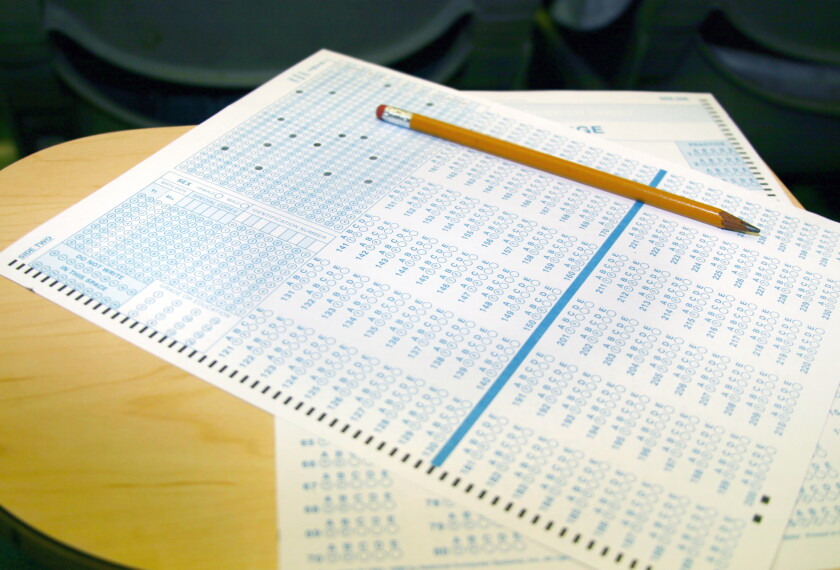
The latest test-fiddling in New York has created a situation in which teachers and students are likely to be demoralized. Last year, 82 percent of New York City students passed their math exams; this year, only about 54 percent passed. In some schools, the drop in passing scores was dramatic—more than 20 percent—and in at least one school, the drop in math proficiency was 63 percent. Such wild fluctuation in passing scores makes school people look ridiculous. Why should the public accept any numbers we give them when next year’s numbers are likely to be entirely different?
Lewis Carroll would have a ball with this. If he were living now, he might write Teacher Tess in Testing Land, the story of a place called school in which nothing is as it seems. Teacher Tess has been working hard for several years to help her students pass the 4th grade math test. Last year, 75 percent of her students passed the test—way up from four years ago. This year, with the same scores, only 40 percent passed. What happened? Tess asks.
Well, Tess, here’s what you must understand. Your students didn’t really pass the test last year. The standard for passing was way too low. You’ll have to do a lot better. We’ve noticed that, even though your kids are doing well on the state tests, they are not doing much better on the big national test. They are doing well on the state test because you are directly teaching that material.
But, but, Tess protests: That is what I’ve been told to do—to skip all the “extra” stuff and teach a specific set of knowledge and skills, and that’s what I’ve done.
Tess, you don’t understand. You must not teach the material directly. You have to teach it in a roundabout way so that the test questions will appear new and different.
Crestfallen, Tess asks: How do I do that? I’m forbidden to deviate from the standard curriculum. And, look—my kids are so proud of what they’ve accomplished. How do I tell them that they are still failures?
Well, tut-tut, my dear. We can’t have all of the kids passing. What would that say about our standards?
Every good math teacher is familiar with a phenomenon that has always been with us. A good teacher can get almost all of her students to do well on a quiz on narrowly defined material. As a high school math teacher (years ago), I gave regular quizzes to check on whether I had taught specific topics effectively. If a large majority of my students (all but two or three) did not score 80 percent or better, I threw out the quiz and retaught the material. We did not go on to a new topic until virtually everyone did reasonably well on the specific topic just taught.
Even so, when we came to a major chapter or unit test, the spread in scores was considerable. On a major test, students hadto read more, identify the type of problem, select an appropriate method of solution, and work through the mathematical mechanics to the answer. Unit tests tended to identify those students with exceptional mathematical talent and interests. I always hoped that all kids would make a respectable showing on the unit tests, and they did fairly well, but I never overcame the quiz-test gap. I had to settle for scores much lower than 80 percent for many of my students.
It is a tragic mistake to coerce all kids toward a standard that a few can meet so easily. Instead, we should be helping them identify and use their own special talents.
It may be that we are now asking our teachers to overcome that quiz-test gap, and I seriously doubt that it can be done. Indeed, I think it is a tragic mistake to coerce all kids toward a standard that a few can meet so easily. Instead, we should be helping them identify and use their own special talents. And we should be satisfied if they learn the basic material that we set out for all kids (if it is chosen reasonably). When they show that they have done this, we should celebrate instead of pooh-poohing their achievement and raising the bar.
The latest test-fiddling in New York has created a situation in which teachers and students are likely to be demoralized. Last year, 82 percent of New York City students passed their math exams; this year, only about 54 percent passed. In some schools, the drop in passing scores was dramatic—more than 20 percent—and in at least one school, the drop in math proficiency was 63 percent. Such wild fluctuation in passing scores makes school people look ridiculous. Why should the public accept any numbers we give them when next year’s numbers are likely to be entirely different?
Now, of course, if the test is so badly constructed or the passing standard so ill-conceived (as some people have complained) that a student could pass by selecting answer “b” and filling that in for every question, then we should apologize to the public for our incompetence and explain why we must start over. Similarly, if we discover that our tests are not measuring what we intended, we should apologize profusely for the enormous waste of money and time and perhaps call a moratorium on testing until we figure out what we really want to test.
In any case, standardized tests should not be used to decide promotion. They shouldn’t be held against the kids in any way. Well done, they should be a useful check on “how we are doing” with respect to the basic required curriculum. Of course, we should be doing much more—restoring opportunities for kids to invent, communicate, explore, and use a variety of talents to fulfill course requirements. We have sacrificed richness, depth, and creativity to a dull struggle for higher and higher scores on material that is quickly forgotten when the test is over.
Let’s free Tess from Testing Land and restore her to a real world of teaching and learning.