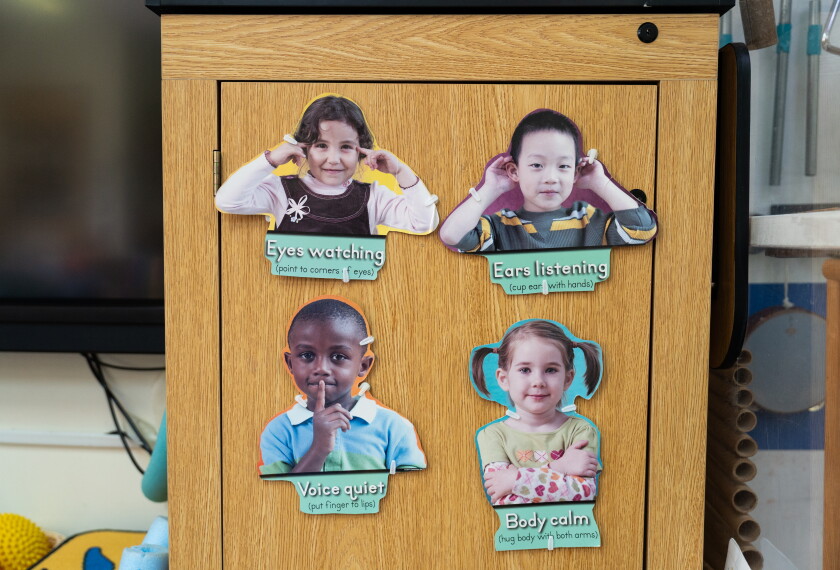
A majority of Latino children enter kindergarten with the same social skills as middle-class white children, while low-income Latinos demonstrate stronger social skills than low-income African-American kindergartners at the start of school, says a study published in the May issue of Developmental Psychology.
The article is one of seven focusing on factors leading to the success or lack of success of Latinos in school published this month in both the print and online editions of the journal. The studies show that, overall, Latino children tend to start school with some strong assets, but those early gains are likely to soon disappear if they attend low-quality schools and live in low-income neighborhoods.
“We need to get beyond this myth that low-income parents always raise disadvantaged children,” said Bruce Fuller, a professor of education and public policy at the University of California, Berkeley, who co-edited the articles and was a researcher for the study looking at kindergarteners’ skills. Latinos appear to have some cultural practices that make their children ready to learn, he said. “We were surprised by how strong these kids’ social skills looked.”
Mr. Fuller and Claudia Galindo, an assistant professor in language, literacy, and culture at the University of Maryland Baltimore County, drew on a database of 19,590 kindergartners, called the Early Childhood Longitudinal Study, to compare the social skills of children from different ethnic and racial groups at the start of kindergarten. The researchers also looked at how having those social skills, which were rated by teachers, translated into kindergartners’ acquisition of mathematics knowledge.
The researchers found a strong correlation between their social competency when entering kindergarten and the gains they made in math skills during kindergarten. They looked at several social areas: self-control, interpersonal skills, approaches to learning, and internalizing and externalizing problem behaviors.
The study found that the children’s competence in “approaches to learning”—their engagement in classroom tasks—had the greatest impact on their math gains. It is measured by factors such as how well a child can sit still at a table and work on a task or how interested the child is in classroom activities, Mr. Fuller said.
Differences Within
The researchers aren’t the first to publish findings on the social skills of Latino children entering kindergarten using that database. But they are the first to draw on it to report differences among subgroups of Latino kindergartners, Mr. Fuller said. For example, the study found that children of Mexican heritage start kindergarten with social skills and task engagement very comparable to those of white children. But that’s not the case with Puerto Rican children, who, on average, enter school with significantly less social competence than white children.
What’s also new are some of the findings in the study about the impact of social-class differences on social skills. While a majority of Latino kindergartners had the same social skills as their white middle-class peers, the study did show a gap, on average, for Latinos from low-income households with white middle-class kindergartners.
An even bigger gap was found, in fact, between the low-income children and the white children in math understanding at the start of kindergarten.
Such results indicate that schools should build on Latino children’s social skills to further their cognitive development, Mr. Fuller said.
Robert Crosnoe, an associate professor of sociology at the University of Texas at Austin who conducted previous research on Latinos using the same national database, said the Developmental Psychology study is in line with his findings.
“Their parents do a great job of getting them school-ready in a behavioral or socioemotional sense, even if their academic skills (e.g., knowledge of math or reading ability) are somewhat lower than those of other children,” he wrote in an e-mail. He said the implication of the collection of studies on Latinos in the most-recent issue of the journal is that “we need to make the investment at the start of school, when [Latino children] are eager and enthusiastic and motivated but before the many disadvantages they face (e.g., lower-quality schools, watered-down curricula) start to chip away at the socioemotional advantages they bring into school.”
Linda Espinosa, a recently retired professor of early-childhood education from the University of Missouri, in Columbia, said the study shows “there is something going on culturally that is protecting [Latino children] during their early-childhood years.”
Unfortunately, she said, the assets that Latino children bring to school may be overshadowed in the minds of educators by the fact that some don’t speak English and are from low-income homes. Educators need to build more on the strengths of Latinos, she said.
A lot of the curricula that focuses on helping Latino mothers prepare their children for kindergarten, Ms. Espinosa said, emphasizes moving parents and children to English as soon as possible, which she contends isn’t the best approach.
She added: “We have some evidence of real capabilities [in Latino youngsters] that our school people are missing once academics starts to take center stage.”