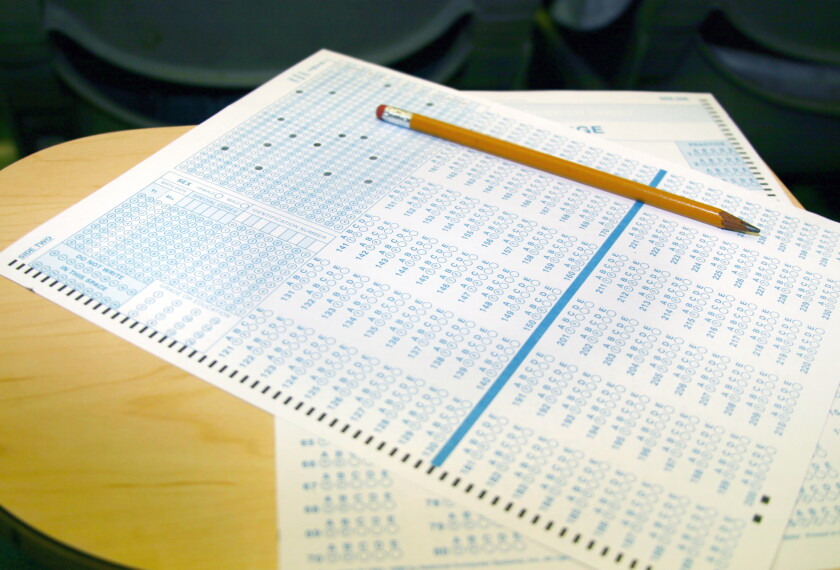
Is testing a waste of time? Teachers seem to think so. In a 2006 survey, 71 percent of them said that students took too many standardized tests, and 62 percent called testing a “necessary evil.”
Yet when Oregon introduced its online testing system, which allows students to take the tests up to three times a year, teachers embraced it. They apparently did not think the testing burden was either excessive or evil.
Why? Because the Oregon test delivers near-instantaneous results that show teachers how students perform on particular content strands, such as geometry or measurement. Teachers can use the information in real time to adjust instruction and devote additional attention to students in areas where they need help. For these teachers, tests are not separate from instruction; they are integral to it.
By contrast, the accountability tests most states use, which loom increasingly large, provide little useful information to teachers. The results often come back too late, in many cases after the class has left for the summer. And the results often tell little about students’ strengths and weaknesses, much less what instructional strategies teachers should employ to raise performance.
Accountability tests can provide important information, but because of their outsized influence in schools, they have been asked to do too much. We expect them to inform students and parents about academic progress, teachers about what to do to improve instruction, community members about school success, and states and the nation about whether students and schools are meeting goals. These expectations, all important, are more than any assessment—even the most sophisticated—can bear. And most of the tests now in use are far from sophisticated.
Accountability tests can provide important information, but because of their outsized influence in schools, they have been asked to do too much."
Fortunately, there is a growing chorus suggesting that states and the federal government reduce their reliance on accountability tests as the primary measure of student and school performance and instead develop comprehensive assessment systems, based on standards, that include a variety of measures that can effectively serve all of the purposes we want tests to serve. These measures won’t simply mean more testing; they can mean better information that can lead to improvements in teaching and learning.
The emphasis on assessment systems is fueled in part by a confluence of factors that make it more likely that these visions can become reality in the next few years. The state-led effort to develop common-core standards for college and career readiness will invariably be followed by new assessments that measure progress toward those standards. (“Rules Urge New Style Of Testing,” April 21, 2010.) These assessments are likely to include components, such as curriculum-embedded projects, that measure competencies traditional accountability tests do not tap.
At the same time, the U.S. Department of Education has launched a $350 million competition for consortia of states to develop assessments to measure the common-core standards. The designs that are being suggested, while in their preliminary stages, represent bold departures from current practice.
Finally, advances in technology make possible new types of assessment formats, such as simulations, that were not available a decade ago, and also make the use of existing formats more feasible. Technology also facilitates the development of information systems that can link assessments and assessment results more closely to instructional tools to support teachers, and directly to the classroom.
As a result, what we might be seeing in the next few years is a sophisticated information system that informs students and parents about progress toward standards for college and career readiness; teachers about the knowledge and skills students can demonstrate and what they need to work on (as well as about what they themselves need to do to address those areas); and communities and states about school progress toward standards. And, if the measures are done right, the assessments themselves can support learning by modeling the kinds of activities students need to be able to know how to perform.
To envision how such a system might shift school practice, consider what has happened in the retail industry. In the past, retail stores would close their doors for a day each year to take inventory. Now, thanks to the accurate and instantaneous information bar codes allow, retailers can keep track of their inventory in real time, 365 days a year. This is not to say that students are commercial products, or that we want to slap bar codes on their foreheads. But a comprehensive assessment system could provide continuous, coherent, and high-quality information on student performance that teachers, school leaders, and district and state administrators could use to improve teaching and learning.
In such a system, assessment is neither excessive nor evil. Nor is it a waste of time. On the contrary, assessment—and the information it provides—is a vital tool to improve instruction, learning, and school practice.