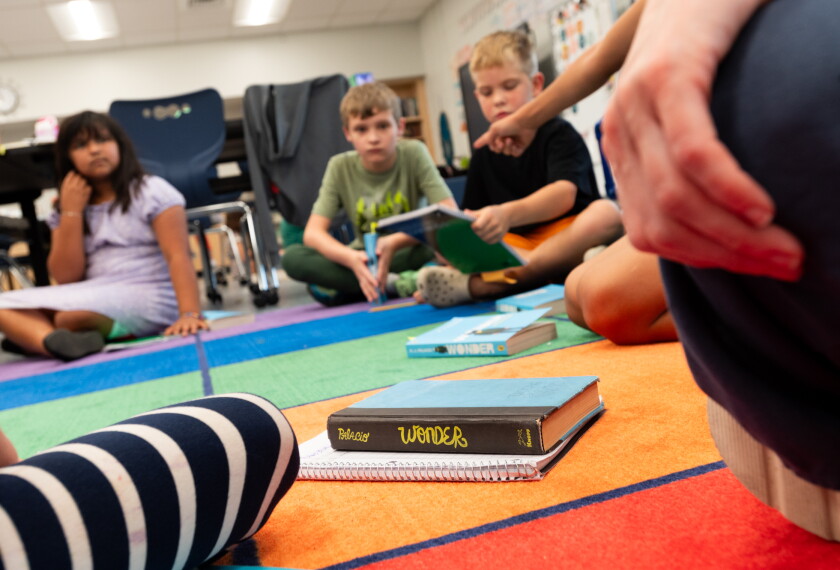
In efforts to encourage young adults to read more, the question of how to decide what they read always prompts lively debate among teachers, parents, and young people themselves. My experience as an educator and lifelong reader leads me to the axiom: The more adults encourage and the less they intrude, the better.
The love and power of reading are part of what led me to become a teacher after leaving the Marine Corps in 1975. As a captain in the armed forces, I had experienced one way of getting people to accomplish a mission. But my civilian upbringing helped me understand that, in working with young people especially, there are other ways to encourage, inspire, and model how to get things done.
A story in The New York Times this year rekindled for me, and no doubt for other educators, that age-old debate over whether we should tell young readers what to read or let them choose for themselves. It recounted the growth in the number of teachers who follow the educator Nancie Atwell’s reading-workshop approach of encouraging children to choose for themselves. But the article also disclosed one instance when the renowned Maine teacher, trainer, and author drew the line: with Gossip Girl. “Despite the student freedom,” the Times article notes in describing one workshop session, “Ms. Atwell constantly fed suggestions to the children. She was strict about not letting them read what she considered junk: no Gossip Girl or novels based on video games.”
This struck a chord with me. Last spring at my school, the voluntary middle school book club and its teachers chose to read a book in the Gossip Girl series. After my initial gasp, I stepped back, read the book myself, and then watched as the students and teachers, together, carefully crafted the reading experience.
Because the books’ author, Cecily von Ziegesar, lives in the neighborhood, the club asked her to make a class visit. She graciously complied, and sat with the students and their teachers to talk about her 13-book series, what motivated her to write, how she viewed the main character (highbrow instigator Serena van der Woodsen), and the realities of writing a book that eventually became a hit television series.
Gathered around a table in the library, the middle school students listened to the author, asking her questions along the way that conveyed a need to decipher truth from fiction. From their thoughtful interactions, it was easy to see that they had experienced a unique, enlightened read with these books. The incident taught me that, while discretion may be essential in choosing books for young people, collaboration between students and teachers can extend a reading list.
But back to the Times article, which quoted the education historian Diane Ravitch as saying: “What child is going to pick up Moby-Dick? Kids will pick things that are trendy and popular. But that’s what you should do in your free time.”
Yes, that’s what I did as a kid in my free time. I was attracted to Archie comics and Mad magazine, with its iconic cover character, Alfred E. Neuman. Yet when I sat in my English class as a 9th grader, I distinctly remember being handed Mary Johnston’s To Have and to Hold to read, and thinking, “Man, this thing is over a hundred pages.” When the student sitting next to me got his copy, he quipped to the teacher, “I read this already.” Her lightning retort: “This will be my fifth time reading it, and it always gets better each time I read it.”
It is a book I cherished, then as now. The teacher did such a good job guiding my class and me through its wonderful plot, Colonial setting, and literary techniques. Sometimes, we all need to be encouraged when it comes to reading. And classes like my 9th grade teacher’s are able to do that, and more.
Such inspirations may be dwindling, though. “Reading Rainbow,” the children’s television program that my children and my wife and I watched together, is ending its run of 26 years on PBS. Its goal was getting kids interested in reading, and I fondly remember the host, LeVar Burton, reading to them and listening to their reviews of the books they had read. What a great idea it is to use popular culture to entice and inspire children to read.
It’s funny how it takes different approaches to accomplish a mission. Take, for instance, the phonics/whole-language wars. Remember how much better things got when enlightened educators realized that both approaches had a place in good reading instruction? The more we are sensitive to the fact that children learn at different paces, and that reading is not a one-size-fits-all process, the sooner we will understand that reading acquisition for young people will happen when the student is ready.
Yet for many public schools, the Times article suggests, the bottom line for giving children the freedom to choose what they want to read appears to be what ultimately pays off in standardized testing. Using numbers in an attempt to measure progress in a child’s development is always a bad idea. So, too, is using a number system like the Accelerated Reader software’s point system based on length and difficulty to determine the worth to a student of reading a particular book.
Decide for yourself the value of such a rating system. Here, according to Susan Straight’s essay in The New York Times Book Review, “Reading by the Numbers,” is a sample of how the software assigns value: Hamlet, 7 points; I Like It Like That (a Gossip Girl novel), 8; Go Tell It on the Mountain, 13; My Antonia, 14; To Kill a Mockingbird, 15; Harry Potter and the Order of the Phoenix, 44.
Whether a young adult picks up The Witch of Blackbird Pond or an Archie comic, To Kill a Mockingbird or Mad magazine, I Know Why the Caged Bird Sings or Gossip Girl, it is the mission of teachers and parents to guide, encourage, and stand by to explain and support when needed—and to do all this without intruding.
Let young people decide what they should read based on where they are in their intellectual development and maturity. It’s the best way to keep them reading.