Parents might not be at sea, after all, when their children go into cyberspace.
A new study of American families finds that the reason most parents and children buy computers and use the Internet from home is to pursue education, and that they regard the online experience as positive and healthy, though not without some dangers.
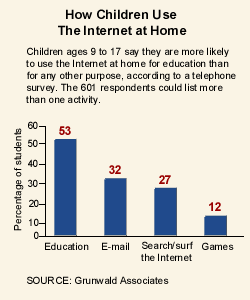
The study, conducted by the market-research firm Grunwald Associates, was commissioned by the National School Boards Foundation, an arm of the Alexandria, Va.-based National School Boards Association.
Gary Knell, the chief executive officer of the Children’s Television Workshop—which underwrote the study along with Microsoft Corp.—said the findings should dispel what he sees as a polarized national debate about whether the Internet is good or bad.
“Both [sides] miss the point. The Internet itself is neither good nor bad. It has potential for great reward and great risk,” Mr. Knell said at the poll’s release here last week.
To skeptics about the use of the Internet in education, he added: “Stopping the [Internet] is not going to happen. It’s up to us to create great content and move forward.”
Follow-Up |
| Read the complete report, “Safe & Smart,” online, courtesy of the National School Boards Foundation. |
Last November and December, interviewers surveyed parents in 1,735 randomly selected households with children ages 2 to 17 by telephone. The interviewers then questioned 601 children ages 9 to 17 in the same households. The full results have a margin of error of 2.4 percentage points. For the children’s sample, the margin is 4 percentage points.
Two-thirds of the families surveyed said they had a home computer. The most commonly cited reason they bought one was to further their children’s education, at 36 percent, followed by business use, at 27 percent.
And once they had acquired the computers, an even larger group of parents—45 percent—said their children’s education was indeed the computers’ most common use.
For many children whose families are online, the Internet has become a routine tool for schoolwork. Fifty-two percent of the 9- to 17-year-olds who use the Internet reported using it for schoolwork at least once a week; an additional 28 percent reported using it for that purpose at least once a month.
Children also go online for many learning activities that are not connected directly with school. Fifty-seven percent of respondents ages 9 to 17 said they used the Internet at least once a month for pursuing information about hobbies and other interests.
Parents who were surveyed expressed concern about online pornography, violations of privacy, and the danger of adult predators. But they and their children were generally upbeat about their online experiences—a conclusion that held across all racial and ethnic groups and economic levels.
The survey, which included questions about Internet use at school, found that 43 percent of 9- to 17-year-olds with Internet access at school said the Internet had improved their attitudes toward school. Virtually none said it had worsened their attitudes. Fifty-seven percent of the students said the Internet had had no effect on their attitudes about school.
Staying Connected
The poll results contradict what has become a popular perception about the Internet: that it causes feelings of isolation in the people who use it. That conclusion was reached in a recent study of 4,113 U.S. adults by two researchers from Stanford University’s Institute for the Quantitative Study of Society.
By contrast, the study released last week found that children who were active online were not cut off from their families, nor did they generally spend less time reading or playing outside.
Anne L. Bryant, the executive director of the NSBA, said the poll results should help educators and lawmakers understand the impact of the Internet on education.
“Too often, we have legislation by anecdote,” Ms. Bryant said. “We need a lot of data around the use of the Internet.”
The National School Boards Foundation also released a set of guidelines for school leaders and parents that encourage what Ms. Bryant called “a balanced approach to the Internet.”
A well-known skeptic about education technology cautioned that the NSBF study would not end the debate about the value of the Internet. “Right now, like so many things regarding education technology, the jury is out,” said William L. Rukeyser, the coordinator of Learning in the Real World, a Woodland, Calif.-based nonprofit information clearinghouse on school technology.


