
Most of the focus on artificial intelligence in K-12 education has been on ChatGPT and how students can use it to cheat. But that obscures the bigger changes to education that recent advances in AI are kicking off, said Peter Stone, an expert on the future of this technology.
“I do think that the concerns about ChatGPT changing the nature of cheating is a little bit of a tempest in a teapot,” he said.
Stone is a professor of computer science at the University of Texas at Austin. He’s the chair of the One Hundred Year Study on Artificial Intelligence (AI100), which draws insights from experts around the world in reports published every five years to try to understand what the long-term impacts of AI will be on society. Stone is also a signatory of an open letter from prominent AI experts and tech leaders calling for a 6-month pause on the development of new AI systems, following the release of ChatGPT-4 and concerns that even the developers of these new technologies don’t fully understand how they work or their power.
Education Week put three questions to Stone on how AI will likely impact education.
This conversation has been edited for length and clarity.
How do you see AI disrupting or fundamentally changing K-12 education?

First of all, it’s going to be very important for students being educated today to learn about artificial intelligence. That’s different than artificial intelligence changing education [and] more about making artificial intelligence as a topic of education.
It’s going to be a part of their careers and their working environment. So, they need to know how to use artificial intelligence technologies and also to be literate as to what AI is capable of, what it’s not capable of, what its potential uses and misuses are.
I taught a graduate course this year on introduction to ethical AI and robotics—things like misinformation and impacts on the economy, and all these sorts of things are very appropriate for K-12 students to be thinking about.
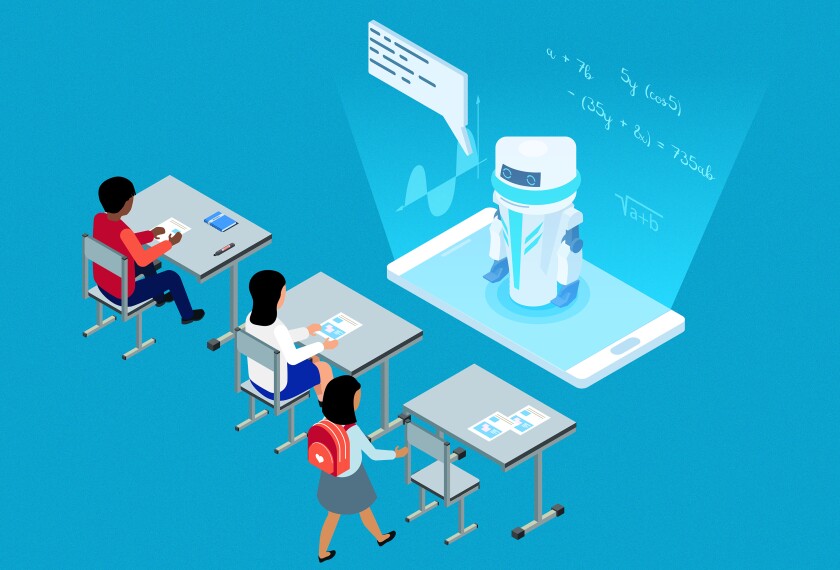
The other is there have been people working in artificial intelligence for a long time on personalizing education. When a person is trying to learn, can we figure out what they’re good at and bad at from watching them do a couple trials and have it [the A.I. program] automatically suggest what task the person should try next? It can apply to learning math. It can apply to learning writing—trying to automate or personalize the curriculum that a student needs to be able to learn as quickly as possible. There’s a whole field of this that goes by the name of intelligent tutoring. This is something that can, as it becomes more mature, definitely disrupt K-12 education.
Is there a role for a teacher in that scenario? Or could they be replaced?
Jobs are going to be transformed. They’re not going to disappear. There’s always going to be a role for a teacher. With automated curricula, there’s still room for a person’s intuition, to watch the student where they’re struggling and to adjust the curriculum.
Teachers are going to be able to help students use the tools. Did a calculator replace the role of human teachers in math classrooms? No. The teacher now has to teach how to do arithmetic without a calculator and then how to use the calculator appropriately. This notion of curriculum learning is aiming to automate some of that process. But it’s a long way from being perfect. I don’t think there’s any danger that it’s going to be better than individualized attention from a human teacher. On the other hand, it may not be a stretch for it to be much better than having no teacher or having a teacher who’s in a classroom that has way too many students for them to pay attention to.
How do you prepare students for a labor market in which you don’t even know what jobs might exist five years from now?
If you look back through human history, it used to be that the job you did was the same job that your parents did and that would be true for generations. Then [with the] industrial revolution, you might not do the same job that your parents did, but you would at least be doing the same job for your whole working life. Over the past decade, that’s no longer the case. People often change careers.
We shouldn’t be educating our students to do a particular job. We now need to be educating our students to be able to be flexible, to be able to retrain themselves, to be able to learn how to learn … because the nature of that job may change over the next few years. Or you may find that you need to be able to jump to a new career partway through. Being empowered to learn how to learn, a lot of that is literacy with technology and literacy with artificial intelligence. Artificial intelligence is going to impact a lot of jobs going forward.
The question we should all be asking is: how can it be used to improve education to make it more effective? How can we find ways to make teachers more efficient at teaching; students more efficient at learning?


