A few weeks ago, I wrote a very personal piece for Education Week, suggesting that, if there had been a pandemic when I was in middle school, I might have been better off because of remote learning.
I said I would have been grateful to get away from the 7th-grade social scene, where I felt lost. I wrote that, given my attention deficit disorder, I would have been better able to tackle difficult-for-me content, especially in math, with the extra time and personalized attention that online learning can allow.
I said I was jealous of some of today’s COVID kids for being able to skip out on at least part of the miserable middle school experience that I went through.
The response from actual COVID-era 7th and 8th graders? You have no idea what you’re talking about, lady. (Well, they put it nicer than that.)
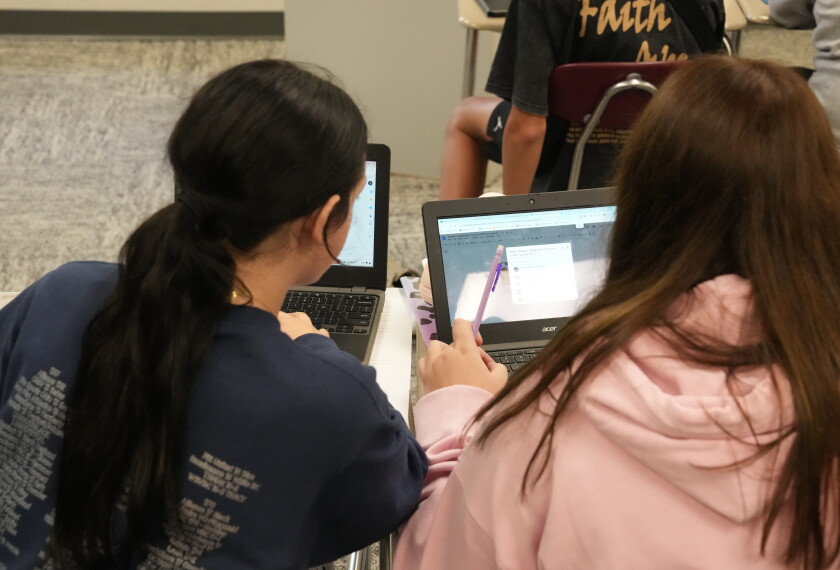
Canye Letizia, who teaches literacy at Valhalla Middle School near New York City, shared my personal essay with his students. They are learning in a hybrid model, where most students split their time between remote and in-person instruction. He wanted to know if my vision of online learning was in line with their reality. Letizia asked the kids to write to me, sharing their thoughts about my perspective and their own experiences.
Bottom-line: The students were all very polite, but most made it clear they think I’m nuts for wishing I could put my 7th-grade self in their shoes.
Here’s a sample of what they had to say:
“It is not as fun as it seems to be home all day. It gets boring in between classes, and you don’t always get the attention you need for your questions to be answered. Take it from somebody doing it first-hand, learning is much easier in a building than at home,” said one boy.
“I thought there was no way someone would want to live through this pandemic,” wrote another. “I don’t really enjoy wearing a mask, and I find it hard to learn anything when I am at home.”
“I am in 7th grade and I’ve never really felt the way that you have,” wrote a girl. “I have plenty of friends and I enjoy getting involved and being different. I try not to think of what others think about me, although I know it is really hard. During the pandemic, online school was so dull for me. I did well in school, got good grades, but every day felt almost the same and I missed seeing my friends and teachers and I missed the normal way of learning. Online school just wasn’t the best for me and living through a pandemic at my age is torture.”
For another boy, online learning is painful. Literally, “I currently get headaches all the time from staring at the computer screen for so long,” he wrote.
And one girl said the arrangement has taken a toll on her mental health:
“Being a ‘COVID kid’ isn’t that great. Last year [when the pandemic hit] I felt I was in a never- ending cycle of just school. You woke up and you went to school, you did your homework all day, ate, then you were just in a slump. The weekends merged into the weekdays. Birthdays felt the same, holidays, all of it came and left, instantly. I was up late at night getting no sleep staring at the ceiling. I’d have toddler meltdowns over nothing sometimes. (and they were absolutely hilarious).” Note: I didn’t ask her parents or guardians if they also found her toddler meltdowns “hilarious.”
Other kids said that they spent too much time dealing with technical difficulties.
“Learning from home isn’t as fun and easy as it seems. Sometimes when my WiFi goes down because too many people are on it, we cannot join our google/zoom meeting,” wrote another student.
But a few kids said they got where I was coming from:
“I am doing fully remote schooling and it does have some benefits. I can eat a snack, re-watch videos, and do assignments at my own pace. Also, I can pursue my own interests like science or coding,” wrote a boy.
And one girl said she her middle school experience was similar to mine–right down to eating lunch in a bathroom stall in order to avoid the cafeteria social scene.
“I have to admit that I did eat lunch in a bathroom stall multiple times,” wrote one girl. “I heard some students saying ‘omg that’s heartbreaking’ while reading (which it is) and I was just silently thinking about every time I’ve done that. I really feel that your 7th grade and my 6th grade were almost identical. I’ve never really related to an actual human being besides my cousins and fictional characters.”
Another boy, who seems to have some of the same learning differences I do, said he found it easier to concentrate at home. “Sitting at a desk all day can be boring and I often get distracted,” he wrote. “That is why I like it at home where I can stand up and walk around to regain focus if I need to.”
Still, it seems that loving online learning is the exception, rather than the rule. Want to know what kind of students are actually doing better academically under this arrangement and what schools can do for them going forward? Check out this story.