
Classroom Technology

What’s in a Name? Check Out ISTE+ASCD’s Rebrand ... ish

By Alyson Klein — June 28, 2026 2 min read
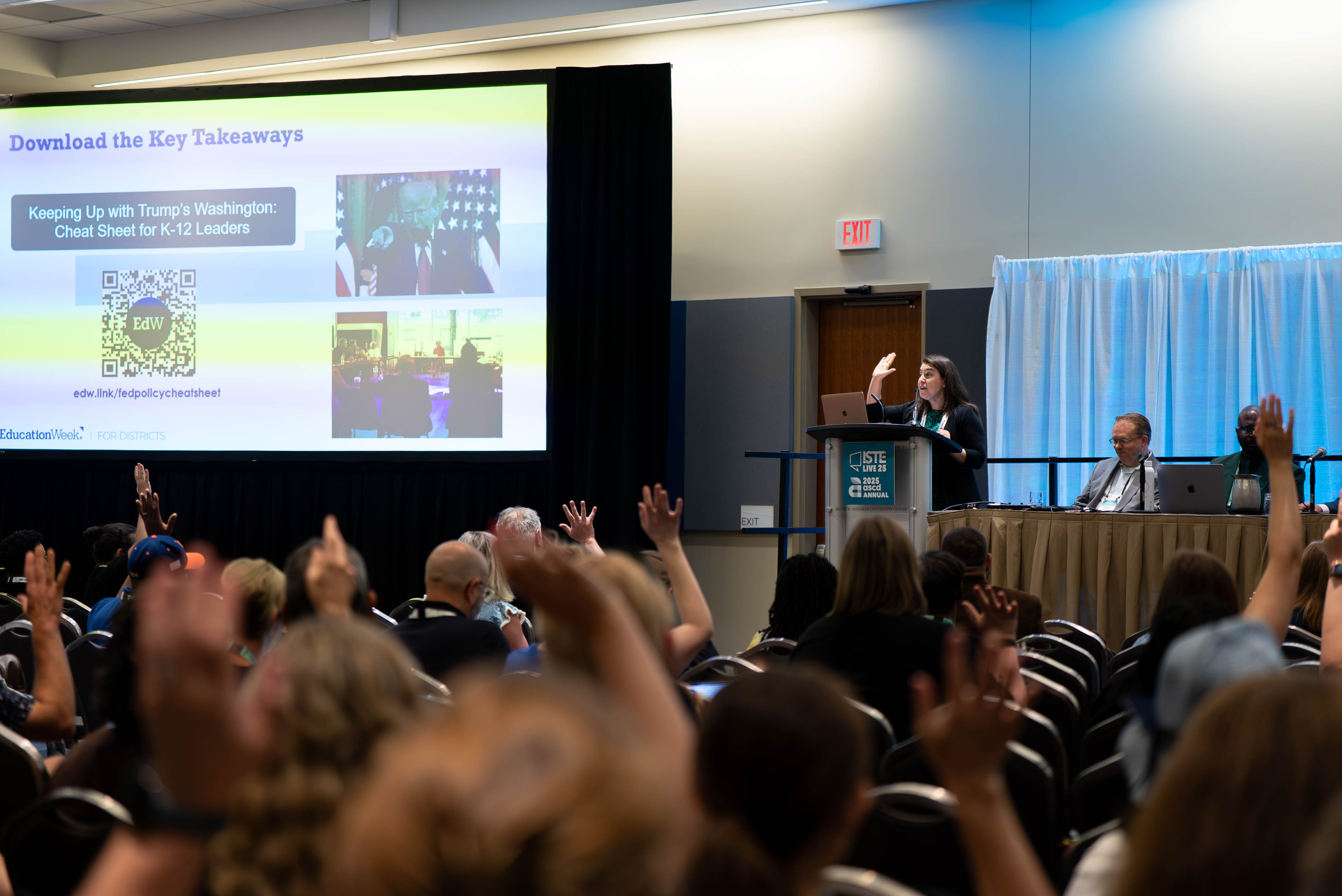
A look at the 2025 ISTE conference in San Antonio.
  • Save to favorites
  • Print

Four years ago, the then-International Society for Technology in Education, better known as ISTE, announced a merger with the former Association for Supervision and Curriculum Development, or ASCD, one of the oldest and largest K-12 professional development associations.

Since then, the combined organization—temporarily called ISTE+ASCD—has “co-located” its mega conferences and sought to define its mission as a centralized resource for educators navigating teaching and learning in the digital age.

Its leaders promised to eventually unveil a new, permanent moniker.

At the kickoff of the organization’s ISTELive 26 + ASCD Annual Conference held in Orlando, Fla., between June 28 to July 1, CEO Richard Culatta revealed that ISTE+ASCD will become … ISTE.

The twist: The acronym will now stand for the International Society for Transforming Education.

The new name comes at a moment when schools are grappling with a gamechanging technological twist—generative artificial intelligence—which purports to personalize lessons for struggling students but can also serve as an uncredited ghostwriter for would-be cheaters and opens the doors for massive student-data privacy problems.

We are in a moment where we need to transform learning. We can’t just keep doing the things that we used to do.

It also comes as school districts around the country are rethinking their use of technology in response to clamorous criticism from parents and caregivers, as well as bipartisan political pushback to a perceived increase in student screen time.

Join us at ISTE+ASCD
Event

Heading to Orlando for the ISTE/ASCD conference? Be sure to attend The Ed-Tech Backlash Is Here. How Should District Leaders Respond? on Monday, June 29, 1-2 pm ET. Join EdWeek Assistant Editor Alyson Klein, EdWeek Research Center Director Holly Kurtz, and a panel of district leaders to understand what’s fueling the ed-tech pushback, get practical takeaways on how to respond to community concerns about screen time, and more.

Join us >

“ISTE was never really about the technology. We were about accelerating innovation,” Culatta said in an interview before the conference. “ASCD was never about supervision and curriculum development. It was about transforming learning through providing good supports to school leaders.

“Both organizations, legacy organizations, had names that were about what they did. We are now shifting to a name that describes why we do it. So that’s the key shift, and I hope I think it will really resonate with people.”

Why add the word transforming?

Culatta explained: “We are in a moment where we need to transform learning.We can’t just keep doing the things that we used to do. We can’t do assessment the way we used to do assessment. We can’t do teaching the way we do teaching. We have to be very thoughtful about pushing the boundaries more. We’re really worried there isn’t enough of a drive to really rethink and reimagine some key parts of learning, and that’s what we do.”

Why the long wait for the big reveal?

“We got some really good advice early on, which was, you don’t make a name and then become what the name is, you become what you want to be, and then you rename” your organization based on that, Culatta said.

Events

This content is provided by our sponsor. It is not written by and does not necessarily reflect the views of Education Week's editorial staff.
Sponsor
College & Workforce Readiness Webinar
From Exposure to Experience: Designing Accessible Work-Based Learning
Learn how schools can create meaningful experiences that help every student build skills, connections, and a clearer path to their future.
Content provided by Project Lead The Way
This content is provided by our sponsor. It is not written by and does not necessarily reflect the views of Education Week's editorial staff.
Sponsor
School & District Management Webinar
A Tale of Two School Districts: Forecasting Enrollment
Forecasting enrollment is hard. Here’s how two different districts are navigating times of change with data that considers the whole picture.
Content provided by Zonda Education
Reading & Literacy K-12 Essentials Forum Strategies to Create a Culture of Reading in Schools
Join this free virtual event to learn how teachers and school district leaders ensure students are reading enough.

EdWeek Top School Jobs

Teacher Jobs
Search over ten thousand teaching jobs nationwide — elementary, middle, high school and more.
View Jobs
Principal Jobs
Find hundreds of jobs for principals, assistant principals, and other school leadership roles.
View Jobs
Administrator Jobs
Over a thousand district-level jobs: superintendents, directors, more.
View Jobs
Support Staff Jobs
Search thousands of jobs, from paraprofessionals to counselors and more.
View Jobs

Read Next

Classroom Technology From Our Research Center Newer Educators Are Less Likely to Say Tech Helps Students Learn
Many teachers new to the profession are more sketpical than veterans about the value of devices.
2 min read
Katrina Sacurom, a teacher at Shawnee Trail Elementary School, in Frisco, Texas, works with her educator peers on Feb. 11, 2026. Sacurom has personalized her school's AI tool to mimic her writing style. A survey conducted by the EdWeek Research Center finds that educators who are relatively new to the profession are more skeptical that tech can positively influence learning than are veterans in the profession.
Emily Bennett teaches freshman algebra at DeTour High School/DeTour Arts and Technology Academy De Tour Village, Mich. on September 22, 2025. She is a first-year high school math teacher.
John T. Greilick/The Detroit News via TNS
Classroom Technology 3 Ways to Build Elementary Students' Digital Literacy Skills
Teachers suggest age-appropriate ways to talk about computers, the internet, and artificial intelligence.
3 min read
A screen displays guidelines for using artificial intelligence above a portrait of Ernest Hemingway in Casey Cuny's English class at Valencia High School in Santa Clarita, Calif., Wednesday, Aug. 27, 2025.
A screen displays guidelines for using artificial intelligence in Casey Cuny's English class at Valencia High School in Santa Clarita, Calif., Wednesday, Aug. 27, 2025. Tip for educators teaching digital literacy to young learners.
Jae C. Hong/AP
Classroom Technology Are Teens Starting to Accept Cellphone Bans? A New Survey Has Answers
Researchers surveyed teens and adults on how well school cellphone policies were enforced over the course of a school year.
5 min read
Students use their cellphones as they leave for the day the Ramon C. Cortines School of Visual and Performing Arts High School in downtown Los Angeles, Aug. 13, 2024.
Students use their cellphones as they leave the Ramon C. Cortines School of Visual and Performing Arts High School in downtown Los Angeles on Aug. 13, 2024. A new set of surveys of teen attitudes toward school cellphone restrictions shows growing acceptance of the policies by those most directly affected.
Damian Dovarganes/AP
Classroom Technology Opinion The Big Flaw With Ed-Tech Tutoring Isn't Technological
Before focusing on the technology, we need to redesign the learning model, Michael Horn argues.
•
4 min read
The United States Capitol building as a bookcase filled with red, white, and blue policy books in a Washington DC landscape.
Luca D'Urbino for Education Week
