Ed-Tech Policy Report Roundup

Online Learning

By Andrew Trotter — December 18, 2007 1 min read
  • Save to favorites
  • Print

Connecting Students to Advanced Courses Online

A new guidebook by the U.S. Department Education’s office of innovation and improvement explores the benefits of using online courses to deliver advanced content for secondary school students.

The 88-page book identifies types of advanced courses most commonly available from online providers, with in-depth profiles of six providers that offer a variety of Web-based courses and delivery models: Colorado Online Learning in Lakewood, Colo.; Florida Virtual School in Orlando; Iowa Online Advanced Placement Academy in Iowa City; Johns Hopkins University’s Center for Talented Youth in Baltimore; Michigan Virtual High School in Lansing; and Virtual High School in Maynard, Mass.

The guidebook’s interviews with those providers, and with educators and students in schools and school districts they have partnered with, create a picture of what online learning looks like in practice.

See Also

For more stories on this topic see Technology.

A version of this article appeared in the December 19, 2007 edition of Education Week

Events

This content is provided by our sponsor. It is not written by and does not necessarily reflect the views of Education Week's editorial staff.
Sponsor
Education Funding Webinar
What Schools Need to Know About the Federal Education Freedom Tax Credit
What schools need to know about the federal Education Freedom Tax Credit: A practical guide from a licensed teacher and policy expert.
Content provided by LearningSpring
This content is provided by our sponsor. It is not written by and does not necessarily reflect the views of Education Week's editorial staff.
Sponsor
School Climate & Safety Webinar
Building Your School Safety Roadmap: Key Priorities for the Upcoming Year
What should be on your school's safety roadmap this year? Join experts to discuss priorities, preparedness, and best practices.
Content provided by Evolv Technology & IdentiSys
English Learners K-12 Essentials Forum Rethinking Instruction for English Learners
Join this free event to explore teacher preparedness, family communication, and strategies to ensure equity and opportunity for students.

EdWeek Top School Jobs

Teacher Jobs
Search over ten thousand teaching jobs nationwide — elementary, middle, high school and more.
View Jobs
Principal Jobs
Find hundreds of jobs for principals, assistant principals, and other school leadership roles.
View Jobs
Administrator Jobs
Over a thousand district-level jobs: superintendents, directors, more.
View Jobs
Support Staff Jobs
Search thousands of jobs, from paraprofessionals to counselors and more.
View Jobs

Read Next

Ed-Tech Policy ‘Essential Infrastructure’: Education Groups Raise Concerns About FCC's E-Rate Review
The FCC might limit or end the program that subsidizes broadband connectivity for schools.
4 min read
Fifth and second grade students work together using Magic School AI to build presentations during class at Galileo STEM Academy in Eagle, Tuesday, Feb. 24, 2026.
Fifth and 2nd grade students work together using Magic School AI to build presentations during class at Galileo STEM Academy in Eagle, Idaho, on Feb. 24, 2026. Education groups are raising concerns that the FCC's review of a program that helps fund school internet connectivity could lead its demise.
Sarah A. Miller/Idaho Statesman via TNS
Ed-Tech Policy RFK Jr. Calls for Children to Have 'Less Screen Time and More Real Life'
Speakers at an event hosted by the Department of Health and Human Services discuss the harms of student screen time, and possible solutions.
4 min read
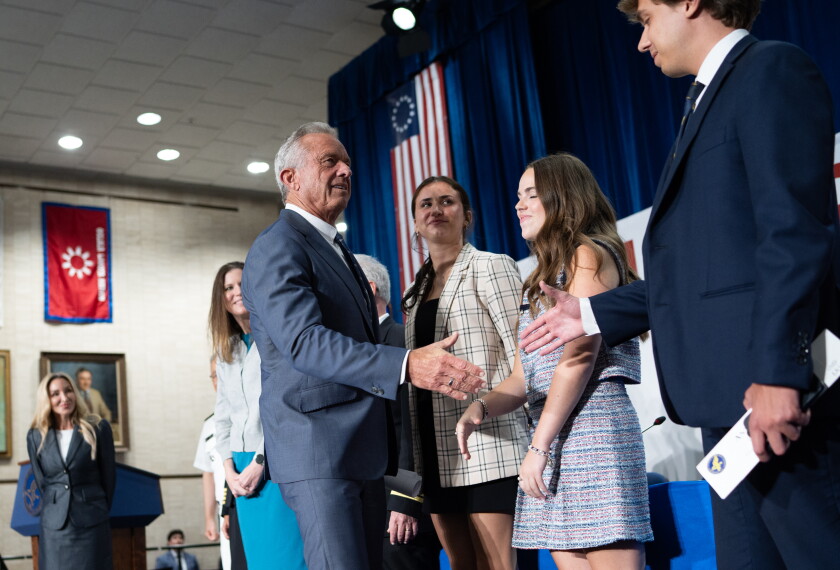
Robert F. Kennedy Jr., Secretary of Health and Human Services, shakes hands with the organizers of the event at the Hubert Humphrey Building in Washington on Sept. 1, 2026.
Robert F. Kennedy Jr., Secretary of Health and Human Services, shakes hands with the organizers of an event focused on the harms of student screen time at the Hubert Humphrey Building in Washington on Sept. 1, 2026. The symposium is part of HHS’s Live Real Life campaign, a national effort aimed at helping families, schools, and communities reduce harmful screen use and create more opportunities for children to engage in real-world experiences.
Sarah L. Voisin For Education Week
Ed-Tech Policy Opinion Is the Backlash Against Tech in Schools Going Too Far?
As schools rethink their relationship with tech, there are questions they should be asking.
Lina Eroh
•
5 min read
Photo illustration of an elementary-aged Caucasian boy with outstretched legs and a laptop on his lap. He is sitting on a very large cellphone propped up by four orange construction cones. The background is a montage of overlapping rectangle shapes with some ghosted images of young elementary students using a variety of tech (headphones and cellphones).
Photo illustration by Gina Tomko/Education Week + Canva
Ed-Tech Policy FCC Launches Review of E-Rate Program Amid Screen Time Debate
The end of the E-rate program would be an "existential threat" for schools, advocates say.
4 min read
Debbie Castlen, a bus monitor for Daviess County Public Schools, sits in front of a parked school bus outfitted with wifi in the parking lot at Russell Shifley Park, Wednesday, Aug. 26, 2020, in Owensboro, Ky. Castlen was working a 4-hour shift at the bus, which enables students without wifi at home to download their school assignments as the new school year begins with students working remotely.
Debbie Castlen, a bus monitor for the Daviess County public schools, sits outside a school bus equipped with Wi-Fi at Russell Shifley Park in Owensboro, Ky., on Aug. 26, 2020, where she worked a shift helping students without home internet download assignments as the school year began remotely. The setup reflects the kind of connectivity effort now under scrutiny as federal officials review the future scope of the E-rate program.
Greg Eans/The Messenger-Inquirer via AP