The National Board for Professional Teaching Standards is upgrading the role of technology in its vision for what makes an excellent teacher.
The board, which has generally been conservative about the value of technology in teaching, recently completed an online library of models for how to use technology in the classroom. It’s a resource that some board-certified teachers say has long been needed.
“A teacher who is not responsive to the use of technology in their classroom is lacking in vision,” said Susie Stevens, a biology and chemistry teacher at Latta High School in Ada, Okla., who earned the board’s national certification in 1999. “In science, technology is so very important for students to become comfortable with.”
In 2001, the board selected 14 teachers, including Ms. Stevens, followed by another 14 teachers in 2002—based on their specific proposals and experience using technology—to spend a year painstakingly designing, testing, and videotaping detailed models, or “exhibits,” of how they used technology in their classrooms. The resulting “Digital Edge Learning Interchange” pulls together 58 exhibits on the Web for teachers to learn from or imitate.
Exhibits like the three created by Ms. Stevens—one was titled “Mitosis in Cyberspace"— show teachers what good practice looks like, said Laura Jones, a Fairfax County, Va., special education teacher hired by the Arlington, Va.-based board to help publish the exhibits online as well as be the author of several herself.
Ms. Jones said that many of the NBPTS standards are being rewritten “to integrate technology more blatantly than before,” and the exhibits will show teachers what the board now expects.
Lynne Wyly, the project manager for the board, said the 28 teachers involved in the project received digital video cameras and professional sound equipment, and were provided with travel and training expenses. The equipment was used to document their exhibits, including interactions with children.
When the teachers completed their projects, which often took several hundred hours of work, they were paid $5,000 per exhibit.
Online Exhibits
The 58 exhibits— which are available at no charge at www.ali.apple.com/deli, a Web site operated by Apple Computer Inc.—include all school levels, and many subject areas. They follow a standard format, with subtler topics such as the teachers’ “reflections” following the straightforward plans for the activity. Short video clips in each exhibit show key moments in the actual lesson.
A teacher who developed two exhibits on world history said the project both recognized and strengthened her technology skills.
|
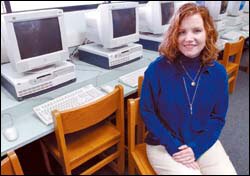
Kim DiBiase, a teacher at Herndon High School in Virginia, participated in the national certification board’s “Digital Edge” project, producing lesson plans similar to the one show below. |
“It did both change and reinforce the way I use technology,” said Kim DiBiase, a social studies teacher at the 2,300-student Herndon High School in Fairfax County.
One of Ms. DiBiase’s exhibits, “A Presentation to the Sultan,” places students in teams of four to collect extensive information and images on the Web about a 16th-century empire they have chosen. They use those materials to propose a treaty between their nation and the sultan of the Ottoman Empire.
Ms. DiBiase’s other exhibit, meant for earlier in the school year, introduces students in 45 minutes to the fundamentals of PowerPoint presentation software, as well as to academic subject matter.
Titled “Mingling at the Renaissance Ball,” the exhibit requires students to choose central figures from the Renaissance, such as Michelangelo. They then use PowerPoint to prepare slides of the figures that can be printed out as name tags. The students wear the name tags to a “ball,” at which they collect signatures of other historical personalities from the era, matched with information about their achievements.
Ms. DiBiase, who is 32 and in her 10th year of teaching, achieved national certification in 2000.
She said using presentation software has invigorated activities that were formerly done on paper and posters. “It grabbed the students’ attention more [than creating posters]; they enjoyed the technology aspect of it,” she remarked.
‘The Real Payoff’
Several experts who have followed the national certification program closely were pleased to see the Digital Edge Web site.
Susan Moore-Johnson, a professor of education at Harvard University, said that the project seems to address a need in schools and districts by expanding the influence of board-certified teachers beyond their own classrooms.
“It does seem to be a very interesting strategy for making the pedagogical expertise of these people available more broadly,” she said.
Though she said she hadn’t looked at the exhibits enough to judge their quality, Ms. Moore-Johnson said that “the real payoff is that these are people who by a rigorous assessment program are judged to be excellent teachers.”
One critic of national certification, however, was not impressed.
J.E. Stone, an education professor at East Tennessee State University in Johnson City, has charged, based on Tennessee data, that teachers with national board certification have no better results in the classroom than other teachers. And he doesn’t believe that the model technology lessons will have much impact on student achievement.
“The lessons here are very stimulating and engaging and so forth,” he said, “but they encourage more of what teachers and kids like to play around with ... fluffy activities.”
Overall, he said, referring to the federal law that aims to raise achievement, the lessons really don’t address “the things that the No Child Left Behind Act is focused on.”
Beyond those criticisms, Mr. Stone suggested that the involvement of two high-tech companies, Apple Computer and AT&T Corp., in the project may taint it, because the use of technology serves those companies’ self-interests.
But Alan Warhaftig, a nationally certified English teacher who has no connection with the project, said that the exhibits make it obvious that the teachers chose the technology purposefully and were not influenced by commercial interests such as Apple.
“The technology is not out of balance or taking a disproportionate amount of time from instructional time,” said the California teacher, who is a well- known critic of the overuse of technology in classrooms.
“I see, in these, models of excellent instruction ... deeply thought through,” said Mr. Warhaftig, who teaches at the 360-student Fairfax Magnet Center for Visual Arts, a magnet high school in Los Angeles. “These are very good teachers.”
‘Perfect Modeling’
Future teachers may be the ones to benefit most from the Digital Edge exhibits, several experts said.
The exhibits are being used in courses at schools of education at four universities: California State University-San Marcos; Louisiana Tech University; Morgan State University; and George Mason University.
Lajeane Thomas, an education professor at Louisiana Tech, said that for the second year in a row, the university has placed a half-dozen student-teachers into model high-tech classrooms at the 600-student Drew Elementary School in Ouachita Parish, La.
Each intern received training in using the Digital Edge exhibits as models for his or her own activities, and was supported through professional development from the university and online mentorships with nationally certified teachers.
The program has been continued this year at Drew and another school, with a new focus on using technology in writing.
Though only a handful of student-teachers are involved so far, all 300 teacher-candidates at Louisiana Tech have learned about the Digital Edge project in their methods classes, Ms. Thomas said.
“If you get them early in the teacher-candidate program, look at all the time they have to grow before getting out in their clinical experience,” she said. “It’s perfect modeling.”
Coverage of technology is supported in part by the William and Flora Hewlett Foundation.



