Ed-Tech Policy

Minnesota Teachers Get Engineering Software

By Vaishali Honawar — August 08, 2006 1 min read
  • Save to favorites
  • Print

A high-tech firm has offered Minnesota teachers free mechanical-engineering and design software potentially worth hundreds of millions of dollars in a bid to foster student interest in math, science, and engineering.

The Needham, Mass.-based Parametric Technology Corp. will give science and technology teachers software worth $5,000 per computer. John Stuart, the company’s senior vice president of education and partners, said the technology would allow students and teachers to create complex, 3-d designs and assemblies and is the same as that used to design cutting-edge products like Motorola telephones, Dell computers, and John Deere tractors.

After receiving training to use the software, teachers will each be licensed to install it on 300 computers.

While such other states as Pennsylvania and Massachusetts have implemented similar programs on a smaller scale, the company said, Minnesota will make the technology available to every public and private school teacher. Schools or districts will pay to train the teachers themselves, a cost that Mr. Stuart estimated at $100 to $150 per teacher.

Minnesota public schools have more than 2,800 science teachers and more than 430 technology teachers, according to the state.

Fewer than 10 percent of Minnesota high school graduates pursue degrees in engineering, and of those, only about half earn a degree. Earlier this year, Gov. Tim Pawlenty, a Republican, signed legislation mandating more rigorous high school mathematics and science courses.

A version of this article appeared in the August 09, 2006 edition of Education Week

Events

This content is provided by our sponsor. It is not written by and does not necessarily reflect the views of Education Week's editorial staff.
Sponsor
Classroom Technology Webinar
Screen Time and AI: An Evidence Playbook for School Leaders
Get a clearer picture of the current policy landscape, a framework for evaluating new tools, plus language to use in the next board meeting.
Content provided by Instructure
This content is provided by our sponsor. It is not written by and does not necessarily reflect the views of Education Week's editorial staff.
Sponsor
School & District Management Webinar
The Principal's Role in Collective Efficacy and Student Outcomes
Learn practical strategies that help principals translate their confidence into stronger collective teacher efficacy and student outcomes.
Content provided by Otus
This content is provided by our sponsor. It is not written by and does not necessarily reflect the views of Education Week's editorial staff.
Sponsor
Education Funding Webinar
What Schools Need to Know About the Federal Education Freedom Tax Credit
What schools need to know about the federal Education Freedom Tax Credit: A practical guide from a licensed teacher and policy expert.
Content provided by LearningSpring

EdWeek Top School Jobs

Teacher Jobs
Search over ten thousand teaching jobs nationwide — elementary, middle, high school and more.
View Jobs
Principal Jobs
Find hundreds of jobs for principals, assistant principals, and other school leadership roles.
View Jobs
Administrator Jobs
Over a thousand district-level jobs: superintendents, directors, more.
View Jobs
Support Staff Jobs
Search thousands of jobs, from paraprofessionals to counselors and more.
View Jobs

Read Next

Ed-Tech Policy ‘Essential Infrastructure’: Education Groups Raise Concerns About FCC's E-Rate Review
The FCC might limit or end the program that subsidizes broadband connectivity for schools.
4 min read
Fifth and second grade students work together using Magic School AI to build presentations during class at Galileo STEM Academy in Eagle, Tuesday, Feb. 24, 2026.
Fifth and 2nd grade students work together using Magic School AI to build presentations during class at Galileo STEM Academy in Eagle, Idaho, on Feb. 24, 2026. Education groups are raising concerns that the FCC's review of a program that helps fund school internet connectivity could lead its demise.
Sarah A. Miller/Idaho Statesman via TNS
Ed-Tech Policy RFK Jr. Calls for Children to Have 'Less Screen Time and More Real Life'
Speakers at an event hosted by the Department of Health and Human Services discuss the harms of student screen time, and possible solutions.
4 min read
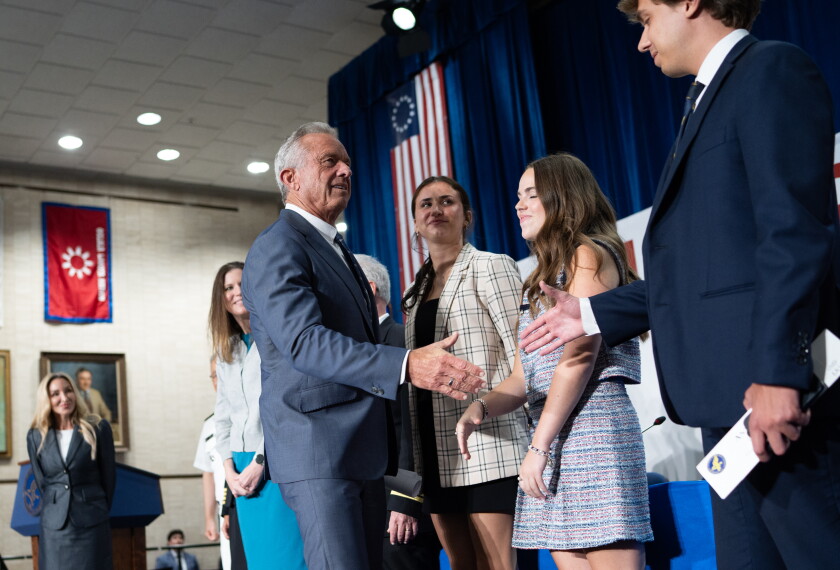
Robert F. Kennedy Jr., Secretary of Health and Human Services, shakes hands with the organizers of the event at the Hubert Humphrey Building in Washington on Sept. 1, 2026.
Robert F. Kennedy Jr., Secretary of Health and Human Services, shakes hands with the organizers of an event focused on the harms of student screen time at the Hubert Humphrey Building in Washington on Sept. 1, 2026. The symposium is part of HHS’s Live Real Life campaign, a national effort aimed at helping families, schools, and communities reduce harmful screen use and create more opportunities for children to engage in real-world experiences.
Sarah L. Voisin For Education Week
Ed-Tech Policy Opinion Is the Backlash Against Tech in Schools Going Too Far?
As schools rethink their relationship with tech, there are questions they should be asking.
Lina Eroh
5 min read
Photo illustration of an elementary-aged Caucasian boy with outstretched legs and a laptop on his lap. He is sitting on a very large cellphone propped up by four orange construction cones. The background is a montage of overlapping rectangle shapes with some ghosted images of young elementary students using a variety of tech (headphones and cellphones).
Photo illustration by Gina Tomko/Education Week + Canva
Ed-Tech Policy FCC Launches Review of E-Rate Program Amid Screen Time Debate
The end of the E-rate program would be an "existential threat" for schools, advocates say.
4 min read
Debbie Castlen, a bus monitor for Daviess County Public Schools, sits in front of a parked school bus outfitted with wifi in the parking lot at Russell Shifley Park, Wednesday, Aug. 26, 2020, in Owensboro, Ky. Castlen was working a 4-hour shift at the bus, which enables students without wifi at home to download their school assignments as the new school year begins with students working remotely.
Debbie Castlen, a bus monitor for the Daviess County public schools, sits outside a school bus equipped with Wi-Fi at Russell Shifley Park in Owensboro, Ky., on Aug. 26, 2020, where she worked a shift helping students without home internet download assignments as the school year began remotely. The setup reflects the kind of connectivity effort now under scrutiny as federal officials review the future scope of the E-rate program.
Greg Eans/The Messenger-Inquirer via AP
