Ed-Tech Policy

Kindergarten 2.0

By Sevans — September 29, 2006 1 min read
  • Save to favorites
  • Print

You get your first hint that the Media Lab is within, but not quite of, the Massachusetts Institute of Technology as soon as you walk in the door. In stark contrast to the iconic neoclassic architecture of the Cambridge, Massachusetts, campus, the lab’s Wiesner Building looks like a cubic spaceship. This incongruity is heightened when you look up into the five-story atrium and realize it’s literally a round hole in a square peg.

The 21-year-old center is an ongoing experiment in how electronics can shape the future, and it helped pioneer digital videography and computer multimedia capabilities, among other innovations.

So it’s no surprise that it is home to Lifelong Kindergarten, a high-tech playground seriously committed to the importance of fun as a teaching tool. The research group’s objective, says LK head and professor Mitchel Resnick, is to “develop new technologies that, in the spirit of the blocks and fingerpaint of kindergarten, expand the range of what people design, create, and invent.”

That’s just what was happening in July for a visiting group of educators and students. See our multimedia presentation for a close-up look at the group’s experience.

A version of this article appeared in the October 01, 2006 edition of Teacher Magazine as Kindergarten 2.0

Events

This content is provided by our sponsor. It is not written by and does not necessarily reflect the views of Education Week's editorial staff.
Sponsor
Recruitment & Retention Webinar
Hiring, Retention, and Fill Rates: A Data-Driven Sub Strategy
Explore what keeps substitutes coming back and hear how one district rebuilt its substitute hiring process and improved its fill rate.
Content provided by Frontline Education
Early Childhood K-12 Essentials Forum Early Childhood Education: Building Essential Skills for Success
Join this free virtual event to examine the biggest challenges in supporting young children, from preschool through elementary school. 
This content is provided by our sponsor. It is not written by and does not necessarily reflect the views of Education Week's editorial staff.
Sponsor
Student Absenteeism Webinar
Attendance Isn't an Attendance Problem
Boost attendance by strengthening relationships, belonging, and support with practical strategies from Doug Fisher & Nancy Frey.
Content provided by Corwin

EdWeek Top School Jobs

Teacher Jobs
Search over ten thousand teaching jobs nationwide — elementary, middle, high school and more.
View Jobs
Principal Jobs
Find hundreds of jobs for principals, assistant principals, and other school leadership roles.
View Jobs
Administrator Jobs
Over a thousand district-level jobs: superintendents, directors, more.
View Jobs
Support Staff Jobs
Search thousands of jobs, from paraprofessionals to counselors and more.
View Jobs

Read Next

Ed-Tech Policy Districts Expand Cellphone Bans to Target AI Smart Glasses. Why It Matters
Smart glasses are particularly challenging to regulate because it’s harder to tell when kids are using them, experts say
Mustard unveils their new consumer line of AI smart glasses with built-in privacy guards during 2025 CES Unveiled, on Jan. 5, 2025, in Las Vegas.
Mustard unveils its new consumer line of AI smart glasses with built-in privacy guards during 2025 CES Unveiled, on Jan. 5, 2025, in Las Vegas. Some schools are banning smart glasses as they crack down on students' digital technology use.
Jack Dempsey/AP
Ed-Tech Policy ‘Essential Infrastructure’: Education Groups Raise Concerns About FCC's E-Rate Review
The FCC might limit or end the program that subsidizes broadband connectivity for schools.
4 min read
Fifth and second grade students work together using Magic School AI to build presentations during class at Galileo STEM Academy in Eagle, Tuesday, Feb. 24, 2026.
Fifth and 2nd grade students work together using Magic School AI to build presentations during class at Galileo STEM Academy in Eagle, Idaho, on Feb. 24, 2026. Education groups are raising concerns that the FCC's review of a program that helps fund school internet connectivity could lead its demise.
Sarah A. Miller/Idaho Statesman via TNS
Ed-Tech Policy RFK Jr. Calls for Children to Have 'Less Screen Time and More Real Life'
Speakers at an event hosted by the Department of Health and Human Services discuss the harms of student screen time, and possible solutions.
4 min read
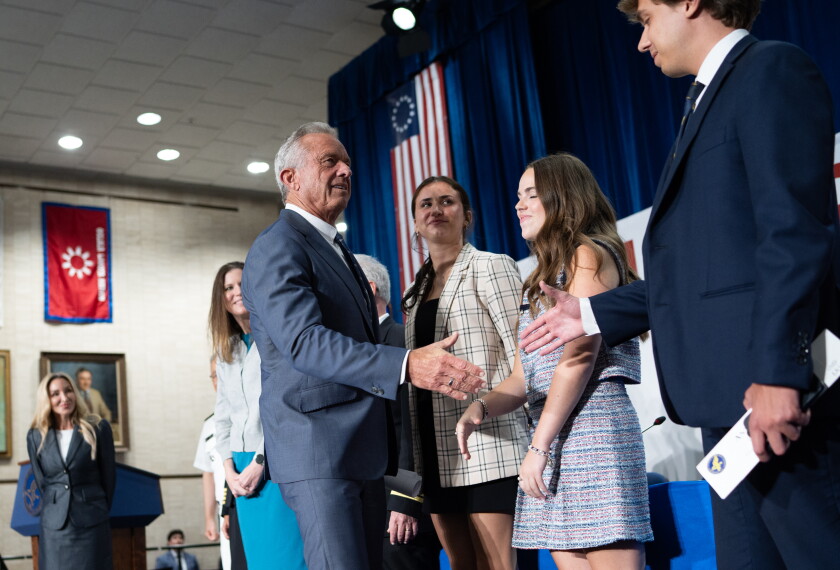
Robert F. Kennedy Jr., Secretary of Health and Human Services, shakes hands with the organizers of the event at the Hubert Humphrey Building in Washington on Sept. 1, 2026.
Robert F. Kennedy Jr., Secretary of Health and Human Services, shakes hands with the organizers of an event focused on the harms of student screen time at the Hubert Humphrey Building in Washington on Sept. 1, 2026. The symposium is part of HHS’s Live Real Life campaign, a national effort aimed at helping families, schools, and communities reduce harmful screen use and create more opportunities for children to engage in real-world experiences.
Sarah L. Voisin For Education Week
Ed-Tech Policy Opinion Is the Backlash Against Tech in Schools Going Too Far?
As schools rethink their relationship with tech, there are questions they should be asking.
Lina Eroh
5 min read
Photo illustration of an elementary-aged Caucasian boy with outstretched legs and a laptop on his lap. He is sitting on a very large cellphone propped up by four orange construction cones. The background is a montage of overlapping rectangle shapes with some ghosted images of young elementary students using a variety of tech (headphones and cellphones).
Photo illustration by Gina Tomko/Education Week + Canva