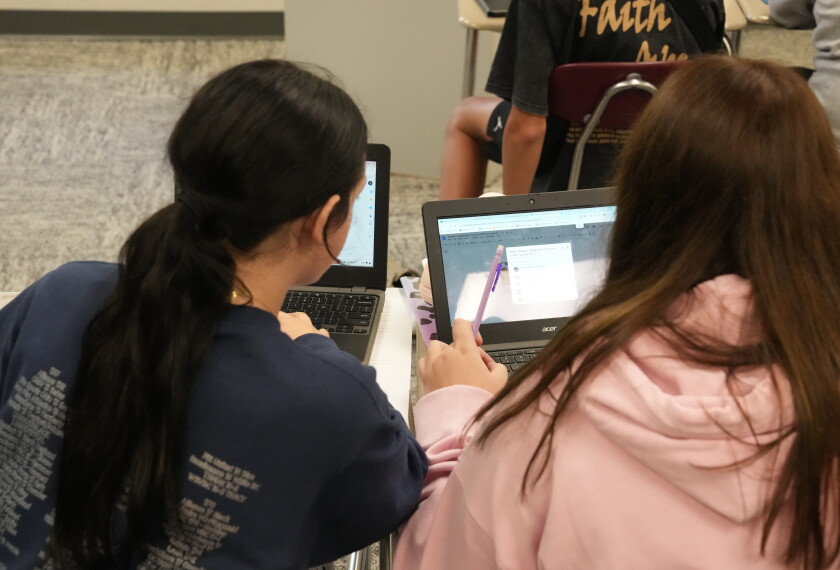
Physical education plays a big role in keeping kids active in an era dominated by screens. But as technology is increasingly incorporated into schools and classrooms, can it also be leveraged to get them moving?
While P.E. is important for ensuring kids get at least some physical activity, not all students look forward to the class. According to a 2024 Gen Youth report on physical education, some students feel a lack of skill or body confidence, don’t have a variety of activities to choose from, or experience physical discomfort, all of which might contribute to their lack of enjoyment.
That’s where technology—specifically virtual P.E. options—can come in. Ed-tech companies have been looking for ways to both increase student engagement and address the shortage or burnout of physical education teachers.
Using technology in P.E. is “meeting students where they’re at,” said Brandy Lynch, a member of the Society of Health and Physical Educators (SHAPE) America board of directors and an associate professor and physical education program coordinator at the University of Central Missouri. SHAPE America is a nonprofit that sets P.E. standards and provides support for educators in the field.
“We can gamify different aspects of our curriculum, we can make it more personalized, we can make it more individual—but we have to know that technology has its proper place,” she said.
Students need exercise, but not all find it at school
Researchers recommend 60 minutes of daily physical activity for young children, but only 1 in 4 kids between the ages of 6 and 17 reach the standard, according to the Gen Youth report.
P.E. can help students reach that goal, but not all schools have robust programs.
While most states require students to participate in physical education, 31 allow substitutions for the credit, and 30 allow student exemptions, according to SHAPE America.
“A lot of times, physical education is seen as something extra or something that’s a little bit novel but not necessary or mandatory in our profession,” Lynch said. “I would say that we’re the heartbeat of the school.”
One barrier to physical education in schools is the lack of certified P.E. teachers. SHAPE America conducted a survey of representatives of P.E. teacher-prep programs across the country and found that 42% said their program enrollments had declined in the last 10 years. When asked to consider future enrollment, 50% of respondents predicted future program declines.
The role screens can play in P.E.
One way to increase student engagement in physical education could be offering more choices through technology, said Joe Titus, co-founder and CEO of Hiveclass, a digital P.E. platform.
Hiveclass has created 1,800 standards-based physical education videos on 18 different sports or wellness activities, from dance to basketball, accessible in both English and Spanish. The product launched in 2022 and now operates in 26 states and across different types of schools, including charter, virtual, alternative education, and traditional public schools.
With Hiveclass, teachers could set up two smartboards with video instructions for different activities students can choose from, Titus said. On one side of the classroom, students can learn dance. On the other side, students can learn basketball skills.
“The teacher can be a facilitator, helping both sets of students, and that makes it personalized,” he said.
Dan DeJager, who oversees secondary physical education for the San Juan Unified School District and was the 2019 SHAPE America National High School Physical Education Teacher of the Year, met with the founders of Hiveclass before it launched in 2020 to share ideas on the P.E. ed-tech space and eventually joined the advisory board.
“I almost look at it like—especially with what they have in the libraries—a Rosetta Stone where you can learn a language. Well, now you can learn a sport,” said DeJager.
A similar product called PLT4M focuses on health and fitness skills and offers teachers ways to track a student’s progress. PLT4M was created in 2013 and now serves more than 1,000 school districts with over 500,000 students.
Since 2019, Molly Collins, a P.E. teacher at Pennfield High School in Battle Creek, Mich., has been using PLT4M in her classes, allowing students to use the app to select an activity or sport. She then tracks how long a student spends on an activity to curate specific goals and measure progress for each student throughout the academic year.
Collins said her favorite part about PLT4M is the opportunity to show students their progress because it makes them excited about their fitness journey.
“That’s what you’re looking for—[students] to start to take ownership through the improvements,” she said.
Technology can’t replace P.E. teachers, advocates say
Lynch said technology solutions like PLT4M or Hiveclass can play a role in P.E. classes if they include options a P.E. teacher cannot offer.
A video, for example, can demonstrate to students how their peers practice a skill or do an exercise—“there’s representation,” she said.
Chief Product Officer and Co-founder Paul Suhr told Education Week that Hiveclass content intentionally includes models and actors that are diverse in ethnicity, body type, and age.
Some educators are concerned about the potential for virtual P.E. ed tech to replace certified P.E. teachers. Lynch, who teaches P.E. teacher-candidates, believes the technology is only a tool, not a replacement.
“My students know how to teach quality physical education without the use of technology, and then they also know how to use it to augment the quality teaching that is already occurring,” said Lynch.
Collins agrees that technology like PLT4M can’t replace P.E. teachers, but says students will search ways to exercise on their own.
For example, Collins has seen students ask ChatGPT to curate workouts. She wants students to learn from her classes instead of from unvetted sources online.
“If we’re not educating kids on how to use technology well, the proper channels and the proper tools, they’re going to go seek it out elsewhere,” she said.