Artificial Intelligence

Education and Tech Heavy Hitters Launch AI Learning Initiative

By Alyson Klein & Lauraine Langreo — May 02, 2023 2 min read
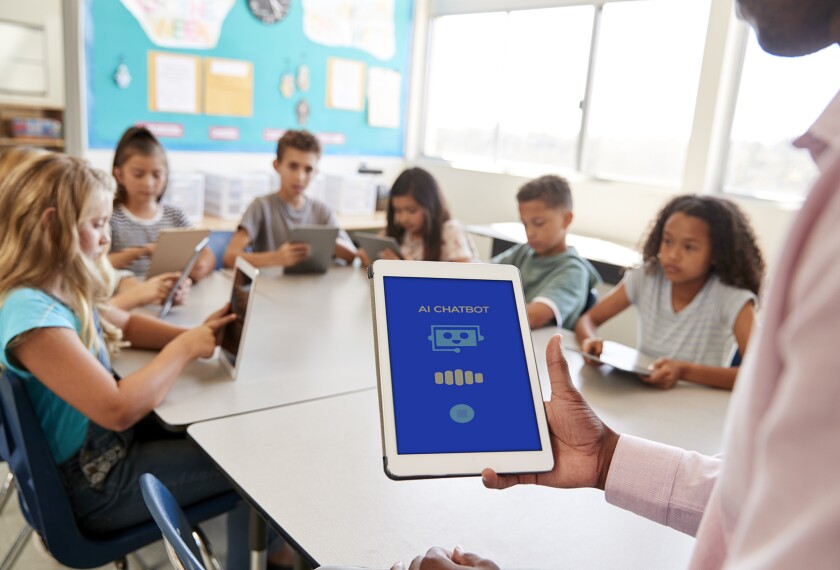
Illustration of a network of laptops around a chatbot
  • Save to favorites
  • Print

A group of influential education, business, and nonprofit organizations—including Code.org, the Educational Testing Service, the International Society for Technology in Education, and the World Economic Forum—announced an initiative May 2 to help schools determine what role artificial intelligence should play in K-12 education.

Dubbed TeachAI, the effort plans to help schools and state education departments figure out how to effectively integrate AI into curricula, while also protecting students’ online safety and privacy, and ensuring educators and students understand the possible pitfalls of AI. Those potential pitfalls include AI systems that are trained to make decisions based on biased data fed into them and the potential of AI to help spread misinformation and disinformation.

TeachAI plans to recommend best practices for helping students understand what’s behind the technology that powers artificial intelligence, as well as bringing AI learning tools and assessments into schools in thoughtful ways that protect students’ data privacy, the groups say.

The announcement of the initiative comes just as school districts are really starting to grapple with how to deal with the rapid evolution of AI technologies such as ChatGPT. Some school districts—such as New York City’s, the nation’s largest—have banned the use of ChatGPT, except for some limited circumstances. Others—such as the Gwinnett school district in Georgia—are integrating AI into the curriculum and encouraging students to investigate how it works.

Artificial intelligence technologies replicate human-like intelligence by training machines and computer systems to do tasks that simulate some of what the human brain can do. It relies on systems that can actually learn, usually by analyzing vast quantities of data and searching out new patterns and relationships. These systems can actually improve over time, becoming more complex and accurate as they take in more information.

Today’s students must master the “superpower of using the technology,” said Hadi Partovi, the CEO and founder of Code.org in an interview about the announcement of the initiative. “What does it mean to teach critical thinking, teach digital fluency, teach safety in a world with these digital tools?”

TeachAI will work with educators to “basically talk about these problems and to help chart a pathway to evolve education,” Partovi said. “Not only in teaching with AI, but also teaching about AI and to do so safely, ethically, and equitably.”

Taking a more critical look at AI is something Google engineer Geoffrey Hinton wants everyone to do. That is why he recently left the company. He wants to speak more openly about the potential dangers inherent in the rapid pace of AI’s development.

Initiative participants also include companies such as Amazon, Cisco, Microsoft, and OpenAI; education organizations such as AASA-The School Superintendents Association, College Board, Council of Chief State School Officers, National Association of State Boards of Education, and the National School Boards Association; well as education leaders from Brazil, Germany, Kenya, Malaysia, South Korea, United Arab Emirates, the United Kingdom, and other nations.


Related Tags:

Events

This content is provided by our sponsor. It is not written by and does not necessarily reflect the views of Education Week's editorial staff.
Sponsor
Special Education Webinar
Bridging the Math Gap: What’s New in Dyscalculia Identification, Instruction & State Action
Discover the latest dyscalculia research insights, state-level policy trends, and classroom strategies to make math more accessible for all.
Content provided by TouchMath
This content is provided by our sponsor. It is not written by and does not necessarily reflect the views of Education Week's editorial staff.
Sponsor
School & District Management Webinar
Too Many Initiatives, Not Enough Alignment: A Change Management Playbook for Leaders
Learn how leadership teams can increase alignment and evaluate every program, practice, and purchase against a clear strategic plan.
Content provided by Otus
This content is provided by our sponsor. It is not written by and does not necessarily reflect the views of Education Week's editorial staff.
Sponsor
College & Workforce Readiness Webinar
Building for the Future: Igniting Middle Schoolers’ Interest in Skilled Trades & Future-Ready Skills
Ignite middle schoolers’ interest in skilled trades with hands-on learning and real-world projects that build future-ready skills.
Content provided by Project Lead The Way

EdWeek Top School Jobs

Teacher Jobs
Search over ten thousand teaching jobs nationwide — elementary, middle, high school and more.
View Jobs
Principal Jobs
Find hundreds of jobs for principals, assistant principals, and other school leadership roles.
View Jobs
Administrator Jobs
Over a thousand district-level jobs: superintendents, directors, more.
View Jobs
Support Staff Jobs
Search thousands of jobs, from paraprofessionals to counselors and more.
View Jobs

Read Next

Artificial Intelligence Opinion AI in the Classroom: What a Skeptic and an Optimist Can Both Agree On
Pedro and Enrique Noguera recommend four steps for embracing chatbots—with guardrails.
Pedro A. Noguera & Enrique Noguera
5 min read
Composite artwork sketch image collage of intelligence assistant creative device internet icon ai hand type laptop cogwheel magnifying glass
iStock/Getty
Artificial Intelligence Fed Regulation of AI Is Virtually Nonexistent. Is This a Problem for Schools?
The Trump administration wants to unleash AI to let it innovate in education and other sectors.
4 min read
Art teacher Lindsay Johnson, center, has students explore how to use generative AI features in Canva at Roosevelt Middle School, on June 25, 2025, in River Forest, Ill. The Education and Workforce Committee held a hearing on Wednesday over the lack of federal regulation and guidance for how schools and other organizations should use AI.
Art teacher Lindsay Johnson, center, has students explore how to use generative AI features in Canva at Roosevelt Middle School, on June 25, 2025, in River Forest, Ill. The U.S. House of Representatives' Education and Workforce Committee held a hearing on Wednesday over the lack of federal regulation and guidance for how schools and other organizations should use AI.
Nam Y. Huh/AP
Artificial Intelligence Opinion This Professor Won the ‘Nobel for Education.’ Here's What His Work Means for Educators
What skills do students need to make sense of complex systems in the age of AI?
7 min read
The United States Capitol building as a bookcase filled with red, white, and blue policy books in a Washington DC landscape.
Luca D'Urbino for Education Week
Artificial Intelligence From Our Research Center More Teachers Are Using AI in Their Classrooms. Here's Why
But there's still a big number of teachers who don't plan to use the technology.
3 min read
Teacher and kids using tablets and artificial intelligence in school classroom; a.i. assisted lessons.
iStock/Getty and Education Week