Ed-Tech Policy

Computers Column

September 09, 1987 4 min read
  • Save to favorites
  • Print

Copyright 1987 A series of contests during the month will offer students and teachers the chance to win computers and software libraries. The contests, to be judged by grade level, involve creative computer-generated art, non-computer art, essays, group projects, and innovative lesson ideas. Entries must be received by Oct. 20, and the judging will take place in early November.

A 30-page booklet, “What Every Parent Should Know About Educational Computing,” will be distributed free-of-charge throughout the month by several leading bookstore chains and state pta’s. And a commemorative poster that includes lesson plans will be distributed with the October issue of six education and computing journals.

For more information about these or other planned activities, write to Computer Learning Month, P.O. Box 19763, Washington, D.C. 20036-7063.

Computers are rarely used to teach traditional high-school mathematics and science courses, according to a survey conducted by a Johns Hopkins University researcher.

Instead, most of the high-school mathematics and science teachers who use computers are using them to teach computer-literacy and programming courses, reports the fourth bulletin from Henry Jay Becker’s “Second National Survey of Instructional Uses of Microcomputers.”

The latest report analyzes the use of computers in traditional math and science courses from data collected in a spring 1985 survey of roughly 8,000 principals and teachers in 2,100 schools that are statistically representative of the computer-using schools in the nation. Previous reports have covered such topics as the opportunities different types of students have to use computers, and the consequences principals and teachers see from their use.

Among the other findings from the most recent bulletin were that: Sixty-three percent of the computer use for mathematics instruction occurred in grades 5 and below; drill and practice was by far the most common activity for elementary-school mathematics; computers are used more often for remediation than for enrichment in the higher grades; and at no grade level did science instruction using computers account for 10 percent or more of the overall use of computers.

A subscription to the series of six newsletters is available for $7.50 by writing to Computer Survey Newsletters, Center for the Social Organization of Schools,

The Johns Hopkins University, 3505 North Charles Street, Baltimore, Md. 21218.

The amount of high-quality software available for ibm PC, PCjr, and compatible computers has increased significantly over the past year, according to the Education News Service.

Forty-five percent of the highest rated programs identified by ens in its 1987 edition of Only The Best: The Discriminating Software Guide for Preschool-Grade 12 are available in versions for ibm computers, compared with only 24 percent last year.

The authors also found that an increasing number of software publishers are offering lab packs and site-licenses to meet the demand for multiple copies of software at substantial discounts.

Of the software released since publication of last year’s edition of the guide, a Sunburst Communications’ program--Green Glob and Graphing Equations--received the most “excellent” ratings from the 30 evaluation services ens surveys. Other software garnering high numbers of positive ratings included: Microtype--The Wonderful World of Paws, by South-Western Publishing Co.; The Newsroom, by Springboard Software Inc.; Geometric Supposer: Triangles, by Sunburst Communications Inc.; and LogoWriter, by Logo Computer Systems Inc.

The 146 programs detailed in the annual directory had to have received a minimum of two “excellent” or one “excellent” and three “good” ratings from the major evaluation services.

Copies of the 1987 edition are available for $21.95 (prepaid) from Education News Service, P.O. Box 1789, Carmichael, Calif. 95609, or call (916) 483-6159 for more information.

Users of the federal Office of Educational Research and Improvement’s electronic bulletin board may have noticed that it was not operating in late August. Apparently, the personal computer used to run the service “just grew legs and walked away,” said Tom Litkowski, an Education Department employee.

Almost 3,000 callers per month have been using the bulletin board since its capacity was expanded in April, he said. The free service for educators can be used to obtain tables of current education data, bulletins, and announcments of data tapes and reports. In addition, users can hold electronic conferences, send messages and electronic mail to other users, and make their own data available to others.

The bulletin board, which operates 24-hours-a-day, can be accessed by almost any type of microcomputer with communications software and a modem. The toll-free number for the bulletin board is (800) 222-4922. Further information can be obtained by calling (202) 357-6524.--ws

A version of this article appeared in the September 09, 1987 edition of Education Week as Computers Column

Events

This content is provided by our sponsor. It is not written by and does not necessarily reflect the views of Education Week's editorial staff.
Sponsor
College & Workforce Readiness Webinar
From Student Trends to Counselor Action: Turning Insight Into Impact
Find out what is changing in how students approach planning for life after graduation and how schools can help.
Content provided by PowerSchool
This content is provided by our sponsor. It is not written by and does not necessarily reflect the views of Education Week's editorial staff.
Sponsor
School & District Management Webinar
McKinney-Vento Transportation Strategies: Managing Cost & Protecting Access
Explore McKinney-Vento transportation strategies to manage costs, respond quickly to changing needs, and protect student access.
Content provided by HopSkipDrive
This content is provided by our sponsor. It is not written by and does not necessarily reflect the views of Education Week's editorial staff.
Sponsor
Families & the Community Webinar
Celebrate Family Engagement Day With Strategies That Work
Join National PTA and AASA to explore practical systems-wide family engagement strategies in celebration of National Family Engagement Day.

EdWeek Top School Jobs

Teacher Jobs
Search over ten thousand teaching jobs nationwide — elementary, middle, high school and more.
View Jobs
Principal Jobs
Find hundreds of jobs for principals, assistant principals, and other school leadership roles.
View Jobs
Administrator Jobs
Over a thousand district-level jobs: superintendents, directors, more.
View Jobs
Support Staff Jobs
Search thousands of jobs, from paraprofessionals to counselors and more.
View Jobs

Read Next

Ed-Tech Policy ‘Essential Infrastructure’: Education Groups Raise Concerns About FCC's E-Rate Review
The FCC might limit or end the program that subsidizes broadband connectivity for schools.
4 min read
Fifth and second grade students work together using Magic School AI to build presentations during class at Galileo STEM Academy in Eagle, Tuesday, Feb. 24, 2026.
Fifth and 2nd grade students work together using Magic School AI to build presentations during class at Galileo STEM Academy in Eagle, Idaho, on Feb. 24, 2026. Education groups are raising concerns that the FCC's review of a program that helps fund school internet connectivity could lead its demise.
Sarah A. Miller/Idaho Statesman via TNS
Ed-Tech Policy RFK Jr. Calls for Children to Have 'Less Screen Time and More Real Life'
Speakers at an event hosted by the Department of Health and Human Services discuss the harms of student screen time, and possible solutions.
4 min read
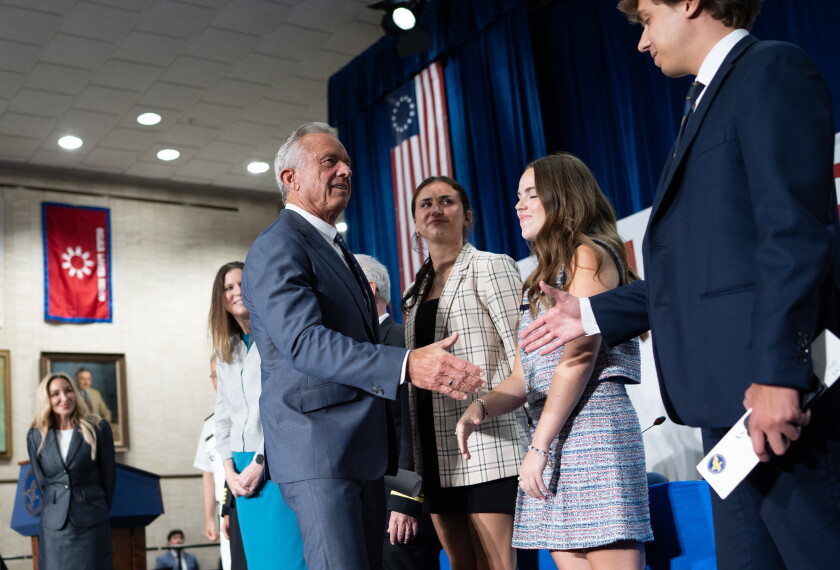
Robert F. Kennedy Jr., Secretary of Health and Human Services, shakes hands with the organizers of the event at the Hubert Humphrey Building in Washington on Sept. 1, 2026.
Robert F. Kennedy Jr., Secretary of Health and Human Services, shakes hands with the organizers of an event focused on the harms of student screen time at the Hubert Humphrey Building in Washington on Sept. 1, 2026. The symposium is part of HHS’s Live Real Life campaign, a national effort aimed at helping families, schools, and communities reduce harmful screen use and create more opportunities for children to engage in real-world experiences.
Sarah L. Voisin For Education Week
Ed-Tech Policy Opinion Is the Backlash Against Tech in Schools Going Too Far?
As schools rethink their relationship with tech, there are questions they should be asking.
Lina Eroh
•
5 min read
Photo illustration of an elementary-aged Caucasian boy with outstretched legs and a laptop on his lap. He is sitting on a very large cellphone propped up by four orange construction cones. The background is a montage of overlapping rectangle shapes with some ghosted images of young elementary students using a variety of tech (headphones and cellphones).
Photo illustration by Gina Tomko/Education Week + Canva
Ed-Tech Policy FCC Launches Review of E-Rate Program Amid Screen Time Debate
The end of the E-rate program would be an "existential threat" for schools, advocates say.
4 min read
Debbie Castlen, a bus monitor for Daviess County Public Schools, sits in front of a parked school bus outfitted with wifi in the parking lot at Russell Shifley Park, Wednesday, Aug. 26, 2020, in Owensboro, Ky. Castlen was working a 4-hour shift at the bus, which enables students without wifi at home to download their school assignments as the new school year begins with students working remotely.
Debbie Castlen, a bus monitor for the Daviess County public schools, sits outside a school bus equipped with Wi-Fi at Russell Shifley Park in Owensboro, Ky., on Aug. 26, 2020, where she worked a shift helping students without home internet download assignments as the school year began remotely. The setup reflects the kind of connectivity effort now under scrutiny as federal officials review the future scope of the E-rate program.
Greg Eans/The Messenger-Inquirer via AP
