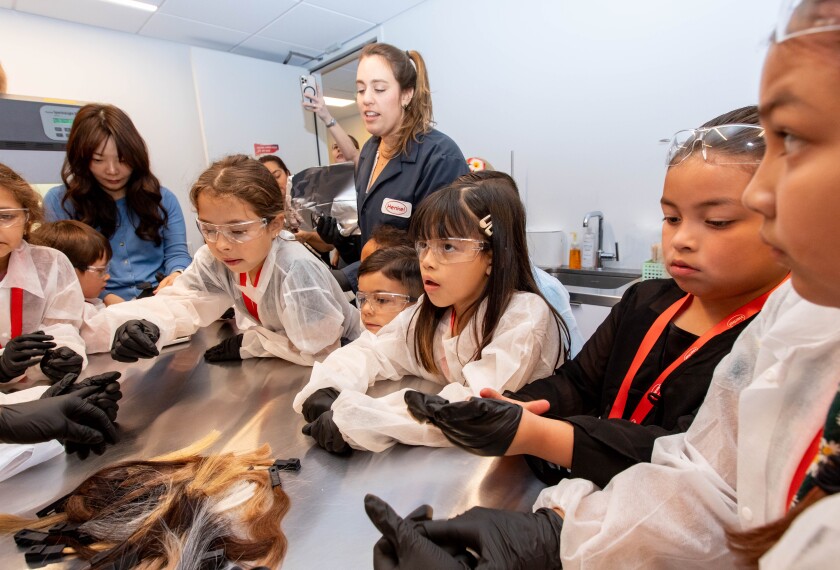
Make a horizontal incision through the skin between the frog’s front legs. Perform the same task between the muscles of the back legs. Then pull back the muscle flaps and hold them with forceps. And finally, use the scalpel to separate the muscles from the nearby tissues.
The Virginia law on dissections is available online from the Virginia Department of Education. (Requires Adobe’s Acrobat Reader.)
This might sound like the guidance of a high school teacher leading a class through one of the biology lab’s most familiar lessons. In fact, it’s part of an interactive program offered online as a resource by the department of education in Virginia, which has joined a growing number of states in requiring schools to give students alternatives to performing dissections of animals in class.
Nine other states have passed laws or resolutions stating that students who object to dissections be given another option, according to an animal-rights organization that has been tracking the issue. Virginia’s measure pass ed the legislature this year and took effect this fall. Earlier this month, Massachusetts lawmakers approved a similar measure, though that proposal’s fate remains unclear.
In Fairfax County, Va., the number of students who typically opt out of picking up a scalpel at the laboratory table is “absolutely very minuscule,” said Jack J. Greene, the K-12 science coordinator for the county’s 166,000-student school district. Students who decline to dissect sometimes do so for religious reasons, he said, or because it makes them physically uncomfortable.
As a general rule, teachers in the district already allow students to choose alter natives to dissections, he said. Mr. Greene is generally supportive of the state law, though he hopes it does not limit classroom participation.
Massachusetts Action
“My only concern is that I don’t want teachers to feel limited in the activities they can present, if it’s in the interests of helping children learn,” he said. “We have a wide range of students who learn in different ways.”
In the past, the northern Virginia district has used Internet sites and video presentations to instruct students without using dissection, he said. The school system has more than 150 biology teachers who might at any given point consider using dissection in class, Mr. Greene estimated.
Massachusetts legislators on Sept. 9 approved a measure that would require the state board of education to draw up guidelines for alternatives for students who do not want to take part in dissection.
Shawn K. Feddeman, a spokeswoman for Gov. Mitt Romney, said he was still reviewing the proposal. But she noted that the Republican governor vetoed similar legislation last year. He called it unnecessary, given the flexibility the state already grants districts in instructional methods, as well as an impediment to research.
Scalpels, Computer Screens
Proposals that guarantee students alternatives to dissection are supported by People for the Ethical Treatment of Animals, a Norfolk, Va.-based advocacy organization that describes itself as the largest such animal-rights group in the world. Advances in classroom technology make it unnecessary for teachers to use dissection, according to PETA, which regards such experimentation as a cruel practice that is more likely to offend students than to inform their knowledge of biology.
“Students who opt out of dissection retain just as much as their dissecting counterparts,” said Jacqueline Domac, PETA’s education policy specialist. By forcing a student to take part, she added, “you may be losing an amazing scientist.”
But others say the instructional value of conducting hands-on classroom dissections cannot be matched.
The Reston, Va.-based National Association of Biology Teachers says in a policy statement that while it supports the responsible treatment of animals and the use of other classroom teaching methods when appropriate, “no alternative can substitute for the actual experience of dissection or other use of animals.”
In Fairfax County, students are already allowed to opt out of dissections, said James C. Firebaugh, the state’s director of middle instruction. Mr. Firebaugh said he had not heard of a rise in the number of students choosing to avoid dissections.
Under the new Virginia law, schools are required to make it clear in course guidelines, syllabuses, or manuals that they do not have to take part in dissections. The state department of education has posted links to Internet programs that lead students through computerized dissections.
Mr. Greene said many Fairfax County teachers were already using those kinds of online options.
But as a former middle school and college teacher, he sees some limitations in not using dissections. Physical anatomy is typically more muddled and complex than what appears on an Internet site, he said.
“Not everything is as perfect as it is in [computer] images, or books,” Mr. Greene said.