As more high schools rush to offer Advanced Placement courses, the College Board says it will soon start auditing all such courses to ensure schools aren’t watering down the program’s standards.
Trevor Packer, the director of the College Board’s AP program, announced the audit plan here this month at a conference attended by more than 2,500 school principals and AP teachers and coordinators.
“The audit is not asking them to do anything they haven’t done all along, … except signing off on the audit form,” Mr. Packer said.
Next February, the New York City-based College Board will send all participating schools audit forms for the AP courses to be offered in the 2007-08 academic year. Schools will have until June 1 to return the forms along with the course syllabus, a sample assignment, and a sample exam for each course.
By September 2006, each school will receive a legal agreement from the College Board authorizing the use of the AP label for qualifying courses for one year. No fee will be charged for the audit or for authorization to use the AP label.
Colleges will receive a listing of all high schools with authorized AP programs, as well as the specific courses authorized at each school. Courses that do not meet AP-prescribed requirements—for instance, a minimum of two double periods per week in lab work for an AP biology course—will not qualify.
The audit plan is driven by calls from colleges and universities to ensure the rigor and high standards of AP courses as the demand for such courses grows, the College Board says.
“We want to use this to help ensure AP students get what they sign up for,” Mr. Packer said. “AP has such cachet that schools are rushing to offer it without the basic infrastructure.”
No Mandatory Test
Schools that choose not to participate in the audit will still be able to order and administer AP exams, because the exam serves as its own measure of quality, Mr. Packer said. Students in such schools would still get college credit for passing the tests.
A report released late last year by researchers at the University of California, Berkeley, found that high school students who enrolled in college-level courses such as Advanced Placement did not perform better in college unless they took the end-of-course tests. (“Study: AP Classes Alone Don’t Aid College Work,” Jan. 05, 2005.)
At this time, Mr. Packer said, the College Board does not plan to make AP tests mandatory for every class participant, because some students cannot afford the $82 cost per test.
Mr. Packer said most of the schools that offer AP courses meet the standards set by the College Board. However, some schools have used the AP designation for courses not developed by the board’s Advanced Placement program, such as AP courses in photography and theater, he said, adding that an audit would prevent such misuses.
The popularity of the AP program has increased rapidly over the past few years. In 2004, 11,196 public schools offered AP courses, an increase of 417 schools over the previous year. The number of private schools offering AP courses grew by 103, from 2,845 to 2,948, during the same time.
Teachers and counselors attending the July 14-18 conference welcomed the audit plan, saying it would ensure that schools focus on maintaining high standards for students.
“This is a step in the right direction,” said Sabrina M. Lavieri, the AP coordinator at the 1,500-student Newington High School in Newington, Conn., near Hartford, whose school offers AP courses in 15 subjects.
“The changes are going to ensure that the rigor we put in our classes is validated and not diluted by a plethora of courses that call themselves AP,” she said.
Deborah St. Jean, an AP English teacher at the school, said the audit was reasonable and even necessary to maintain the “gold standard” of the College Board and Advanced Placement.
Other teachers said they were waiting to learn more about what the audit entails, to gauge the impact on their own schools. “People are always anxious about change,” said Nancy Price, an AP literature teacher at Fort Scott High School in Fort Scott, Kan.
Among other changes announced at the conference, the College Board will send schools a new report, starting in September, called the AP Instructional Planning Report, which will compare their students with AP participants around the country and worldwide. More than 760 schools outside the United States now offer AP courses.
AP Comedy
Advanced Placement teachers and coordinators at the conference attended workshops and more than 200 breakout sessions on specific subject areas.
Raymond J. Simon, the deputy secretary of the U.S. Department of Education, delivered what was nearly a stand-up comedy routine, using as his prop an obsolete slide rule.
He drew peals of laughter with a story about scaring off bullies in school with his “deluxe model” fiberglass slide rule that came with its own, holster-like “deluxe carrying case.” Holding up a hand-held calculator, which almost overnight replaced the slide rule in the 1970s, Mr. Simon shrugged as he declared that the newer instrument was just not as cool.
And then he delivered his message: Although cool, the slide rule was way off the mark when it came to actual calculations, in contrast to the calculator.
“Without the high expectations that AP is all about, we run the risk of graduating students with slide-rule skills in the calculator age,” Mr. Simon said.
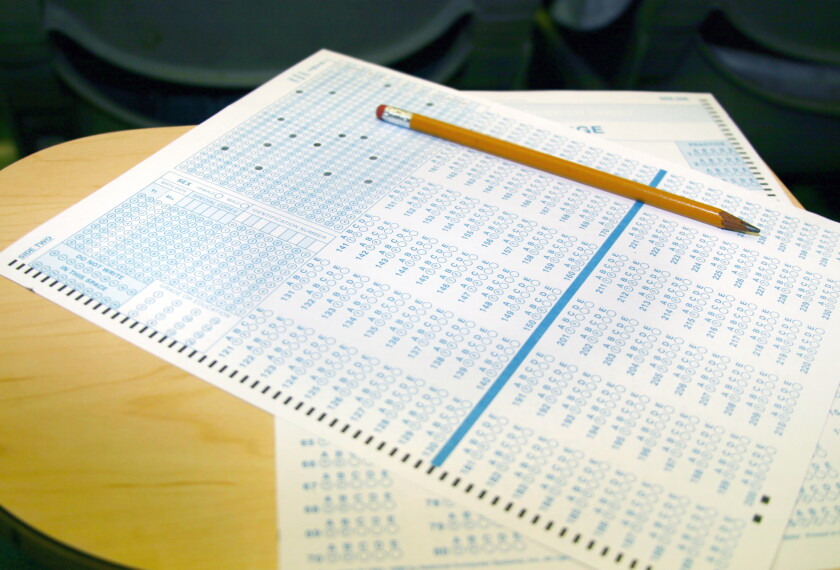
Nina Shokraii Rees, the assistant deputy secretary in charge of the Education Department’s office of innovation and improvement, brought along some props, too—AP-approved exam materials, including sharp No. 2 pencils and a calculator.
Ms. Rees pointed to flat math and reading scores among high school students on the National Assessment of Educational Progress and called for revising high school graduation requirements.
“It is no surprise colleges and universities are spending millions on remedial education,” she said, adding that data have shown that rigorous coursework is a good predictor of college success.
But even as she lauded the Advanced Placement program’s success, and a 73 percent increase in federal funding proposed by President Bush for states to bolster AP programs at schools for fiscal 2006, Ms. Rees called for making AP courses more accessible to students, particularly those in rural areas.
“The AP program can impact even more lives if students are given a chance to access them,” she said.