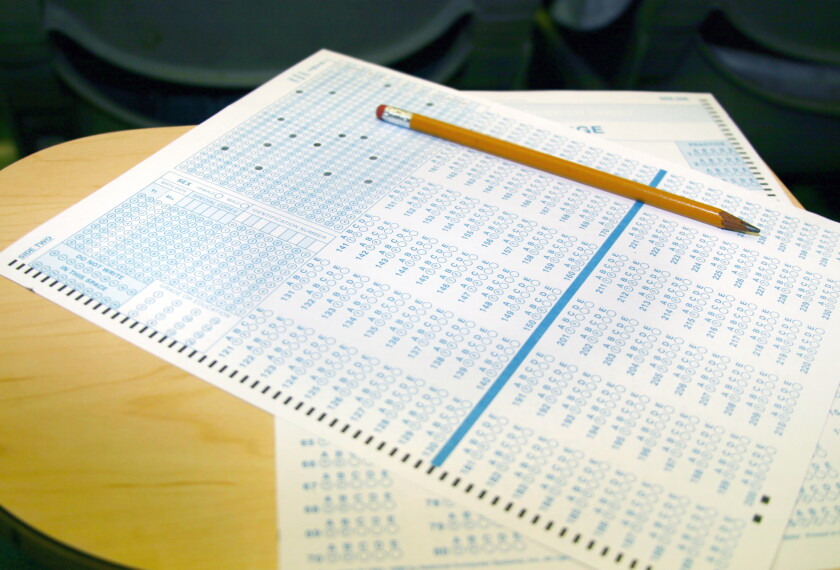
If you tapped into the voice mail of the man overseeing Colorado’s new student assessment last week, you got more than just a greeting.
Unsolicited, Don Watson’s voice announced the April and May dates when the statewide test of student achievement is to be given for the first time.
The message is not only a public service. It is also emblematic of a testing system plagued with uncertainty in the past couple of months, including when it would get under way and where its funding would come from.
But Mr. Watson and his colleagues are forging ahead and now plan to launch the testing program April 28.
Though less pummeled than Colorado’s, new testing ventures linked to academic standards are appearing all over the country. This spring marks the birth of either a whole new statewide assessment system, as in Florida, or new pieces of a recently introduced one, as in Utah and Kansas.
In other states, such as Maryland, state officials are making the commitment to create new examinations.
In either case, such planned or existing state assessments are aligned with standards that the state has recently set for what students should know and be able to do. That way, tests in a given state can measure how well students are achieving the specific goals that educators have set for them.
That scenario has been pursued by state policymakers at least since 1989, when the nation’s governors and President Bush met in Charlottesville, Va., a seminal moment in the movement to set high academic expectations for U.S. students. And it’s particularly been the aim since it became clear politically that the states--not any federally created body--would be the ones deciding just how high to set those standards.
Aligning assessments with state standards “is a natural evolution and consequence of what we’ve been engaged in for a number of years,” said Christopher T. Cross, the president of the Council for Basic Education in Washington, which promotes high standards in schools. “It’s the bow wave of what will be actions in many states.”
“What’s encouraging to me,” said Mr. Cross, who was an assistant secretary of education in the Bush administration, “is we’re really following through on a strategy and direction that has considerable support and around which there is remarkable consensus.”
Colorado Retools
In Colorado, Mr. Watson, the student-assessment supervisor, perhaps wishes there had been more consensus there in recent weeks. In January, just two months after the state school board formally awarded the contract for writing the state’s rigorous new assessment, the exam’s future was thrown into question.
With the start of the legislative session, lawmakers balked at the $1.6 million first-year cost of the testing program. Some thought they had been promised a price tag more like $600,000. A state education department request for supplemental funding never made it out of the joint budget committee, Mr. Watson said.
After legislators made clear their displeasure, the testing system--which has been on a mercilessly tight schedule--was retooled. And the education department has vowed to find the money it needs from within its own coffers, without squeezing districts or laying off workers.
Originally, every 4th grader was to be tested in either reading, writing, or geography, and testing was to get under way April 14. Now, there’s a two-week delay, and geography has been shelved. Every 4th grader will take both reading and writing instead.
“It’s playing havoc with everything, logistically and technically,” Mr. Watson said of the furor and changes. “I have joked about ‘which assessment are we going to work on today?’”
Nonetheless, Colorado’s content standards are well regarded and seen as challenging.
And now, after negotiations between officials in the education department and state legislators, Mr. Watson said last week, “We’re on track.” But, on a realistic note, he added: “That doesn’t mean it couldn’t get derailed.”
Florida Debut
This month in Florida, meanwhile, students in grades 4, 5, 8, and 10 are taking reading and math field tests for the new Florida Comprehensive Assessment Test. Once officials see how the field tests go, the first testing that will count will be given next January and February, said Thomas Fisher, the testing director for the state education department.
The new, $8 million-a-year testing is aligned with the Sunshine State Standards, which the state board adopted last May. The exam will provide results about the performance of individual students as well as help the state monitor how schools and districts are doing.
The new tests both complement existing statewide tests and replace old ones. They fill the void left in 1990 when the state canned its minimum-competency testing in grades 3, 5, and 8, Mr. Fisher said.
In addition to a separate essay test of writing for three grades and another 10th grade reading and math test, students currently must pass the state’s high school competency test before they can graduate.
With the advent of the new assessment, the existence of the 11th grade graduation test “will become an obvious problem next year,” Mr. Fisher said, “because the minimum-competency test is going to be easier than the FCAT.”
A decision has yet to be made, Mr. Fisher said, but the 10th grade test could become the exit exam. Or, he said, any student who does well enough on the new comprehensive assessment might not have to take the competency test.
Delaware, too, is working hard to have its new testing system debut next school year with assessments in language arts and math for grades 3, 5, 8, and 10.
In the 1998-99 year, the state would inaugurate exams in science and social studies. The assessments are to include multiple-choice questions, open-ended responses, and hands-on tasks.
How High the Stakes?
Other states, including Utah and Maryland, are adding new pieces to assessment systems that have already gotten under way.
This spring, Utah will give a new secondary-level math test for the first time and field-test a secondary science exam.
The new state tests reflect recently revised state core curriculum standards, said Barbara Lawrence, the coordinator of evaluation and assessment for the state education department.
In 1995, Utah kicked off its new elementary math exam, and last year did so with its elementary science test. Other subject tests will follow, such as the field test of elementary language arts in 1999.
The Maryland state school board last month moved into new territory by creating tough new end-of-course tests for high school students in English, math, science, and social studies.
For several years, the state has given challenging assessments in grades 3, 5, and 8 that were created in conjunction with state standards.
The high school tests, which would begin in 1999, would provide individual student scores, unlike those in the lower grades. They would replace the state’s low-level competency tests that high school students now must take to graduate.
Still to be decided is whether a student’s performance on the tests would be linked to the award of a high school diploma, said Mr. Cross, who is also the president of the Maryland state board.
Concerns from parents and others about the potential high-stakes nature of the new high school tests prompted state schools Superintendent Nancy S. Grasmick last month to vow to convene an advisory panel of community members, educators, and students.