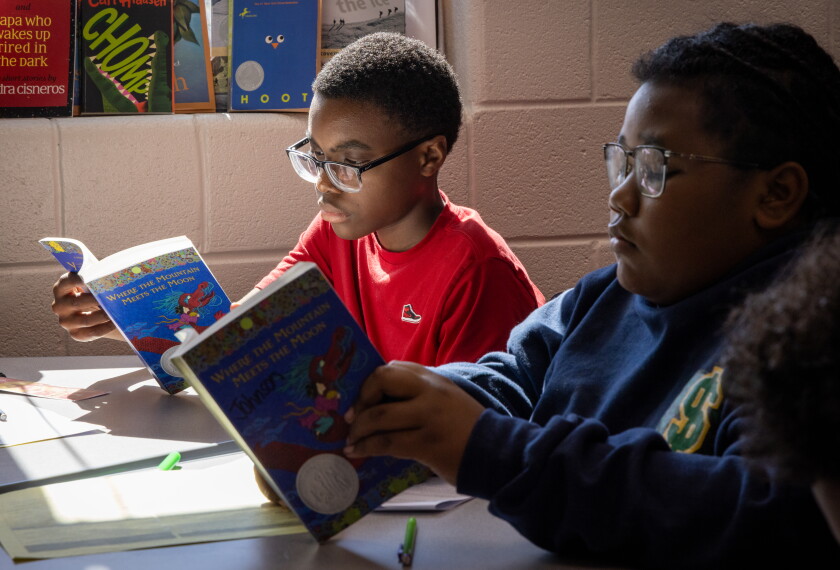
Gone are the days of just dusty book spines and the sounds of silence.
Throughout the country, public libraries are extending their mission beyond loaner books and resources: They’re providing opportunities for students to engage in digital learning opportunities aimed at making them college- and career-ready, often in partnership with schools.
During the past two decades, libraries have steadily added technology services, but those tended to be along the lines of providing free Internet use. Now, though, limited budgets and the growing need to prepare students for the 21st century have pushed these venerable institutions into new roles. They are teaching technology-driven workshops for middle and high school students, providing hands-on activities for young children, and bringing their best practices into school classrooms and other institutions to share.
“Today’s education landscape includes school closings, deficits, layoffs, and the elimination of arts and music programs; it’s a desert of opportunities,” said Theresa Ramos, the
The Free Library, which has 54 branches in greater Philadelphia, is part of a new cadre of libraries throughout the country that are creating multimedia learning “labs” for middle and high school students, funded by $2.4 million in grants from the John D. and Catherine T. MacArthur Foundation and the Institute for Museum and Library Services.
So far, 24 libraries and museums are using the money to help establish spaces within their institutions for young people to engage in a wide range of activities, such as creating videos and designing websites. Eight libraries started their work in early 2012, and seven others joined them this year. The project is part of a larger effort by both MacArthur and the institute to expand youth offerings within libraries and museums nationally.
The learning-labs concept stems from a MacArthur-funded library project in Chicago called YOUmedia, which provides students access to digital technologies, multimedia workshops and classes, and opportunities for self-driven projects like recording and producing music. YOUmedia is now in five libraries in Chicago and a library in Miami.
“We’re seeing real innovation in thinking at public libraries and museums across the country as they create relevant and positive experiences for youth in the out-of-school time space,” said Amy Eshleman, the program leader for education at the Urban Libraries Council, a Chicago-based membership organization that is helping implement the Learning Labs project nationally. “This has sparked a reimagining of the role of the public library and museum as critical nodes on youths’ network of learning.”

The learning-labs grants only underwrite the development component of the projects; however, some libraries and museums had work underway before they received the money. Some of the grantees, like the library in Philadelphia, the Columbus Metropolitan Library in Ohio, and the Carnegie Library in Pittsburgh, have already secured additional grants from other organizations to continue and expand their efforts to other library branches and sustain the work. For some, like Columbus and the San Francisco Public Library, the projects have involved linking arms to nearby cultural institutions for support.
In Columbus, the city library system, which includes 21 branches, applied for a grant in conjunction with four other institutions—a local public radio station, the city science museum, an art museum, and a performing-arts center—collectively called “Surge Columbus: A Creative Circuit for Youth. ”
Representatives of the five organizations meet at least twice a month to hash out how they can collaborate to provide more hands-on learning experiences for teenagers and encourage more to use all their resources, said Kathy Shahbodaghi, the director of early-childhood literacy at the Columbus Metropolitan Library.
Hanging and Geeking
But finding more money or partners may be the easier part of the process, some say; designing relevant and engaging programming that teenagers want to voluntarily participate in is a big challenge, especially as technology evolves.
All of the grant-funded learning labs are to be built on research findings indicating that young people’s use of digital technology goes through three stages: “hanging out” with friends, such as on Facebook; “messing around” or experimenting with various technologies, such as playing digital games; and “geeking out” to explore specific interests with smaller groups, such as creating a multimedia video or writing a blog.
Some libraries have looked to youths themselves to guide the process, establishing youth advisory councils that make recommendations or surveying participants after workshops to gauge interest in the opportunities they’ve already provided. Others are figuring out next steps as they go along, observing responses to offerings.
At the Carnegie Library in Pittsburgh, students are provided options to meet different needs and interests. Educators and mentors lead workshops on weekly themes, but students also have independent-study periods where they are able to create their own projects, too.
The mission is not just to provide “fun” activities but opportunities for real learning that can provide teenagers the 21st-century skills they need, such as designing websites or creating videos, said LeeAnn Anna, the teen-services coordinator at the Pittsburgh library.
“After sitting in a classroom for hours every day, the last thing teens want to do when they come into a library after school is sit in another class,” she said. “We are really trying to build digital literacy skills in an informal setting by providing something different from a structured class, using their interest as a springboard for engagement.”
Although not all libraries are creating learning labs, others are still trying to ramp up their offerings to meet growing public demand, particularly that of younger generations, said Shannon Peterson, the president of the Young Adult Library Services Association, a suborganization of the American Library Association, based in Chicago. But what services to offer and how to implement programming vary greatly library to library and community to community, she said.
Libraries are creating innovative teaching methods, such as having students train other students, and enabling access to library books after hours through book vending machines, much like the RedBox DVD kiosks. They are also providing a growing array of digital resources online for home-access.
A number of libraries, such as the Detroit Public Library, are providing “maker spaces,” or opportunities for the public, particularly young people, to create and build things, often using technology. Creations can range from simple crafts or woodworking to high-tech engineering projects or 3-D printing.
School Pairings
Recent findings from the Pew Research Center’s Internet & American Life project indicate that young people could be driving much of the demand and interest in 21st-century libraries. The center found 16- to 29-year-olds are more likely than any other age group to see and use libraries for a larger variety of purposes—such as studying, hanging out, or learning new skills—and expect libraries to provide digital resources and opportunities for engagement. Additionally, younger visitors still expect libraries to provide traditional resources and use them regularly; 16- to 17-year-olds were more likely than any other age group to have read a print book in the past year, while adults in their 30s and 40s were the most likely to have read an e-book.
The photos featured at the top of this story were originally posted on Education Week’s Instagram account. Follow @educationweek on Instagram to get an inside look at the people and places featured in our stories.
In some places, both the need and interest have inspired local libraries to work harder at building connections with the local schools.
The Institute for Museum and Library Services, for example, has provided $1.7 million to libraries in 2012 alone to help get low-income students reading at grade level, in conjunction with the Campaign for Grade-Level Reading, a collaborative effort of states, organizations, and schools to improve national reading proficiency.
And in Nashville, Tenn., the mayor’s office in 2009 spearheaded an initiative to upgrade the school district’s libraries with the help of the city library system. The goal, according to Tricia Bengel, the associate director for collections and technology services at the Nashville Public Library, was to encourage more students to use their school libraries, gain digital literacy skills, and develop long-term relationships with libraries that extend to the city branches.
For the Nashville project, city librarians and additional staff members developed profiles of every district school, taking note of their demographics and any specific features, such as what career academies were housed within a school and whether they had special programs like International Baccalaureate. Then they assessed existing collections, determining how well library materials matched the needs of the students in the school and academic standards for curriculum, including the common-core standards. They found most held outdated or irrelevant books and contained limited digital resources.
“If 95 percent of the student [population] at a school is African-American, Little House on the Prairie is not a relevant book for the library,” Ms. Bengel said.
With the city funds, currently amounting to $1.8 million annually, librarians discarded old, irrelevant books and bought new print and audio books. They also purchased laptops and iPads for students to check out and take home. They then helped train school librarians to integrate digital learning opportunities into the school day and enabled access to the city’s library collections through a linked database and courier service.
As a result, the district and city have so far seen increased circulation and use at 74 of the 128 schools, with students often checking out resources for use by their families.
Other cities regularly inquire about how they can replicate the model in their communities, Ms. Bengel said.
“The old model for libraries, where we waited for kids, families, and community partners to come to us, is quickly becoming outdated,” Ms. Peterson said. “One of the responsibilities of the 21st-century librarian is to reimagine what the library walls are and move outside of them, knowing what’s happening in our schools and be able to speak the language of schools.”